
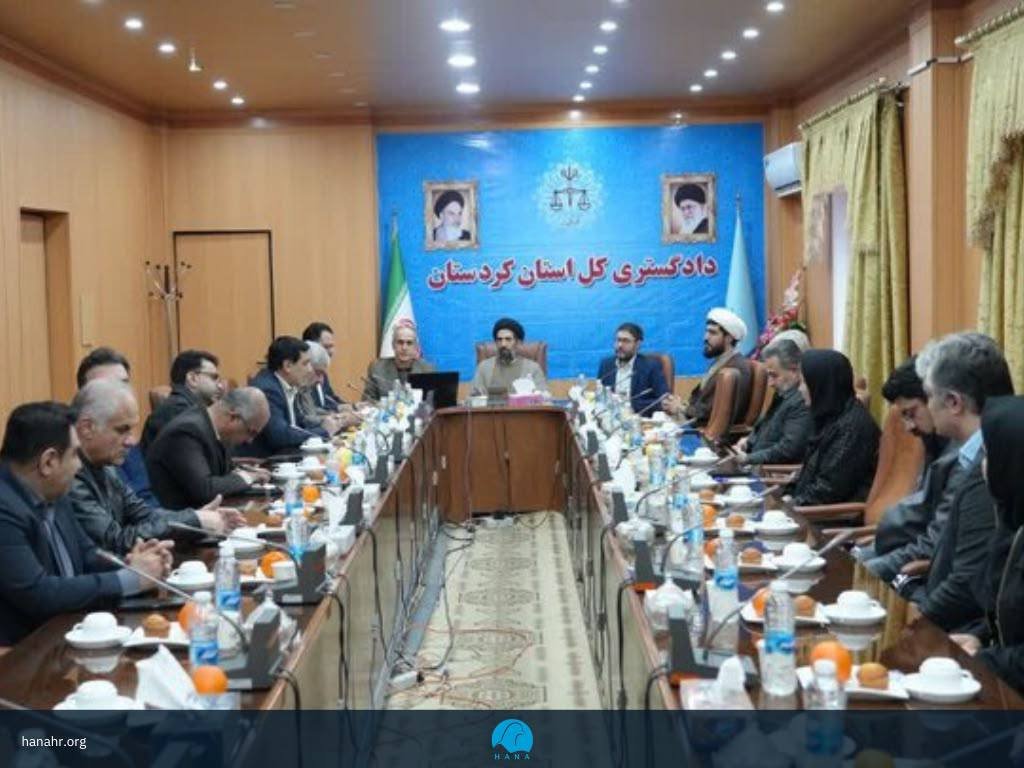
Hana Human Rights Organization Report on the Unlawful Seizure of Citizens’ Property in Kurdistan: A Clear Violation of Property Rights, the Presumption of Innocence, and the Right to a Fair Trial
Hana Human Rights Organization strongly condemns the announcement by the Chief Justice of Kurdistan Province regarding the seizure of the assets of 19 citizens from the province. Hana considers this measure a clear example of arbitrary deprivation of property and the imposition of punishment prior to the issuance of a final judicial verdict.
According to the official statements of the Chief Justice of Kurdistan Province, judicial cases have been opened against 19 individuals on accusations of cooperating with “hostile groups” and sending images and content to media outlets, including BBC Persian, Iran International, Voice of America, Radio Farda, and Manoto TV. Subsequently, judicial orders were reportedly issued for the monitoring, identification, and seizure of their assets. The Chief Justice further stated that “no leniency will be shown to the accused.”
These statements alone raise serious concerns regarding violations of fundamental fair trial guarantees. The individuals concerned remain merely “accused persons” and, unless and until the allegations against them are proven before a competent, independent, and impartial court, they are entitled to the presumption of innocence. Nevertheless, the public announcement of the seizure of their assets and the explicit declaration that no leniency will be granted create a strong impression that punishment has effectively begun before the completion of legal proceedings and the issuance of a final judgment.
The right to property is one of the most fundamental rights recognized under international human rights law. Article 17 of the Universal Declaration of Human Rights affirms that everyone has the right to own property and that no one shall be arbitrarily deprived of it. Furthermore, Article 14 of the International Covenant on Civil and Political Rights (ICCPR) guarantees the right to a fair trial, judicial independence and impartiality, and the presumption of innocence. Any restriction on an individual’s property must be based on necessity, proportionality, transparency, effective judicial oversight, and the availability of genuine avenues for appeal. The mere attribution of political or security-related accusations, without lawful proof, cannot serve as a legitimate basis for depriving individuals of their fundamental rights.
Moreover, Article 19 of the ICCPR recognizes the right to seek, receive, and impart information. While judicial authorities have alleged that part of the accusations concerns sending images and content to media organizations, no explanation has been provided regarding the precise nature of these activities, the evidentiary basis for the allegations, or any direct connection between such conduct and a genuine threat to national security. Under these circumstances, reliance on broad and ambiguous labels such as “hostile,” “traitor,” or “enemy-affiliated” cannot substitute for proving criminal conduct through a judicial process consistent with international standards.
From the perspective of Islamic jurisprudence, private property also enjoys a special status. Established legal principles, including the doctrines of dominion over property (Qa’idat al-Taslit), respect for property rights, and the prohibition of interference with another person’s property without lawful authorization, recognize ownership as a fundamental human right. Nevertheless, the experience of the past four decades in the Islamic Republic of Iran demonstrates that, under the prevailing political jurisprudence and the doctrine of “preserving the system,” fundamental rights such as property, freedom, and fair trial guarantees have repeatedly been subordinated to the political and security interests of the state. As a result, citizens’ property rights have often been treated not as inherent and inviolable rights, but as privileges contingent upon political conformity.
Hana Human Rights Organization emphasizes that the seizure or confiscation of citizens’ property without full compliance with fair trial guarantees, without a final judicial ruling, and without providing an effective opportunity for defense constitutes arbitrary deprivation of property and a violation of the Islamic Republic of Iran’s international obligations. Hana calls for the immediate publication of the legal details of these cases, guaranteed access for the accused to independent legal counsel, the provision of effective mechanisms to challenge judicial decisions, and the suspension of any punitive measures against individuals before the issuance of final and lawful judgments.
Hana Human Rights Organization also urges international human rights bodies, the United Nations Special Rapporteur on the situation of human rights in Iran, and relevant UN mechanisms to closely monitor and document the growing use of property seizure and confiscation in political and security-related cases, particularly in Kurdistan. This practice has increasingly become a tool for suppressing dissent, creating public intimidation, and punishing citizens before any criminal wrongdoing has been proven.