
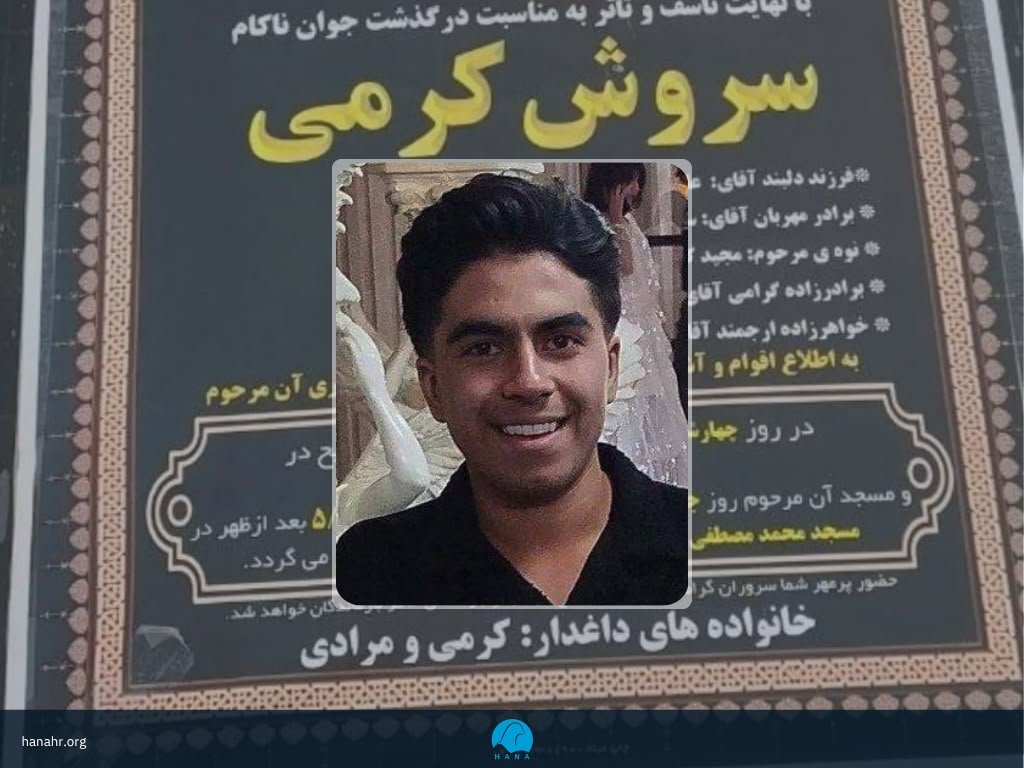
According to information received by HANA, the body of Soroush Karami, an 18-year-old Kurdish protester from Sonqor and Kolyaei, has been identified following an exhumation, after six months and nineteen days during which his family had no information about him. He had been shot dead during the crackdown on protests in Kermanshah on Thursday, January 8, 2026.
In violation of the legal requirements governing the identification, registration, and return of bodies, Karami’s remains had been handed over to the family of Amirali Heydari and buried under his name in the village of Sarableh. After months of pursuit by the Karami family, the grave was exhumed in the presence of both the Karami and Heydari families, a prosecutor’s representative, and forensic officials, and his identity was confirmed.
At the same time, it has come to light that Amirali Heydari’s own body had, all this time, been buried in an unmarked grave with no proper record of his identity. Swapping bodies, burying someone without confirming who they are, and leaving families without accurate information about their children’s fate and burial site is not a mere administrative error. It amounts to a serious violation of the right to truth, the right to an effective remedy, and the dignity owed to the dead.
Soroush Karami’s death from gunfire attributed to state forces, combined with the total lack of transparency and the irregularities surrounding the identification and return of his body, raises serious suspicion of a state-sponsored killing and an attempt to conceal evidence about how he died. In such circumstances, the state is obligated to carry out a prompt, independent, impartial, and effective investigation into who fired the shots, who may have given the orders, and who bears responsibility for the handling, transfer, and burial of the bodies.
According to sources close to the family, security agencies have pressured the Karami family to describe him instead as “a government agent killed during the protests.” If confirmed, imposing this narrative would amount to intimidating a victim’s family, distorting the truth, tampering with the identity of the deceased, and unlawfully interfering with a family’s right to speak freely about how their child actually died.
HANA Human Rights Organization stresses that responsibility in this case is not limited to whoever fired the fatal shot. Any official or institution involved in ordering the killing, concealing information, mishandling or wrongly burying the bodies, falsifying records, or pressuring the family must be investigated and held accountable through an independent judicial process.
Soroush Karami’s body is set to be buried on Wednesday, July 28, 2026, in the village of Lanjab in Sonqor and Kolyaei County.