
Kolbari as an Unofficial Border-Labour Regime

HANA HUMAN RIGHTS ORGANIZATION

Kolbari as an Unofficial Border-Labour Regime

State Regulation, Employment Relations, Hawala-Based Settlement and Human Rights along the Borders of Iranian Kurdistan

A THEMATIC REPORT

July 2026

CONTENTS

I. Executive Summary

II. Introduction

III. Methodology and Limitations

IV. Applicable Legal Framework

V. Structure of the Border Labour Chain

VI. Employment Status and Unofficial Labour Rules

VII. Hawala and Informal Transfer of Value

VIII. Occupational Safety, Social Security and Compensation

IX. Criminal Responsibility and the Use of Force

X. Child Labour and Gender-Specific Vulnerability

XI. HANA’s Documented Findings

XII. Principal Legal Findings

XIII. Recommendations

XIV. Conclusion

XV. Selected Legal Authorities and Materials

I. EXECUTIVE SUMMARY

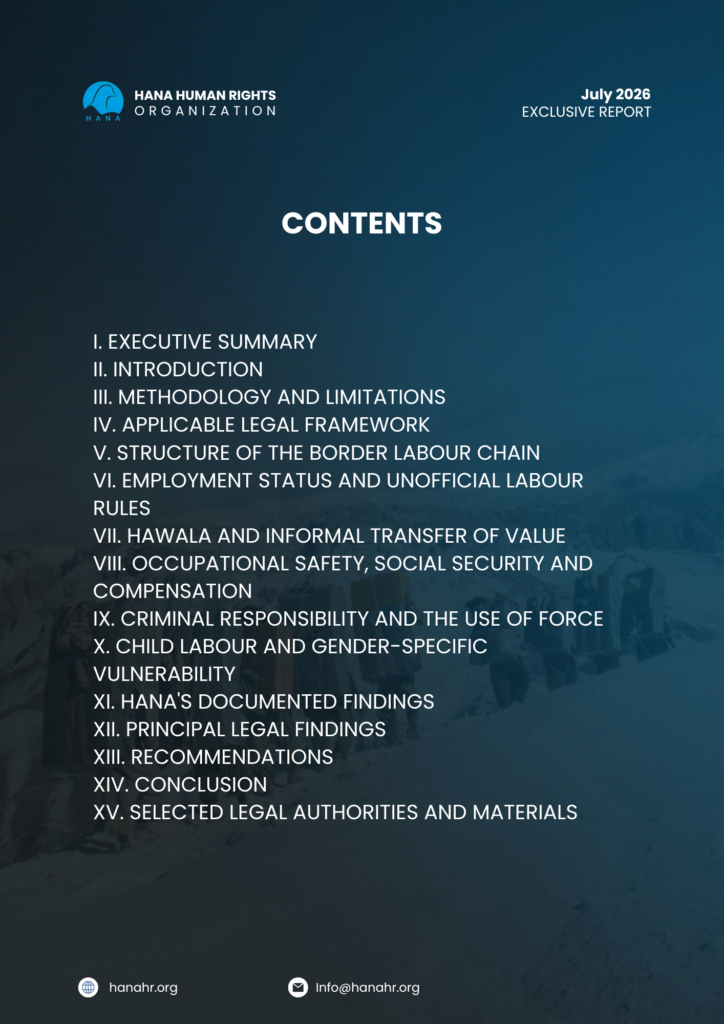
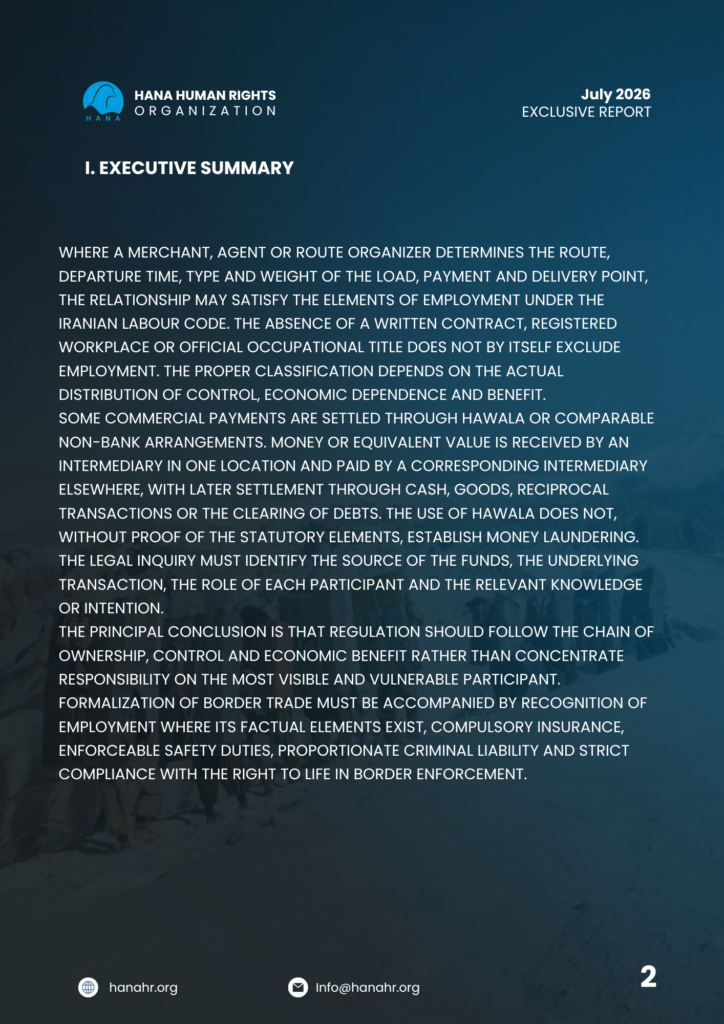
Kolbari is commonly described as the unauthorized carriage of goods across Iran’s western borders. That description is legally incomplete. It isolates the person carrying the load from the commercial structure in which the work is organized. The evidence considered in this report indicates that border transactions may involve investors, merchants, purchasers, warehouse operators, route organizers, financial intermediaries, recipients and distributors. The kolbar ordinarily controls neither the capital nor the goods and may have no meaningful share in the commercial profit. The kolbar nevertheless performs the most dangerous stage of the transaction and bears its principal physical, criminal and economic risks.

The report approaches kolbari as an unofficial border-labour regime governed by two overlapping bodies of rules. State law regulates customs procedures, registration, social security, criminal liability, financial supervision and the powers of border forces. Unofficial rules govern recruitment, allocation of loads, remuneration, guarantees, route selection, credit and the settlement of accounts. These unofficial arrangements are not equivalent to legislation, but they determine how the work is performed and how obligations are enforced in practice.

Iranian legislation now provides limited administrative recognition for specified forms of kolbari and border trade. Its principal concern is the supervision of goods and the formalization of trade. It does not clearly determine the worker’s legal status, identify the employer, ensure compulsory insurance or establish an effective system of compensation for occupational injury and death. The result is a marked separation between the regulation of goods and the protection of labour.

Where a merchant, agent or route organizer determines the route, departure time, type and weight of the load, payment and delivery point, the relationship may satisfy the elements of employment under the Iranian Labour Code. The absence of a written contract, registered workplace or official occupational title does not by itself exclude employment. The proper classification depends on the actual distribution of control, economic dependence and benefit.

Some commercial payments are settled through hawala or comparable non-bank arrangements. Money or equivalent value is received by an intermediary in one location and paid by a corresponding intermediary elsewhere, with later settlement through cash, goods, reciprocal transactions or the clearing of debts. The use of hawala does not, without proof of the statutory elements, establish money laundering. The legal inquiry must identify the source of the funds, the underlying transaction, the role of each participant and the relevant knowledge or intention.

The principal conclusion is that regulation should follow the chain of ownership, control and economic benefit rather than concentrate responsibility on the most visible and vulnerable participant. Formalization of border trade must be accompanied by recognition of employment where its factual elements exist, compulsory insurance, enforceable safety duties, proportionate criminal liability and strict compliance with the right to life in border enforcement.

II. INTRODUCTION

Kolbari has developed within border regions affected by limited formal employment, weak infrastructure, restrictions on cross-border trade, currency instability and reduced access to conventional banking channels. These conditions do not make every border transaction lawful. They are nevertheless material to understanding why workers accept physically dangerous tasks for modest and uncertain remuneration.

A legal analysis focused only on unauthorized crossing or customs classification produces a distorted allocation of responsibility. It treats the kolbar as the central actor because the kolbar is physically present at the border, while investors, goods owners, organizers and financial intermediaries may remain removed from the route. The visible carrier is then exposed to arrest, confiscation and force, although the carrier may exercise little control over the transaction.

This report does not seek to confer legal validity on every practice associated with border trade. Its purpose is to distinguish the legal position of the paid carrier from that of the person who finances, owns, directs or profits from the transaction. It also examines whether mandatory protections concerning wages, occupational safety, social security, due process and the right to life continue to apply where the underlying commercial activity is informal or partly unlawful.

The report gives particular attention to the rules operating outside formal institutions. Oral agreements, local brokers, personal guarantees, informal account books, repeated dealings and exclusion from future work may function as effective methods of ordering labour and credit. Their practical force must be considered without confusing social effectiveness with legal validity.

III. METHODOLOGY AND LIMITATIONS

This report adopts a qualitative methodology combining field-based documentation with doctrinal legal analysis. The field component draws on direct observation in selected border areas, semi-structured interviews with kolbars, interviews with local informants familiar with border trade, and HANA’s documentation of deaths, injuries, arrests and other incidents involving kolbars.

The interviews addressed the ownership and destination of goods, methods of recruitment, instructions given to carriers, calculation of remuneration, allocation of loads, route selection, payment, dealings with intermediaries and the distribution of risk. Information concerning hawala was considered only where the interviewee possessed direct knowledge of the payment or settlement arrangement. Statements based on rumor or inference were not treated as proof of a financial transaction.

The doctrinal component examines the legislation governing border trade, the Iranian Labour Code, social-security legislation, the Law on Combating the Smuggling of Goods and Foreign Currency, anti-money-laundering provisions, the Law on the Use of Firearms by Members of the Armed Forces and Iran’s obligations under international human rights and labour law.

Interview material is used as qualitative evidence and not as a statistically representative survey. The available material does not support generalized claims about the total number of kolbars, average earnings, educational background or the proportion of women and children involved. Quantitative claims require disclosure of the sample, geographical coverage, period of research and method of selecting interviewees.

The concealed character of parts of the border economy creates further evidentiary limits. Kolbars and families may fear prosecution or retaliation. Commercial records are commonly retained by merchants and intermediaries rather than workers. Payments may be made in cash and communications may occur through unregistered numbers or temporary accounts. The identity of the beneficial owner of the goods may be obscured by several layers of intermediaries.

For publication and future verification, HANA should retain a confidential methodology record stating the dates and general locations of fieldwork, the number and category of interviewees, the method of obtaining consent, measures taken to protect identity and the extent to which material statements were corroborated. Precise locations and personal details should not be published where disclosure would create a foreseeable security risk.

IV. APPLICABLE LEGAL FRAMEWORK

A. Border-trade regulation

The Law on the Organisation and Supervision of Border Trade, Kolbari and Seafaring, and the Creation of Sustainable Employment for Border Residents was adopted in February 2024. Its implementing framework created a temporary and conditional procedure for importing specified goods through designated border arrangements. Eligibility depends on administrative criteria that include residence, registration, authorized routes, categories and quantities of goods and cooperation with approved agents.

The legislation constitutes partial administrative recognition of kolbari. It is directed primarily to customs supervision, traceability of goods and the organization of border trade. It does not, in sufficiently clear terms, identify the employer, establish minimum remuneration, impose compulsory occupational insurance or determine responsibility for injury and death. The legal problem is therefore not complete non-recognition, but recognition confined principally to the trade procedure rather than the labour relationship.

B. Labour and social-security law

Articles 2 and 3 of the Iranian Labour Code define the worker and employer by reference to work performed at the request and for the account of another person in return for remuneration. Article 7 recognizes both written and oral employment contracts. The absence of a written agreement is therefore not decisive. Classification must be based on the substance of the relationship.

The Labour Code also imposes duties concerning occupational safety and requires employers to insure workers under the Social Security Act. These duties are mandatory where an employment relationship exists. They cannot be avoided solely by describing the arrangement as cooperation, carriage or occasional assistance.

C. Customs, anti-smuggling and financial law

The Law on Combating the Smuggling of Goods and Foreign Currency regulates unauthorized importation, exportation, transportation, storage and exchange. Liability depends on the nature and quantity of the goods, the route, the applicable customs procedures, the person’s role and the required knowledge or intention. The legal position of a paid carrier must be distinguished from that of the owner, investor or organizer.

Anti-money-laundering law addresses specified dealings with property derived from criminal activity. An informal transfer or unlicensed remittance may raise regulatory questions, but it does not alone prove money laundering. Proof remains necessary as to the criminal origin of the property and the mental element prescribed by law.

D. Use of force and international human rights law

The Law on the Use of Firearms by Members of the Armed Forces permits firearms in defined circumstances and subject to statutory conditions. Those conditions include necessity, the absence of less harmful means, warning requirements and graduated force. The provision concerning unauthorized border movement cannot be interpreted as general permission to shoot persons carrying goods.

Article 6 of the International Covenant on Civil and Political Rights protects the inherent right to life and prohibits arbitrary deprivation of life. In law-enforcement operations, intentional lethal force is permissible only where strictly necessary to protect life against an imminent threat. Unauthorized crossing, suspected smuggling or flight does not, without such a threat, justify intentional lethal force.

V. STRUCTURE OF THE BORDER LABOUR CHAIN

The organization of kolbari varies across locations and transactions, but the available evidence shows a recurring separation between capital, control and physical carriage. A transaction may involve an investor who supplies capital, a purchaser who acquires the goods outside Iran, a warehouse operator, a currency or hawala intermediary, a route organizer, one or more kolbars, and a recipient or distribution network inside Iran.

The kolbar is generally paid for a defined journey or load. Remuneration may vary according to weight, distance, weather, route difficulty, urgency and the perceived risk of interception. The carrier commonly has no control over the commercial value of the goods, the final sale price or the profit obtained after delivery.

This organization transfers risk downwards. Capital owners can divide financial exposure across several shipments and workers. The kolbar cannot divide the consequences of a fall, mine explosion, frostbite, gunshot injury or permanent disability. Those costs are borne directly by the worker and, in cases of death or incapacity, by the worker’s family.

The legal inquiry must therefore identify the chain of ownership, direction and benefit. Physical possession at the border is evidence of carriage, but it does not establish ownership, control of the network or entitlement to the commercial profit. Treating the carrier as the principal actor without examining the wider chain produces an inaccurate assessment in labour, civil and criminal law.

VI. EMPLOYMENT STATUS AND UNOFFICIAL LABOUR RULES

A. Determining employment status

The legal classification of a kolbar depends on the actual organization of the work. Indicators of employment include selection of the worker by a merchant or organizer, determination of the departure time and route, specification of the goods and their weight, fixing of remuneration, supervision through guides or communications, expectation of personal performance and dependence on the same organizer for repeated assignments.

Payment per journey does not necessarily establish independent contracting. Task-based remuneration can operate within an employment relationship. Nor should the use of terms such as cooperation or carriage displace mandatory labour protections where the factual elements of subordination and economic dependence are present.

Some carriers may operate with genuine independence. A person who negotiates the fee, freely accepts or rejects assignments, chooses the route and organizes performance without direction may be classified as an independent contractor. Even then, civil liability may arise where the goods owner or organizer conceals a danger, supplies false route information, imposes an excessive load or requires performance in manifestly unsafe conditions.

The use of several intermediaries must not prevent identification of the actual employer. The person communicating with the kolbar may not own the goods or receive the principal benefit. The analysis should determine who exercises effective control, who determines remuneration, who can exclude the worker from future assignments and for whose economic account the work is performed.

B. Unofficial recruitment and enforcement

Recruitment commonly occurs through personal contacts, relatives, local brokers, telephone calls or messaging applications. Terms are often oral. Payment may be linked to the weight of the load, the route and the assessed danger. These practices create enforceable expectations within the network even where no formal contract is produced.

Performance is supported by personal guarantees, prior dealings, reputation and informal account records. A defaulting participant may be denied future work or excluded from a commercial network. Debts may be carried forward and cleared against later transactions. These methods can be effective among merchants and brokers, but they provide limited protection to a worker who disputes deductions, delay or non-payment.

The absence of a written contract gives the economically stronger party an evidentiary advantage. A labour claim should therefore be capable of proof through witness testimony, messages, call records, recurring payment patterns, photographs, delivery confirmations, informal ledgers and evidence of repeated assignments. A worker should not lose a claim merely because the stronger party chose to keep the arrangement outside formal documentation.

A customs offence and a claim for earned remuneration protect different legal interests. The possible unlawfulness of the goods should not automatically extinguish every claim arising from the labour performed. The same applies to claims for bodily injury caused by unsafe working conditions or unlawful force.

VII. HAWALA AND INFORMAL TRANSFER OF VALUE

Some border transactions are settled outside conventional banking channels through hawala or comparable arrangements. A customer pays an intermediary in one location. That intermediary instructs a corresponding broker elsewhere to pay the equivalent amount to a designated recipient. The brokers later settle between themselves through cash, goods, reciprocal payments, currency exchange, netting or the clearing of existing debts.

Hawala does not necessarily involve the physical movement of the same money across the border. Its operation depends on liquidity, repeated dealings, account records, personal guarantees and commercial reputation. Default may be addressed through exclusion from future transactions or loss of standing within the local network.

Within border trade, hawala may be used to pay suppliers, purchasers, warehouse operators and other intermediaries. It may also be used to settle advances or commissions. The kolbar may have no direct involvement in this financial arrangement and may receive only a cash payment from a route organizer after delivery.

The use of hawala must be distinguished from money laundering. Informality, anonymity or lack of a banking record can increase regulatory risk, but these features do not establish the criminal origin of funds or the required knowledge. A proper investigation should determine the source and beneficial owner of the funds, the underlying transaction, the identity and function of each intermediary, the method of settlement and the knowledge or intention of the person concerned.

Multiple layers of payment can also obscure the identity of the real employer or principal. The person who hands cash to the kolbar may be only an operational intermediary. Labour and financial investigations should therefore examine payment flows together with evidence of control over the work.

A proportionate regulatory policy should distinguish small-value remittances and ordinary commercial settlement from deliberate assistance in laundering criminal proceeds. Broad criminalization may drive payments further underground, weaken records and increase dependence on unaccountable intermediaries. Accessible and low-cost channels for lawful border payments would reduce these risks.

VIII. OCCUPATIONAL SAFETY, SOCIAL SECURITY AND COMPENSATION

The hazards associated with kolbari are foreseeable. They include excessive loads, falls, extreme cold, night travel, mine-contaminated areas, confrontation with armed forces and delayed access to medical treatment. The legal issue is not simply that the activity is dangerous. It is that commercial actors may continue to profit while the cost of foreseeable injury is transferred almost entirely to the carrier and the carrier’s family.

Where an employment relationship exists, the employer’s duties concerning occupational safety and social insurance should apply. The owner or organizer may influence the load, timing, route and number of workers. A person exercising such control possesses the capacity to reduce risk and should not avoid responsibility by relying on the oral or unofficial character of the arrangement.

Administrative registration of kolbars without compulsory accident insurance creates a serious protection gap. The state may identify eligible persons, regulate goods and supervise routes while leaving disability, medical costs and loss of household income without an effective compensation mechanism.

A protective system should include compulsory accident and health insurance, disability and survivors’ benefits, maximum load standards, suitable clothing, emergency communication, route assessment, mine-risk information and access to rescue and medical evacuation. The cost should be incorporated into the commercial transaction and allocated among the persons who control or benefit from it.

Compensation for unlawful shooting, failure to provide assistance or unsafe working conditions should not depend on the outcome of separate customs proceedings. The legal status of the goods does not remove the rights to life, physical integrity and reparation for disproportionate harm.

IX. CRIMINAL RESPONSIBILITY AND THE USE OF FORCE

A. Individual criminal responsibility

Being identified as a kolbar is not, in itself, a distinct criminal offence. Liability must be based on specific conduct and the elements of the applicable offence. The assessment should consider the nature and quantity of the goods, the route, customs requirements, ownership, knowledge, intention and the person’s actual role within the transaction.

A legally coherent analysis must distinguish the paid carrier from the investor, owner, organizer, warehouse operator, recipient and financial intermediary. It must also distinguish ordinary consumer goods from prohibited or dangerous goods and determine whether the carrier knew what was being transported.

Enforcement directed principally at kolbars risks punishing the poorest and most replaceable participant while leaving the principal commercial beneficiaries beyond scrutiny. Relevant evidence may include communications, warehouse records, delivery receipts, account books, recurring payment patterns and testimony from carriers and route organizers.

The presence of a customs offence does not suspend ordinary guarantees of criminal procedure. Arrest, investigation, access to counsel, adjudication and punishment remain subject to legality, personal responsibility, proportionality and fair-trial guarantees.

B. Use of firearms and the right to life

The presence of a person on an unauthorized border route does not constitute general authority to shoot. Each incident must be assessed according to whether the person was armed, whether an imminent threat to life existed, whether a comprehensible warning was issued, whether arrest or seizure could have been achieved without shooting and whether force complied with the statutory sequence.

International human rights law requires that potentially lethal force be used only where strictly necessary to protect life against an imminent threat. Carrying goods, failing to stop or fleeing from officers does not, without such a threat, justify intentional lethal force. The state may seize goods, arrest suspects and prosecute offences, but it may not treat the life of the alleged carrier as forfeited.

Every death or serious injury resulting from firearm use requires a prompt, independent, impartial and effective investigation. The investigation should preserve the scene, weapon, ammunition, medical evidence, operational communications and witness testimony. It should not depend exclusively on the account of the unit to which the officer belongs.

Where the force was unlawful, unnecessary or disproportionate, the victim or family must have access to information, legal representation, prosecution where warranted and compensation. The classification of the goods cannot extinguish these rights.

X. CHILD LABOUR AND GENDER-SPECIFIC VULNERABILITY

A. Child kolbari

The use of persons under 18 in kolbari constitutes hazardous child labour. Heavy loads, mountainous routes, extreme weather, mines, armed encounters and night travel create direct risks to life, health, education and development. Responsibility should be directed towards adults who recruit, organize or profit from the child’s work.

Enforcement directed solely at the child or family may displace the activity into more concealed and dangerous routes. Effective protection requires family income support, access to education, social assistance, healthcare and accountability for merchants and organizers who use child labour.

B. Women kolbars

Women participating in kolbari face the general risks of border labour together with barriers associated with restricted access to formal employment, responsibility for dependants, harassment and limited access to medical and rescue services. Claims concerning the number or proportion of women involved must be supported by reliable data.

Protective measures should include confidential complaint procedures, access to healthcare, female medical and rescue personnel, childcare support and employment programmes directed towards women responsible for household income. The absence of comprehensive statistics should not be used to disregard documented cases.

XI. HANA’S DOCUMENTED FINDINGS

HANA’s documentation indicates that deaths and injuries among kolbars are recurrent. The organization recorded 41 Kurdish kolbars killed by direct fire from Iranian border forces in 2024 and 216 others injured. During the first three months of 2025, HANA recorded 16 cases involving death or injury. Its annual documentation for 2025 recorded 61 cases involving kolbars and border traders who were killed or injured. During the first six months of 2026, HANA documented at least three deaths and three injuries. On 23 July 2026, HANA reported the killing of 18-year-old Soheil Fardousi near Nowsud.

These figures should be treated as documented minimums rather than a complete account of all incidents. Access limitations, fear of reporting and the absence of official disclosure make comprehensive enumeration impossible.

For legal analysis, HANA should distinguish deaths caused by direct fire from those resulting from falls, hypothermia, mines, vehicle incidents and other causes. The distinction is necessary because the applicable duties, evidentiary requirements and legal bases of responsibility differ.

Each case file should contain a unique reference number, date and location, verified identity or anonymized designation, source of information, cause of injury, available medical or visual evidence, identity of the alleged responsible institution and information concerning any investigation or compensation claim. Field testimony should be supported, where possible, by independent corroboration.

XII. PRINCIPAL LEGAL FINDINGS

1. Kolbari operates as an organized system of labour, trade and financial settlement rather than as a series of isolated acts by individual carriers.

2. The recent border-trade framework partially formalizes the movement of goods but does not provide equivalent recognition of employment, insurance, occupational safety or compensation rights.

3. A kolbar may qualify as a worker under the Iranian Labour Code where the factual relationship demonstrates remuneration, direction, subordination and economic dependence, notwithstanding the absence of a written contract.

4. Unofficial rules concerning recruitment, credit, guarantees, payment and exclusion have practical regulatory force, but they do not displace mandatory labour, criminal or human rights law.

5. Hawala-based settlement must be assessed according to the source of funds, underlying transaction and individual knowledge. Informality alone does not establish money laundering.

6. Criminal responsibility must be allocated according to ownership, control, knowledge and benefit. A paid carrier should not be equated with the investor or organizer who directs and profits from the transaction.

7. Customs enforcement does not suspend the right to life. Lethal force is lawful only where strictly necessary to protect life from an imminent threat.

8. The state and commercial beneficiaries possess duties to prevent foreseeable occupational injury and to provide effective remedies where harm occurs.

XIII. RECOMMENDATIONS

1. The border-trade legislation should establish a rebuttable presumption of employment where a kolbar works regularly for payment under the direction of a merchant, agent or route organizer.

2. Registration should automatically provide accident insurance, health coverage, disability protection and survivors’ benefits. It should not function solely as a mechanism for identifying persons and goods.

3. The goods owner, investor, authorized agent, cooperative and route organizer should bear responsibility in proportion to their control and financial benefit. Joint liability should be available where fragmentation of the commercial structure would otherwise defeat an effective claim.

4. Labour and judicial authorities should accept oral testimony, messages, account books, recurring payment patterns, delivery evidence and proof of organizational control as evidence of employment and unpaid remuneration.

5. Operational standards should impose maximum load limits, route risk assessments, protective clothing, emergency communication, mine-risk information and access to mountain rescue and medical evacuation.

6. Financial regulation should distinguish ordinary hawala-based remittances and commercial settlement from knowing participation in money laundering. Liability should be based on proof of the statutory elements and individual mental state.

7. Accessible and low-cost channels for lawful small-value border payments should be developed in order to reduce reliance on opaque and unaccountable intermediaries.

8. Criminal investigations should trace ownership, financing, organization and profit rather than concentrate principally on paid carriers found in physical possession of goods.

9. Rules governing border forces should state clearly that unauthorized crossing, possession of goods or flight does not independently justify the use of lethal force.

10. Every shooting resulting in death or injury should be investigated outside the chain of command of the officers concerned. Victims and families should have access to essential information, legal representation and compensation.

11. The use of children in hazardous border transportation should be prohibited and addressed through family income support, education, welfare services and accountability for persons who recruit or profit from child labour.

12. HANA should maintain connected but distinct documentation categories for labour conditions, firearm incidents, accidents, child labour, payment disputes and the commercial participants associated with each case.

XIV. CONCLUSION

Kolbari is an organized form of border labour embedded in a wider structure of investment, trade, informal financial settlement and distribution. Within that structure, ownership, control and profit are commonly separated from physical exposure to danger.

The investor supplies capital, the merchant controls the goods, the financial intermediary transfers value and the organizer coordinates the route. The kolbar carries the load and bears the immediate risk of injury, arrest and death. A legal analysis that concentrates on the carrier while disregarding the wider structure assigns responsibility to the participant with the least control.

Iranian law has begun to regulate the movement of goods associated with kolbari, but it has not provided equivalent protection to the persons performing the work. Trade may therefore become partly formalized while employment remains oral, uninsured and difficult to enforce.

The appropriate legal response is to identify the persons who exercise control, receive the economic benefit and possess the capacity to prevent harm. A customs violation does not extinguish the right to life. An oral agreement does not remove the right to earned remuneration. The use of hawala does not establish money laundering without proof of the required legal elements. Effective regulation must follow the chain of capital, control and benefit rather than place the principal burden on its weakest participant.

XV. SELECTED LEGAL AUTHORITIES AND MATERIALS

Constitution of the Islamic Republic of Iran.

Iranian Labour Code, 1990, including arts 2, 3, 7, 85, 91, 95 and 148.

Social Security Act of Iran, 1975, as amended.

Law on the Organisation and Supervision of Border Trade, Kolbari and Seafaring, and the Creation of Sustainable Employment for Border Residents, adopted February 2024.

Implementing Regulation concerning the organization and supervision of kolbari and border trade, adopted January 2025.

Law on Combating the Smuggling of Goods and Foreign Currency, 2013, as amended.

Anti-Money Laundering Act of Iran, 2008, as amended.

Law on the Use of Firearms by Members of the Armed Forces in Necessary Cases, 1994.

International Covenant on Civil and Political Rights, arts 2(3), 6, 9 and 14.

International Covenant on Economic, Social and Cultural Rights, arts 6, 7, 9 and 12.

Convention on the Rights of the Child, art 32.

International Labour Organization Convention No. 155 concerning Occupational Safety and Health.

International Labour Organization Convention No. 182 concerning the Worst Forms of Child Labour.

United Nations Human Rights Committee, General Comment No. 36 on article 6 of the International Covenant on Civil and Political Rights.

United Nations Basic Principles on the Use of Force and Firearms by Law Enforcement Officials.

Financial Action Task Force, The Role of Hawala and Other Similar Service Providers in Money Laundering and Terrorist Financing.

HANA Human Rights Organization, annual and periodic documentation concerning deaths and injuries of kolbars, 2024 to July 2026.

RELATED ARTICLES

Most Popular