
May 24 to August 3, 2026
The Hana Human Rights Organization publishes this report as a continuation of its previous investigative report on the cross-border attacks by the Islamic Republic of Iran against the camps and bases of Iranian Kurdistan parties in the Kurdistan Region. It is worth noting that the first report included documentation of 695 missile and drone attacks from February 28 to April 24, 2026, along with human casualties, the displacement of families, and explosive weapons striking camps and residential areas.
The current report is compiled based on Hana’s field data, official statements from Kurdish parties, and official reports in Iraqi Kurdistan. The collected information indicates that between May 24 and August 3, 2026, the Islamic Republic of Iran continued its missile and drone attacks against the bases of the Komala Party of Iranian Kurdistan, the Kurdistan Freedom Party (PAK), and the Khabat Organization of Iranian Kurdistan in the Erbil and Sulaymaniyah provinces.
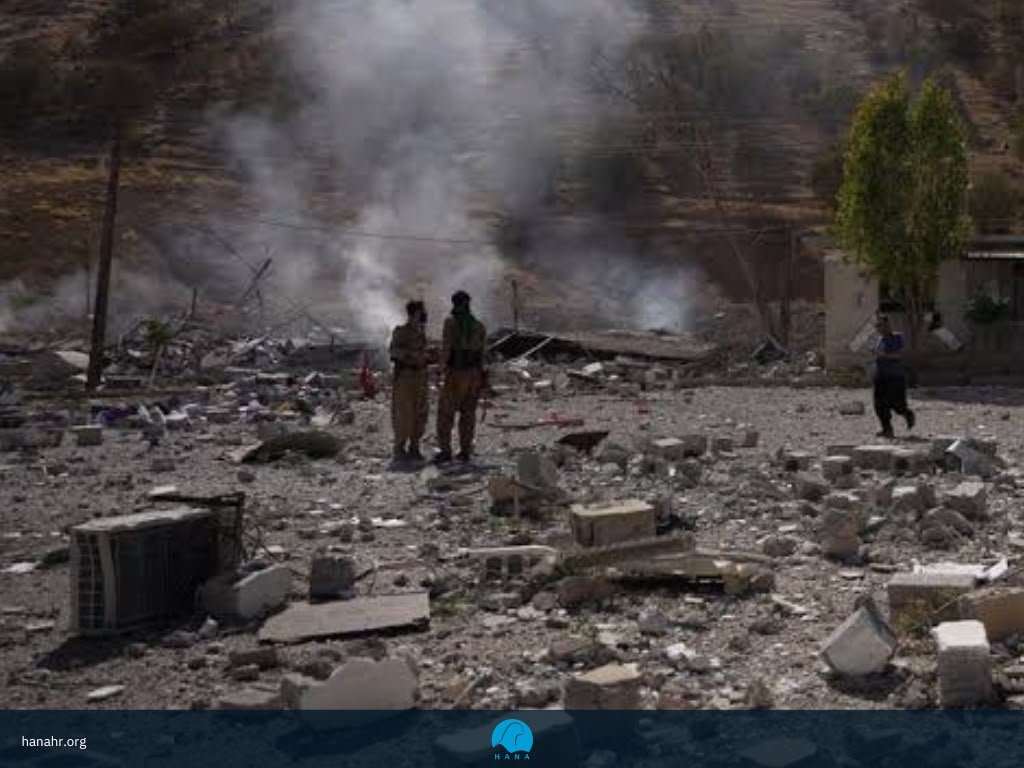
The deadliest attack took place on July 17, 2026, against the Zargwezela camp in Sulaymaniyah province. In this attack, 9 members of the Komala Party of Iranian Kurdistan lost their lives, and several others were injured. Abubakr Houshangi, one of the injured in this attack, succumbed to the severity of his injuries on July 21, 2026, bringing the death toll to 10. Simultaneously, the base of Komala members in Surdash was also targeted by missiles, leaving several injured.
On July 19, 2026, a suicide drone targeted the base of the Kurdistan Freedom Party near Darashakran. At least eight members of this party were injured in this attack. The type and depth of the burns caused, the continuous combustion after impact, and the residues left at the scene strongly indicate the use of munitions containing white phosphorus. Some of the injured have suffered deep and extensive burns that clearly differ from injuries caused by conventional explosions.
Medical evidence, images of the injured, and the manner in which the fire spread reinforce the probability of the Islamic Republic of Iran using phosphorus munitions. Confirming the exact composition of the munitions requires laboratory analysis of their remnants; however, the documented traces at the scene and the injuries inflicted on the victims highlight the necessity of conducting an independent investigation into the use of an incendiary substance capable of causing deep and lasting burns.
On July 27 and 28, 2026, the bases of the Kurdistan Freedom Party in Koya and its surrounding areas were once again targeted by suicide drones. Furthermore, on July 31, 2026, the centers of the Organization of Iranian Kurdistan Struggle in Topzawa and Bashiq were struck by drones, destroying parts of their buildings and facilities. Local sources also reported a drone strike around the village of Gachineh in the Dukan area on August 1, 2026, resulting in a massive fire. As of the drafting of this report, no reliable information regarding potential casualties from this attack has been released.
Under international humanitarian law, political or organizational membership in a Kurdish party, residing in a camp affiliated with that party, or holding the title of Peshmerga does not, in itself, authorize a direct attack against an individual. Targeting a person is only permissible when their direct participation in hostilities or their continuous combat function has been established based on specific and reliable information. This assessment must be made for each individual and take into account their status at the time of the attack.
Regarding the victims of the Zargwezela attack, the Islamic Republic of Iran has not published any evidence or explanation indicating that they were engaged in military operations at the time of the attack. Officials of the Islamic Republic have also remained silent regarding the reason for selecting the camp, the status of the individuals present at the location, the military necessity of the attack, and the measures taken to protect individuals not taking part in combat operations. Under such circumstances, the deliberate and lethal attack on these individuals constitutes the arbitrary deprivation of the right to life, and if their lack of direct participation in the conflict is established, it can amount to an extrajudicial killing.
The potential presence of individuals with combat functions in a camp does not turn all party members, their families, buildings, and facilities into military targets. The Islamic Republic was obligated to distinguish between individuals directly participating in military operations and other persons present at the location, assess the foreseeable damages of the attack, and take all feasible precautions to minimize casualties. Repeatedly targeting camps based on the political identity of their residents violates the principle of distinction and the prohibition of indiscriminate attacks.
The use of munitions containing white phosphorus in a location where the presence of individuals not involved in combat operations is foreseeable raises serious violations of the rules governing precaution in attack, proportionality, and the prohibition of causing unnecessary suffering. The injuries documented in Darashakran show that the effects of the munitions were not confined to the point of impact and have left severe and lasting burns on the bodies of the injured.
The attacks documented in this report are a continuation of the Islamic Republic of Iran’s policy of pursuing and targeting Kurdish opposition members outside Iran’s borders. By resorting to missiles, suicide drones, and munitions with incendiary effects, the Islamic Republic has exposed members of Kurdish parties to the deprivation of life and severe injuries solely due to their political identity and activities. The Hana Human Rights Organization emphasizes that political activity, party membership, and opposition to the Islamic Republic do not deprive any person of the protection of the right to life and the fundamental guarantees of international humanitarian law.
The legal office of the Hana Human Rights Organization will closely monitor and document the latest developments and cross-border attacks by the Islamic Republic against Kurdish parties and will publish them in future reports.