
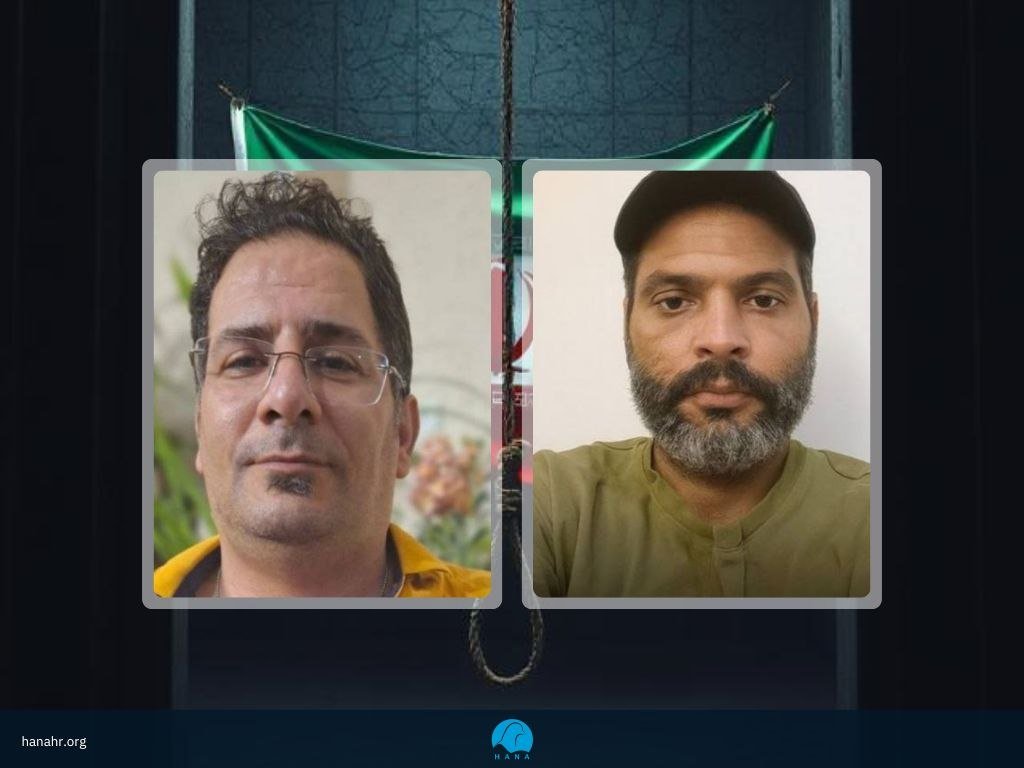
Hana: Mizan News Agency, affiliated with the judiciary of the Islamic Republic of Iran, has reported the execution of Hamed Validi and Mohammad Masoum-Shahi on Monday, April 20, 2026, on charges of “espionage.” These executions once again demonstrate that amidst a climate of war and heightened security, the Islamic Republic employs the death penalty not within the framework of lawful due process, but as a tool for intimidation and repression.
According to claims made by state institutions, these two prisoners had allegedly established contact with Israeli intelligence agencies through cyberspace and travels to the Kurdistan Region of Iraq, receiving training to attack public and military centers in Tehran. However, no clear or verifiable information regarding the circumstances of their arrest, the quality of evidence, the conduct of the trial, access to independent legal counsel, or their ability to present an effective defense has been released.
In recent years, charges such as “Moharebeh” (enmity against God), “cooperation with a hostile state,” “assembly and collusion against national security,” and “propaganda activities against the state” have been repeatedly used in security-related cases to justify judicial suppression. In this case as well, the complete lack of transparency in the proceedings subjects the execution of the sentences to serious legal doubt. Even under the flawed and restrictive laws of the Islamic Republic itself, the deprivation of life without adhering to minimum defense guarantees is a clear sign of the violation of the rule of law and the invalidity of the judicial process.
The execution of these two prisoners is part of an increasing wave of capital punishment occurring within the context of military and security tensions. This is a trend in which the Islamic Republic, by resorting to broad and vague accusations, has turned the atmosphere of war into a cover for intensifying repression and eliminating the fundamental guarantees of a fair trial. Under such circumstances, the carrying out of death sentences is less a result of independent and fair judicial proceedings and more a reflection of the instrumental use of the death penalty to consolidate authority through fear.