
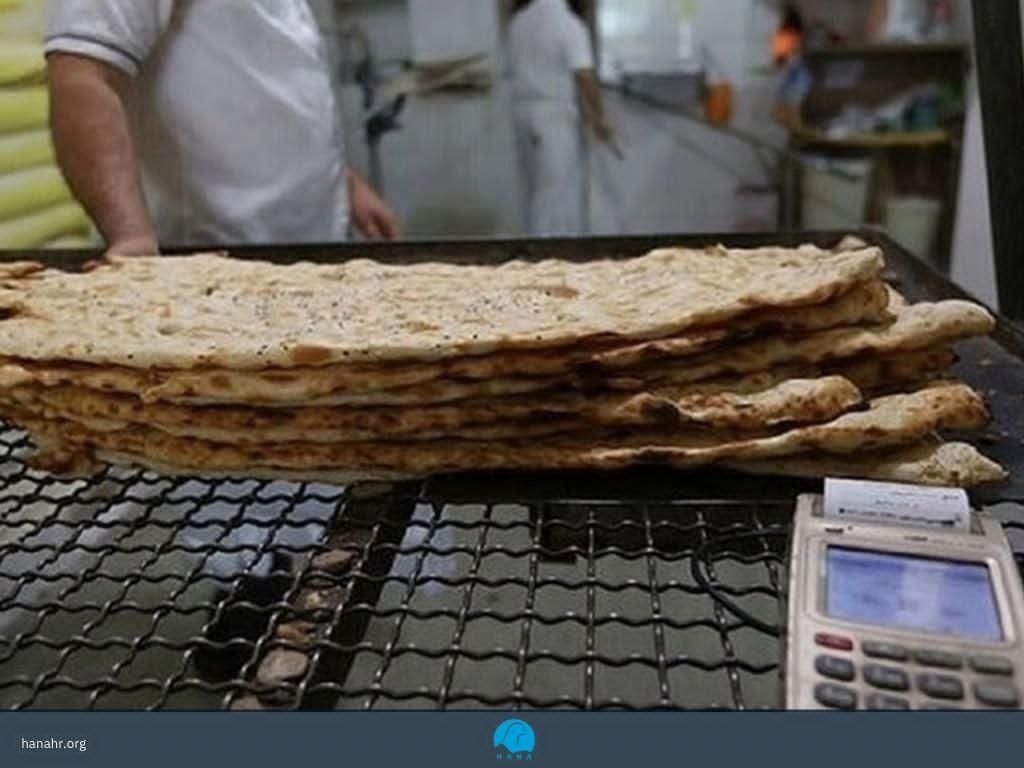
HANA Human Rights Organization, expressing concern over the official increase in bread prices in Tehran Province, examines this decision through the lens of citizens’ rights, the state’s legal obligations, and its impact on livelihoods and food security.
According to official statements by Mohammad Javad Karami, head of the Flour and Bread Working Group at the Iran Chamber of Guilds, new bread prices in Tehran Province have been set through a directive from the Tehran Governor’s Office and applied to the point-of-sale systems of bakeries. Under this announcement, the prices of lavash, barbari, and sangak bread have risen considerably, with the new rates taking effect from the beginning of July 2026. This decision comes at a time when Iranian household economies have for years been battered by persistent inflation, a depreciating national currency, rising living costs, and declining purchasing power.
In Iran, bread is not simply a consumer good. It is the primary staple of daily nutrition and, for many households, the most essential component of the food basket. For millions of citizens, particularly workers, retirees, the unemployed, female-headed households, children, and residents of deprived areas, bread remains the most important source of energy and an inseparable part of household food security. Any increase in the price of this basic commodity therefore goes beyond an economic decision and carries direct social and legal consequences.
Under Article 3 of the Islamic Republic of Iran’s Constitution, the state is obligated to eliminate poverty, address deprivation, and meet the basic needs of the population. Article 29 recognizes access to social and livelihood support as a general right of citizens, while Article 43 identifies the provision of basic needs, including food, as a fundamental objective of the country’s economic system.
Article 3(12) further emphasizes the need to build a just economy that eradicates poverty and provides for the essential needs of the people.
The rise in bread prices comes at a time when a significant portion of society was already grappling with serious economic hardship. Official reports and social indicators in recent years have pointed to growing poverty, declining purchasing power, and rising living costs. In many parts of the country, buying essential goods on credit has become part of how low-income households meet their daily needs, and many citizens have been forced to cut consumption of other essentials simply to secure minimum food requirements.
From a legal standpoint, what makes this issue particularly significant is that bread falls squarely within the category of essential and vital commodities.
In such cases, the state is not merely responsible for setting prices; it is obligated to assess and manage the social and economic consequences of its decisions. Whenever an economic decision limits the access of a segment of citizens to basic necessities, the need for protective and compensatory policies becomes all the more pressing.
The consequences of this price increase will not be limited to higher bread costs alone. It may reduce low-income households’ access to adequate food, lower nutritional quality, increase financial pressure on vulnerable families, and deepen food insecurity. Past experience has shown that increases in the price of basic goods tend to hit the lowest income deciles hardest, since food makes up a far larger share of their household expenditure than for other segments of society.
Beyond economic effects, this decision may also carry wide-ranging social consequences. Increased economic pressure, growing poverty, greater household dependence on state and charitable support, declining general welfare, and widening social inequality are among the outcomes that, in the absence of effective protective policies, may emerge over the medium and long term. From this perspective, the question of bread is not merely a trade or economic matter; it is directly connected to citizens’ social rights and human dignity.
HANA Human Rights Organization stresses that the right to a minimum standard of living and access to adequate food are among the fundamental requirements of a life lived with dignity. Decisions regarding the pricing of essential goods must be grounded in the principles of social justice, the protection of vulnerable groups, and the state’s legal obligations toward its citizens. Without this, there is a real risk of deepening economic deprivation and a further restriction of access to basic necessities for a portion of society.
On this basis, HANA Human Rights Organization calls for the public disclosure of the technical justifications behind the bread price increase, a transparent assessment of the decision’s impact across different income groups, and the adoption of effective protective measures to prevent a worsening of economic hardship for low-income households. It is also expected that responsible institutions will continuously monitor and evaluate the short and long-term effects of this policy on food security and the welfare of society.
For a large part of Iranian society, bread is not a choice but a livelihood necessity. Any policy affecting citizens’ access to this basic commodity must therefore be adopted with the highest degree of accountability, transparency, and adherence to legal requirements and citizens’ rights.