
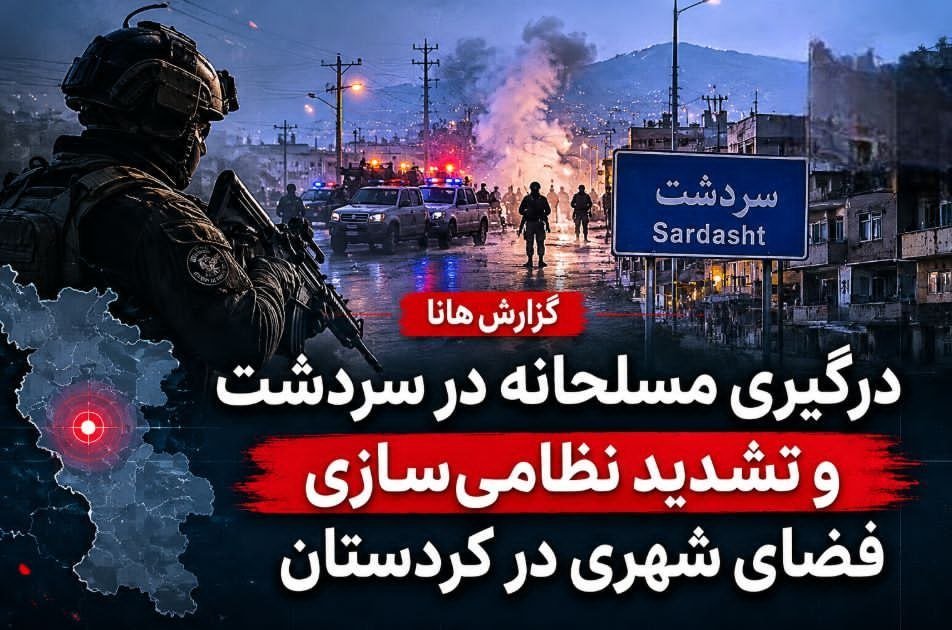
According to reports received by the Hana Human Rights Organization, early this morning, Sunday, May 24, 2026, an armed clash occurred between Islamic Revolutionary Guard Corps (IRGC) forces and an armed group at a checkpoint in the city of Sardasht.
According to received information, the clash involved heavy gunfire, leaving at least three people wounded. As of the drafting of this report, no independent information regarding the identities of the injured, potential casualties, or the affiliation of the opposing group has been published, and no group has claimed responsibility for the attack. The lack of official and transparent information regarding the scope of the incident, the condition of the injured, and the actions of security forces has raised concerns about the situation of citizens and the potential violation of their fundamental rights.
Following this event, the security climate in Sardasht has significantly intensified. Local sources have reported the widespread deployment of security and military forces across the city, strict control of entry and exit routes, an increase in checkpoints, and the imposition of restrictions on citizens’ movements. Furthermore, there have been reports of widespread disruptions or total blackouts of internet and mobile networks in parts of the city. This measure has seriously hindered citizens’ free access to information, their ability to communicate with families, and efforts to track the condition of those affected.
Based on fundamental human rights principles and the international obligations of states, including those arising from the International Covenant on Civil and Political Rights, governments are obliged even during security conflicts to observe the principle of proportionality in security measures, protect civilians, and respect the right to access information, freedom of movement, and the personal security of citizens. Imposing extensive communication and security restrictions without transparency, effective judicial oversight, and public disclosure can pave the way for serious human rights violations and the expansion of impunity for security forces.
The Hana Human Rights Organization emphasizes that in the aftermath of the recent ceasefire in the war with the United States and Israel, the Islamic Republic of Iran, instead of de-escalating tensions and ensuring the security of citizens, has intensified the militarization of cities in Kurdistan to an unprecedented degree. The widespread deployment of military and security forces, strict control over public spaces, restriction of communications, and the handover of significant quantities of weapons to paramilitary forces and elements known as “Jash” (local collaborators) are part of an organized securitization policy that directly threatens the security, freedom, and fundamental rights of civilian populations.
Hana strongly condemns this trend and warns that the arming of affiliated and unofficial forces, alongside the expansion of the security apparatus in the cities of Kurdistan, has seriously elevated the risk of increased violence against civilians, arbitrary arrests, intensified repression, and systematic human rights violations. Hana has previously warned about the dangerous consequences of this policy and underscores that the Islamic Republic of Iran will be directly responsible for any harm, violation of fundamental rights, and insecurity resulting from these security and militarization policies in the Kurdistan regions.
The Hana Human Rights Organization calls for immediate, transparent, and verifiable disclosure of information regarding the scope of this clash, the condition of the wounded, potential arrests, and the extent of the restrictions imposed in the city of Sardasht. Hana also reiterates the necessity of fully respecting the rights of civilians, refraining from collective punishment and restrictions, and ending the ongoing expansion of the military and security environment in the cities of Kurdistan.