
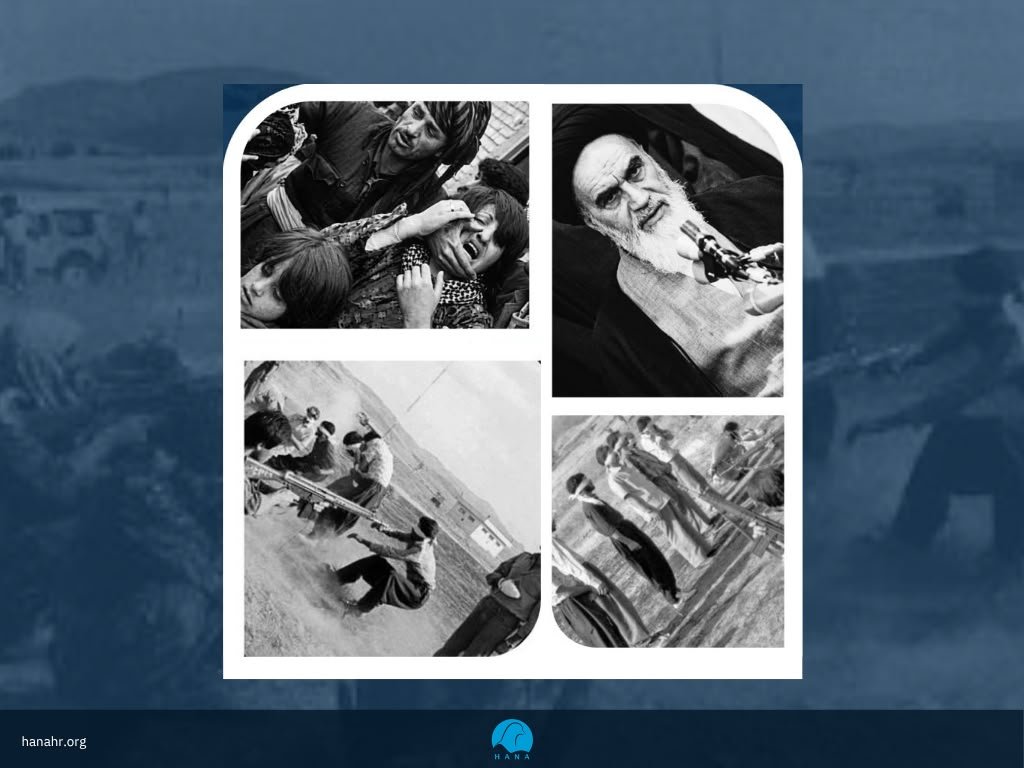
HANA Human Rights Organization’s Legal Report on the Forty-Seventh Anniversary of the Islamic Republic’s Military Assault on the Cities of Kurdistan
1. Summary of the Report
In August 1979, Ruhollah Khomeini issued a series of religious and governmental directives mobilizing the army, gendarmerie, Islamic Revolutionary Guard Corps and paramilitary forces against the cities of Kurdistan. These directives, remembered in Kurdistan as the “Jihad Fatwa”, provided the religious, political and operational basis for a large-scale assault marked by summary executions, field trials, the killing of civilians, the destruction of towns and villages, collective punishment and forced displacement.
An examination of historical records, contemporary press reports, survivor testimony and human rights documentation provides reasonable grounds for investigating ethnic cleansing and the commission of crimes against humanity and war crimes. Yet, forty-seven years later, no independent and comprehensive investigation has addressed these crimes, the relevant chain of command, or the responsibility of those who ordered and carried them out.
HANA Human Rights Organization considers that the available evidence exceeds the threshold required to open an independent investigation. Continued silence has sustained impunity and facilitated the recurrence of the same pattern of repression in Kurdistan.
2. Introduction
Following the establishment of the Islamic Republic, the people and political representatives of Kurdistan sought recognition of their political and cultural rights, democratic local governance, elected councils, and guarantees for the teaching and use of the Kurdish language. Contrary to the official narrative, these demands did not necessarily amount to separatism. A substantial part of the Kurdish political movement pursued a democratic and decentralized constitutional arrangement within Iran.
The widespread boycott in Kurdistan of the referendum on the Islamic Republic, together with disagreements concerning the Constitution, the concentration of power and ethnic rights, was gradually recast by the authorities as a security question. Negotiations between government representatives and the “Delegation Representing the Kurdish People” failed amid mutual distrust, an expanding military presence and escalating hostilities.
Rather than address these demands through political and legal means, the Islamic Republic transformed the dispute into a military and religious confrontation. The Jihad Fatwa of August 1979 marked the decisive turn and the beginning of an organized assault on the cities of Kurdistan.
3. Statement of Facts
On 18 August 1979, Khomeini instructed the commanders of the army, gendarmerie and Revolutionary Guards to pursue and arrest opposing forces, seal Kurdistan’s borders and deliver detainees immediately to the courts. The following day, invoking religious verses and describing opponents as “bandits”, “corruptors” and “counter-revolutionaries”, he demanded that they be dealt with severely.
The directives were issued by a person who simultaneously occupied the positions of political leader, religious authority and supreme commander of the armed forces. They were addressed to identified military and security institutions and were followed immediately by mobilization, military operations and widespread executions. The Jihad Fatwa therefore combined a religious ruling, a governmental order and an operational command, carrying both religious authority and institutional force for those subject to it.
Following the Fatwa, army, Revolutionary Guard, gendarmerie and paramilitary forces, supported by ground and air power, were deployed to the cities of Kurdistan. A number of towns and villages were subjected to siege, shelling, extensive searches and mass arrests. Human rights reporting indicates that, during the ensuing campaign, scores of towns and villages were destroyed and approximately 10,000 Kurdish women, men and children were reportedly killed.
At the same time, Sadegh Khalkhali was dispatched to Kurdistan as a Sharia judge and sentenced scores of people to death without access to counsel, a genuine opportunity to present a defence, or a right of appeal. Some sentences were carried out within hours of arrest; others were executed without any trial at all. Between 19 and 29 August 1979 alone, at least 58 Kurdish citizens were executed.
The Qarna massacre on 2 September 1979 remains one of the clearest manifestations of this policy. According to available records and testimony, government-affiliated forces entered a village in which no armed confrontation was taking place and killed dozens of civilians in an act of retaliation. The victims were targeted not on the basis of individual criminal responsibility, but because they belonged to the Kurdish community and were subjected to collective punishment. Official promises to prosecute those responsible never resulted in an independent and effective investigation.
Forty-seven years later, there is still no comprehensive record of the victims, detainees, executed persons, disappeared persons or those forced from their homes. Military and judicial archives remain under the control of institutions that were themselves involved in planning, implementing or concealing the events.
4. Legal Analysis
The expression “Jihad Fatwa” is not merely a historical or political label. In law, the formal designation of an instrument is not determinative. What matters is the authority of its issuer, its content, its intended recipients, the circumstances in which it was issued and the manner in which it was implemented. Khomeini’s directives of August 1979 were simultaneously religious, governmental and military in character, and furnished the basis for mobilizing forces and legitimizing coercive action in Kurdistan.
The religious and security language used against opponents was not merely rhetorical. Labelling people as “infidels”, “bandits”, “corruptors” and “counter-revolutionaries” placed members of a community outside the ordinary protection of the law and portrayed violence against them as a religious and revolutionary duty. The close temporal connection between the directives, the deployment of forces and the onset of widespread executions strengthens the need to investigate the causal and operational relationship between the Fatwa and the crimes that followed.
Ethnic cleansing is not codified as a separate offence in the Rome Statute of the International Criminal Court. It is nevertheless a recognized legal and descriptive concept denoting a policy designed to remove a population from its place of residence through killing, intimidation, detention, destruction, displacement and other forms of coercion. Coordinated attacks on Kurdish towns and villages, the killing of civilians, collective punishment, executions based on actual or imputed political affiliation, destruction of homes and the creation of coercive conditions of displacement provide serious grounds for investigating the existence of such a policy.
Acts undertaken to carry out ethnic cleansing may constitute murder, persecution on ethnic grounds, forcible transfer, imprisonment, torture, enforced disappearance and other inhumane acts, and may therefore amount to crimes against humanity. This classification requires proof that the prohibited conduct formed part of a widespread or systematic attack directed against a civilian population and that the perpetrators knew of the broader attack.
The geographical scope of the operations, the simultaneous involvement of several state institutions, the deployment of a Sharia judge, the repetition of similar methods, the speed with which death sentences were carried out and the support of senior authorities are all indicia capable of establishing a widespread or systematic attack. The severe deprivation of the fundamental rights of Kurds on ethnic grounds, or because of an imputed political affiliation, may also constitute persecution as a crime against humanity.
Where the intensity of the violence and the organization of the parties reached the threshold of a non-international armed conflict, Common Article 3 of the Geneva Conventions applied. Iran had been a party to the Conventions since 1957. Common Article 3 prohibits the murder and torture of civilians and persons hors de combat, as well as the passing and execution of sentences without judgment by a regularly constituted court affording indispensable judicial guarantees. Depending on their nexus to the armed conflict, the execution of detainees, killing of persons hors de combat, intentional attacks against civilians and collective punishment may constitute war crimes.
Iran was also bound at the time by the International Covenant on Civil and Political Rights. Summary executions, denial of the right to a defence, mass arrests, torture and the killing of civilians violated the rights to life and a fair trial, the prohibitions of torture and arbitrary detention, and the principle of equality before the law. Neither a public emergency nor an asserted need to preserve territorial integrity could lawfully deprive an ethnic community of these protections.
Although the International Criminal Court has no temporal jurisdiction over events occurring in 1979, the definitions set out in the Rome Statute provide an authoritative framework for their legal characterization. The prohibitions of large-scale killing of civilians, summary proceedings and persecution of a population were already recognized in international law before 1979.
Responsibility is not confined to the immediate perpetrators. Those who issued orders, mobilized forces, provided the means for the operations, or knowingly failed to prevent the crimes or punish those responsible may incur individual responsibility. Khomeini’s combined position as political leader, religious authority and supreme commander requires investigation of both his direct responsibility and his responsibility as a superior. The responsibility of military commanders, Sharia judges and local officials must likewise be assessed individually, by reference to each person’s role, authority and knowledge.
5. Continuation of a State Policy
The events of 1979 were not isolated from the Islamic Republic’s subsequent policies. The securitization of Kurdish identity, the collective attribution of Kurdish citizens to Kurdish political parties, the use of charges such as moharebeh and baghi, the imposition of death sentences after unfair trials and the deployment of armed forces in the cities of Kurdistan have continued over subsequent decades.
The suppression of the “Woman, Life, Freedom” protests and the killing of demonstrators in Javanrud, Mahabad, Bukan and Piranshahr showed that the same institutional structure continues to treat the political and legal claims of the people of Kurdistan as security threats. United Nations bodies and experts have repeatedly found that Kurds and Baluch have been disproportionately exposed to killings, arbitrary detention, torture, enforced disappearance and execution.
This continuity does not, by itself, prove the crimes committed in the past. It does, however, show that impunity for those responsible for the events of 1979 has enabled the same methods of repression to be preserved and repeated.
6. Conclusion and HANA’s Legal Demands
The available material provides reasonable grounds to believe that serious violations of international human rights law and international humanitarian law followed the Jihad Fatwa against Kurdistan. The coordinated character of the operations, the number of state institutions involved, summary executions, killings of civilians, destruction of towns and villages, collective punishment and forced displacement require an investigation into ethnic cleansing and the commission of crimes against humanity and war crimes.
HANA Human Rights Organization calls upon the Human Rights Council, the Special Rapporteur on the situation of human rights in Iran and other relevant United Nations mechanisms to examine this case and to preserve documentary evidence and survivor testimony. Unresolved cases of enforced disappearance should also be referred to the competent United Nations mechanism.
HANA further calls upon the European Union and the European Parliament to recognize the Jihad Fatwa and the ensuing crimes as part of the history of the organized repression of the Kurdish people, and to support an independent mechanism for truth-seeking and accountability. States possessing jurisdiction should examine whether suspects within their reach may be investigated under applicable domestic law.
Iranian opposition parties and movements should likewise recognize and unequivocally condemn the Jihad Fatwa, the assault on the cities of Kurdistan and the ensuing ethnic cleansing. They should incorporate the victims’ rights to truth, justice, reparation and guarantees of non-recurrence into their transitional justice programmes.
Justice cannot be achieved by reducing these crimes to a “conflict between the government and armed groups”. The first step is to recognize accurately what occurred: a Jihad Fatwa against Kurdistan, an organized assault on its cities, the killing and execution of civilians, and the implementation of a policy of ethnic cleansing under the authority of the Islamic Republic’s highest official.
Legal Office of HANA Human Rights Organization
19 August 2026