
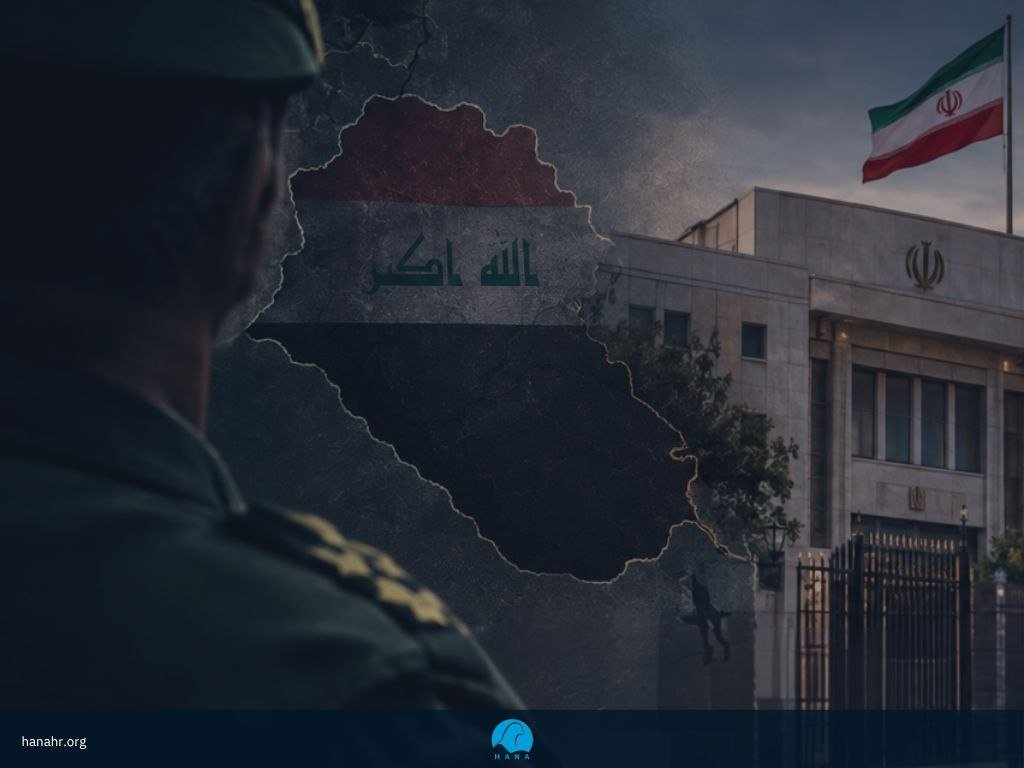
A review by the Hana Human Rights Organization of the backgrounds of the Islamic Republic’s ambassadors in Baghdad shows that, over the past two decades, Tehran has consistently entrusted its diplomatic representation in Iraq to figures affiliated with the Islamic Revolutionary Guard Corps (IRGC) and its Quds Force. Their backgrounds are linked not only to the diplomatic service but also to the Islamic Republic’s military and security structures and its extraterritorial operations.
Since the fall of Saddam Hussein’s government, four successive ambassadors of the Islamic Republic to Iraq, Hassan Kazemi Qomi, Hassan Danaeifar, Iraj Masjedi, and Mohammad Kazem Al-e Sadegh, have had documented or reported backgrounds in the Quds Force. Hassan Kazemi Qomi, Iran’s ambassador from 2006 to 2010, was accused of being a member of the Quds Force in 2007 by General David Petraeus, then commander of US forces in Iraq. His successor, Hassan Danaeifar, had a background in the Quds Force and had previously served as a commander in the IRGC and at the Khatam al-Anbiya Construction Headquarters. He headed Iran’s embassy in Baghdad until 2017.
Iraj Masjedi, the Islamic Republic’s next ambassador, was a senior Quds Force commander and one of Qassem Soleimani’s closest advisers. In October 2020, while serving as ambassador, he was sanctioned by the US Department of the Treasury for acting on behalf of the Quds Force. The department stated that Masjedi had played a role in training and supporting Iraqi militias, backing groups responsible for armed attacks, and facilitating the transfer of financial resources for the Quds Force. It also said he had used his diplomatic position to conceal these financial activities.
Mohammad Kazem Al-e Sadegh, the Islamic Republic’s current ambassador, represents a continuation of this pattern. Born in Najaf, Iraq, he has been described as a former close associate of Qassem Soleimani and Abu Mahdi al-Muhandis. Iranian state media have previously referred to him as a Quds Force member and an adviser to the ambassador. Before his appointment as ambassador in 2022, he served as Iraj Masjedi’s deputy and maintained extensive ties with commanders of the Popular Mobilization Forces (PMF), also known as Hashd al-Shaabi. Despite his official position, little publicly available information outlines his education or independent professional experience within the diplomatic service.
This persistent pattern of appointments raises serious questions about the boundary between diplomatic responsibilities and the Islamic Republic’s security activities. Under the 1961 Vienna Convention on Diplomatic Relations, the functions of diplomatic missions are based on developing official relations, conducting negotiations, and protecting the lawful interests of the sending state. Article 41 also requires diplomats to respect the laws of the host country and refrain from interfering in its internal affairs. Although a military background alone does not legally disqualify someone from being appointed ambassador, using diplomatic status and immunity to direct security operations or support armed groups conflicts with the legal limits of diplomatic functions.
In the latest example, on October 20, 2026, Al-e Sadegh claimed that Baghdad and Tehran had reached an agreement to expel members of Iranian Kurdish parties from the Kurdistan Region of Iraq or hand them over to the Islamic Republic. This claim was not confirmed in the Iraqi side’s official statement. The fact that such a claim was made by an ambassador with a reported background in the Quds Force heightens concerns about the use of diplomatic relations to intensify security pressure on political opponents beyond Iran’s borders.
The Hana Human Rights Organization emphasizes that diplomatic immunity and privileges are intended to ensure the performance of legitimate diplomatic functions, not to provide legal cover for cross-border security activities. The documented backgrounds of these appointees underscore the need for host governments to monitor the activities of the Islamic Republic’s diplomatic missions and prevent any abuse of diplomatic status against political opponents and refugees.