
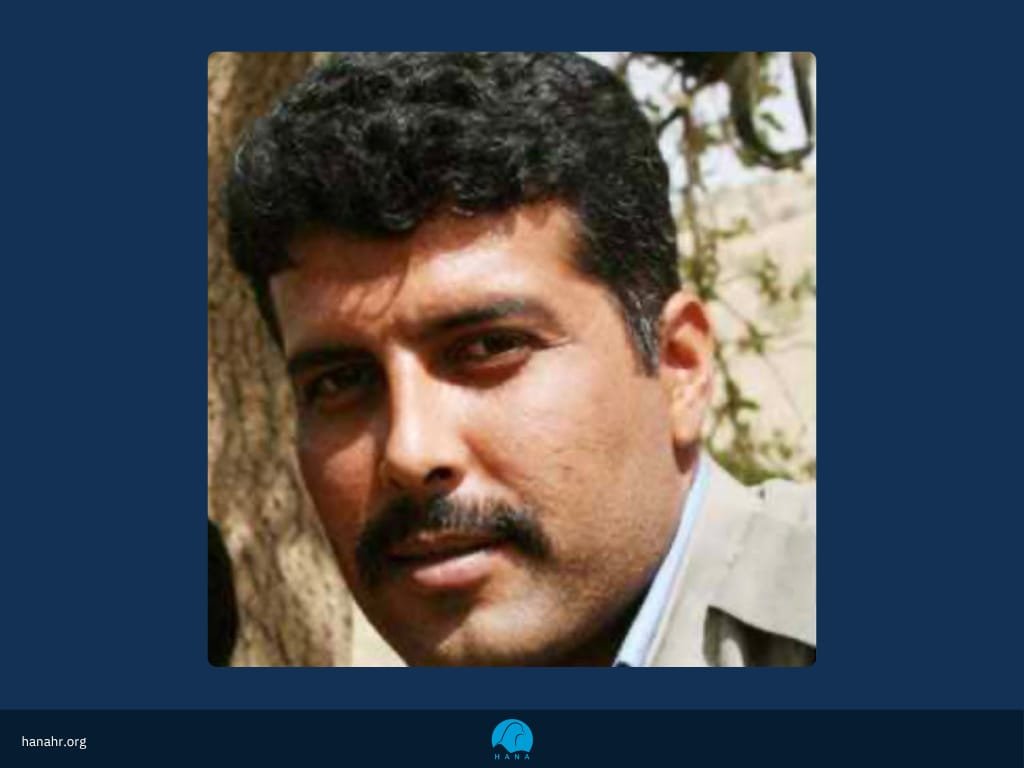
On the 13th anniversary of the execution of Sherko Maarefi, a Kurdish political prisoner, Hana Human Rights Organization revisits his case and documents violations of his fundamental rights, including torture during detention, denial of the right to an effective defence, the imposition of a death sentence in proceedings that lacked fair trial guarantees, and the secret execution of the sentence without prior notification to his family or lawyer. Maarefi was executed in Saqqez Prison in the early hours of November 4, 2013, after more than five years in detention.
Sherko Maarefi was born in 1981. On July 30, 2008, he was arrested by Islamic Revolutionary Guard Corps (IRGC) forces in a village in Saqqez County. After one week of interrogation at the IRGC detention facility in Saqqez, he was transferred to the Intelligence Department detention facility in Sanandaj, where he was held for approximately two months. In an interview conducted in 2013 with a Kurdish human rights activist, Maarefi reported being subjected to physical and psychological torture, continuous interrogations, threats to arrest members of his family, and forced consumption of substances whose nature was unknown to him.
Approximately three months after his arrest, Branch One of the Saqqez Revolutionary Court sentenced Maarefi to death on the charge of “moharebeh” (enmity against God) through membership in the Komala Party. According to his own account, the initial proceedings took place without access to a lawyer of his choice. He was only permitted to appoint legal counsel after the sentence had been issued, at the appeal stage. His lawyer, Ahmad Saeed Sheikhi, filed a request for a retrial under the mechanism known as Article 18. Although the request was accepted, the case was referred to Branch 27 of the Supreme Court in Qom, which once again upheld the death sentence.
Maarefi also faced severe restrictions during his imprisonment in Saqqez Prison. According to his account, receiving a collection of poetry by Sherko Bekas, the Kurdish poet, resulted in his punitive transfer to solitary confinement. Furthermore, despite suffering from a stomach ulcer and doctors recommending his transfer to a hospital, the Intelligence Department opposed the transfer, preventing him from receiving the medical care he required.
According to the account of one of Maarefi’s fellow inmates, on the evening of November 3, 2013, Maarefi and another political prisoner, Matlub Ahmadian, were removed from their ward on the orders of Norouzi, the prison’s then head of security, under the pretext of smoking cigarettes. They were handcuffed and shackled and transferred to solitary confinement. At approximately 5:30 a.m. the following morning, Maarefi was taken out of his cell under the pretext of being temporarily transferred to Sanandaj Prison. He only learned of the authorities’ decision to execute him after arriving at the execution site and seeing the gallows.
Sherko Maarefi’s death sentence was carried out in the early hours of Monday, November 4, 2013, without prior notification to his family or lawyer and in the presence of prison officials and representatives of the judiciary and the Saqqez Intelligence Department. His body was handed over to his family several hours later and buried that same day in Baneh Cemetery under heavy security measures.
Hana Human Rights Organization emphasizes that the reported violations in Sherko Maarefi’s case raise serious concerns regarding the right to life, the prohibition of torture, and the right to a fair trial. Under Article 6 of the International Covenant on Civil and Political Rights (ICCPR), to which Iran is a state party, the death penalty may only be imposed within the strict limits of the “most serious crimes” and in full compliance with fair trial guarantees. According to General Comment No. 36 of the United Nations Human Rights Committee, offences that do not directly and intentionally result in death do not fall within this category. Accordingly, mere membership in a political party, in the absence of proof of conduct meeting the requirements of Article 6, cannot constitute a legitimate basis for imposing a death sentence.
Furthermore, allegations of torture and forced confessions, denial of access to a lawyer during the initial proceedings, and restrictions on access to medical care raise serious concerns about compliance with Articles 7, 10, and 14 of the ICCPR. Under Iranian domestic law, Article 38 of the Constitution prohibits torture for the purpose of extracting confessions or obtaining information. The charge of “moharebeh” must also be established through proof of its legal elements under the law applicable at the time of the alleged conduct. In addition, the execution of the sentence without prior notification to the family or lawyer, and the concealment of the execution date from the prisoner, underscore the need to examine whether the legal safeguards governing the implementation of death sentences were respected.
From the perspective of international human rights law, where a death sentence results from proceedings that violate fundamental fair trial guarantees, its implementation may constitute an arbitrary deprivation of life. Hana Human Rights Organization stresses the need for an independent and effective investigation into the allegations of torture, the judicial proceedings, and the manner in which Sherko Maarefi’s death sentence was carried out. The organization calls for accountability on the part of the officials involved and for the right of his family to truth, justice, and an effective remedy to be guaranteed.