
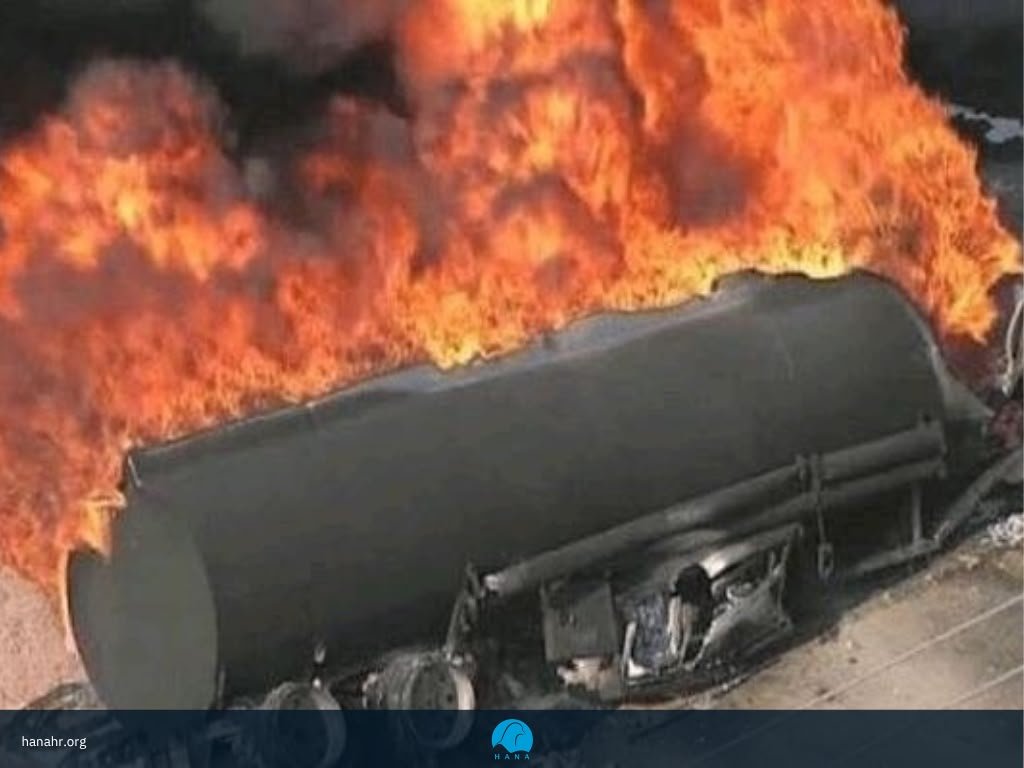
At approximately 5:30 PM on Saturday, September 5, 2026, a fuel tanker transporting nearly twenty thousand liters of gasoline lost control at the entrance of Sanandaj on the road leading to Hamedan, colliding with a minibus. The subsequent explosion of the tanker and the rapid spread of the fire to the minibus and surrounding vehicles resulted in the deaths of eleven individuals and left seven others injured.
The minibus was carrying a number of employees from the Kurdistan Municipalities Assistance Organization who were returning to Sanandaj after their workday. As of the drafting of this report, the identities of eight of the deceased have been definitively confirmed. However, due to the extreme severity of the burns, the identification of the remaining three bodies has been deferred pending DNA testing. Of the seven injured victims, two have been discharged, while five remain under hospital care, including one individual currently admitted to the intensive care unit.
Preliminary investigations by judicial authorities have cited a technical failure in the braking system of the tanker as a potential cause of the incident. While the definitive cause remains under investigation, this initial finding reveals a deeply alarming reality. A vehicle carrying thousands of liters of highly flammable material, suffering from a probable defect in one of its most critical safety components, entered a heavily trafficked route at the entrance of Sanandaj and ultimately precipitated a human catastrophe.
This tragic event is not without precedent. In July 2018, another fuel tanker lost control on Doctor Hosseini Boulevard in Sanandaj, in close proximity to the location of this recent incident, and collided with a passenger bus. The resulting explosion and fire claimed the lives of fifteen people. In that particular case, the condition of the braking system of the tanker, the overall safety of the road, the regulations governing the transit of fuel vehicles, and the performance of the responsible government agencies were all subjects of investigation.
Following the 2018 tragedy, official reports highlighted severe safety deficiencies along the route, citing previous warnings and emphasizing the urgent necessity of restricting the movement of fuel tankers within city limits. Nevertheless, eight years later, this exact pattern of peril has repeated itself. It involves another fuel tanker, a likely brake failure, the entrance parameters of Sanandaj, and the renewed loss of innocent citizens who played absolutely no part in creating this hazard.
From the perspective of the Hana Human Rights Organization, reducing such an event to a mere traffic accident severely distorts its true nature. A hazard that has previously resulted in mass casualties, which has been explicitly identified by official agencies, and about which repeated warnings have been issued can no longer be considered an unknown or unpredictable danger. The recurrence of this deadly pattern serves as a glaring testament to the structural failure of the Islamic Republic to fulfill one of its most fundamental public duties, namely the effective protection of the lives of its citizens.
Domestic regulations have clearly delineated the responsibilities of the relevant authorities. The transportation of hazardous materials is subject to stringent requirements regarding the technical certification of the vehicle, fleet safety, the qualifications of the transport operator, periodic inspections, and oversight by public institutions. Furthermore, the Crisis Management Law places the prevention and mitigation of known risks squarely among the duties of the state. Therefore, should the failure of the braking system be confirmed, merely citing a technical defect cannot serve as a legally sufficient response to the deaths of eleven human beings. Accountability must be rigorously evaluated across the entire chain of oversight, from the initial technical certification and maintenance of the tanker to the operational conduct of the transport company and the regulatory bodies.
According to Hana, the right to life is not exclusively protected against direct acts of deprivation. This fundamental right also mandates that the government take effective preventive measures against severe, known, and foreseeable hazards. Monitoring the transport of dangerous goods, ensuring the mechanical integrity of heavy vehicles, securing high risk routes, and preventing the recurrence of established tragedies are not mere administrative privileges but constitute an essential part of the obligation of the state to safeguard the lives of the public.
For the people of Kurdistan, this systemic inefficiency occurs at a time when the community is simultaneously enduring the burdens of conflict, severe economic pressure, rampant inflation, discrimination, and widespread violations of fundamental rights. Under such dire circumstances, the sheer inability of the state to ensure the most basic level of public safety demonstrates that the current crisis is not solely political or economic in nature. Instead, it reveals a profound erosion of the fundamental state functions required to protect the daily lives of its citizens.
In the aftermath of this recent incident, familiar directives for immediate investigation have been issued once more, alongside the opening of a legal case and promises to uncover the cause of the disaster. The true value of such mandates must be measured against the outcomes of the actions taken following the 2018 tragedy. That disaster was also investigated, the apportionment of blame among various institutions and individuals was discussed, and warnings were issued to prevent its repetition. Yet, eight years later, eleven more individuals have lost their lives in a catastrophe following an identical pattern.
The Hana Human Rights Organization asserts that post incident directives cannot substitute the preventative obligations that should have been implemented prior to the loss of civilian lives. A governing structure that has recognized a danger, received explicit warnings about it, and yet failed to contain it despite the passage of years cannot consider its responsibility absolved simply by opening another file or issuing administrative orders. Furthermore, the established historical record has severely undermined any remaining public trust in the efficacy of such internal governmental mechanisms.
The deaths of eleven citizens in Sanandaj cannot be reduced to a simple brake failure. The core issue at hand is the perpetuation of a recognized peril and the structural impotence of the state in preventing its recurrence. A government that, following a similar tragedy, official warnings, and an eight year window of opportunity, once again oversees the exact same deadly pattern, has unequivocally failed in fulfilling its most foundational commitment to protecting the right to life of its citizens.