
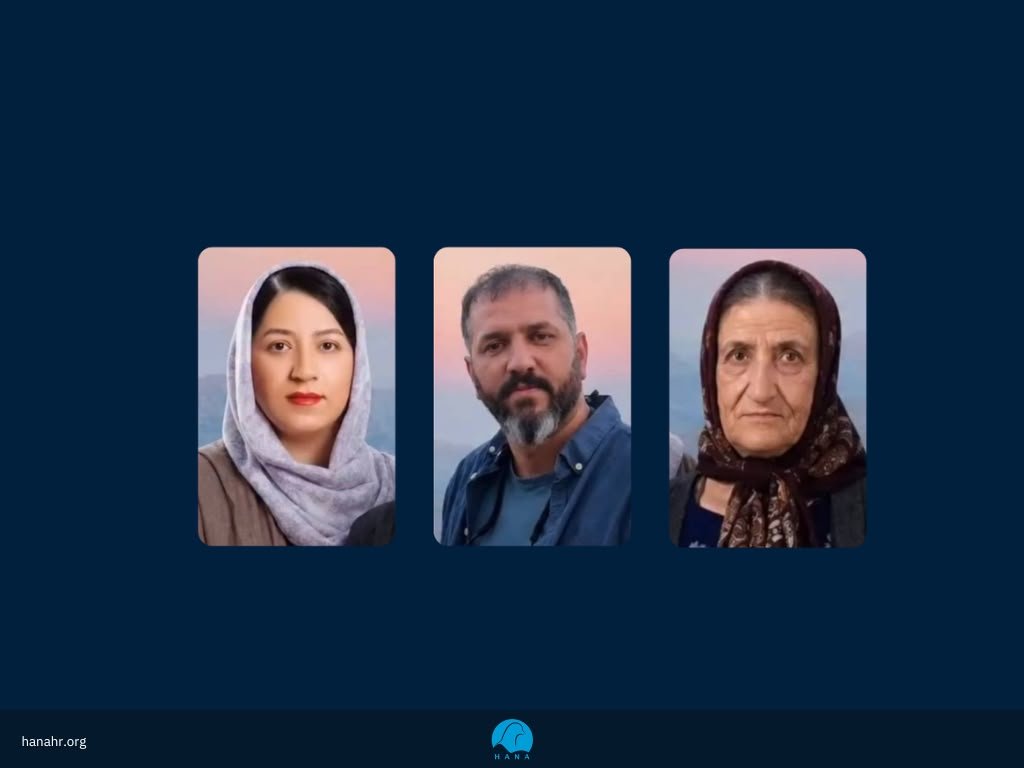
According to information received by the Hana Human Rights Organization, on the afternoon of Sunday, July 26, 2026, the personal vehicle of Mehdi Tavakoli, a Kurdish cultural and artistic activist, was targeted by direct fire from the intelligence forces of the Islamic Revolutionary Guard Corps (IRGC). As a result of this shooting, Mehdi Tavakoli, along with his mother, Maryam Aslani, and his sister, Somayeh Tavakoli, lost their lives.
Reports received by Hana indicate that the bodies of the victims were transferred to Sanandaj under the supervision of security forces and were buried on Monday, July 27, 2026, in the Behesht-e Mohammadi cemetery in a strictly securitized environment. Simultaneously, the victims’ family has been pressured to refrain from sharing information about how the incident occurred and to instead declare a “car accident” as the cause of death.
In contrast, the spokesperson for the Law Enforcement Command (FARAJA) and state media have claimed that the occupants of the vehicle were members of an armed Kurdish group and were killed during an armed clash. However, as of the publication of this report, no independent and verifiable evidence regarding the occurrence of a clash, the victims being armed, an exchange of fire, or the existence of an imminent threat against the agents has been published. The lack of any independent documentation, coupled with the security control over the bodies, the restriction of the burial ceremony, and the pressure exerted on the family, casts serious doubt on the credibility of the official narrative.
In accordance with international human rights standards, the use of lethal force is only permissible under circumstances where it is absolutely necessary to protect lives against an imminent and unavoidable threat. The fatal shooting of a vehicle carrying three members of a family, without the presentation of reliable evidence regarding the existence of such a threat, is a clear instance of the arbitrary deprivation of the right to life and extrajudicial killing.
Mehdi Tavakoli was the director of the Kurdistan Photographers’ House, the founder of the “Chaw” Art House, and a former political prisoner who had previously faced pressure and confrontation from security institutions due to his cultural, artistic, and civil activities.
The Hana Human Rights Organization strongly condemns the killing of Mehdi Tavakoli, Maryam Aslani, and Somayeh Tavakoli. This incident cannot be considered an isolated event or the result of a routine security operation; rather, it must be evaluated as a continuation of a persistent and systematic pattern of the unlawful use of lethal force against Kurdish citizens, civil activists, and their families.
Direct shooting, the transfer and burial of bodies under security control, exerting pressure on the family, and attempting to impose a false narrative of the cause of death are components of a well-known mechanism for killing, concealing the truth, and ensuring impunity for the perpetrators. The continuation of this pattern indicates that extrajudicial killings in Kurdistan are not the result of isolated actions by agents, but rather part of the Islamic Republic’s organized policy of repression, a policy that violates the right to life and subjects victims’ families to intimidation, coercion, and the deprivation of the right to know the truth.