
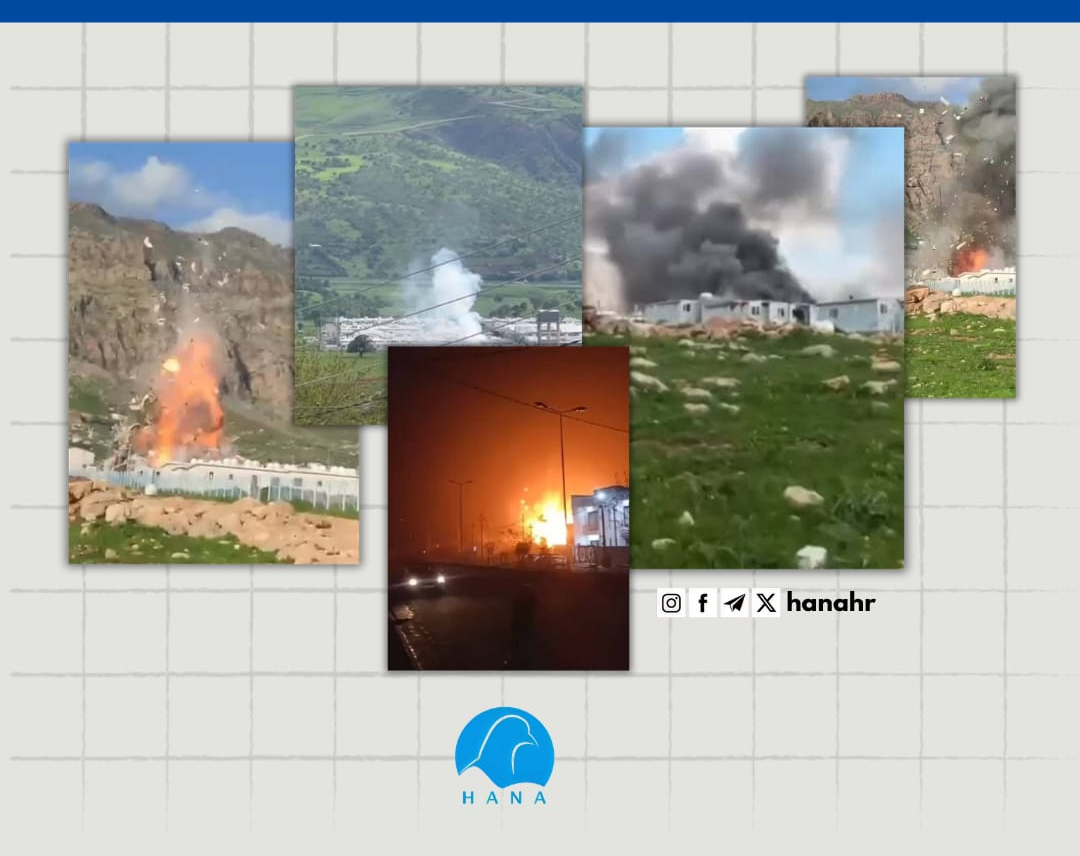
Investigative Report by the Hana Human Rights Organization: The Islamic Republic of Iran’s Cross-Border Attacks on Camps and Residences of Iranian Kurdish Parties in the Kurdistan Region of Iraq
Drawing on gathered documentation, field data, testimonies from local sources, medical records, video footage, and logged reports from the attack sites, the Hana Human Rights Organization has investigated the pattern of cross-border strikes launched by the Islamic Republic of Iran and its proxy groups against the camps, residential centers, and settlements of Iranian Kurdish parties in the Kurdistan Region of Iraq.
This report is not a mere ledger of statistics; it is a vital legal assessment of these assaults grounded in international humanitarian law (IHL), the fundamental right to life, refugee rights, and the responsibilities of the authorities holding effective control over the targeted areas.
Based on our documented data, between February 24 and May 24, 2026, at least 809 attacks were recorded across various areas of the Kurdistan Region of Iraq. Of these, 647 strikes occurred during the active war phase, and at least 162 strikes were carried out after the ceasefire was announced. These bombardments swept across the provinces of Erbil, Sulaymaniyah, Duhok, and Halabja, systematically targeting specific localities including Jezhnikan, Degala, Topzawa, Zargwez, Zargwezala, Surdash, and Sidekan.
Our data reveals a grim reality: a significant portion of the targeted areas were not military installations. They were living spaces sheltering families, children, women, the elderly, the wounded, the sick, and individuals holding refugee or refugee-like status. A legal evaluation of these strikes demonstrates that the Islamic Republic of Iran routinely ignored the mandatory distinction between military objectives and civilian spaces, deliberately targeting camps and living quarters simply because of their residents’ political or organizational ties to Iranian Kurdish parties.
1. The Governing Legal Framework
Even in the throes of armed conflict, international humanitarian law strictly forbids indiscriminate attacks on civilians and civilian objects. The principles of distinction, proportionality, and precaution are not optional guidelines; they are binding foundational rules. Under Article 48 of the 1977 Additional Protocol I, warring parties must at all times distinguish between the civilian population and combatants, and between civilian objects and military objectives. Article 51 explicitly prohibits direct attacks against civilians and indiscriminate strikes. Article 52 further dictates that civilian objects must not be attacked unless they make an effective and direct contribution to military action by their nature, location, purpose, or use, and their destruction offers a definite military advantage.
Therefore, the mere political affiliation of a camp or residential center with an opposition party does not automatically convert that space into a legitimate military target. The legal benchmark is not political allegiance; it is the objective, current, and effective use of the location in military operations. Prefabricated homes, family trailers, schools, medical clinics, children’s quarters, and camp service areas remain fully protected under IHL unless they definitively meet the strict criteria of a military objective.
In the initial phase of these assaults, out of the 809 recorded attacks, 281 targeted civilian and residential infrastructure within the Kurdistan Region, and 184 directly hit the camps, medical clinics, and residential complexes of the Iranian Kurdish parties. These figures expose that a staggering portion of the strikes struck environments where the presence of civilians was not just likely, but glaringly obvious.
2. Statistical Pattern and Its Legal Meaning
Of the 809 attacks logged up to May 24, 2026, 544 occurred in Erbil province, 230 in Sulaymaniyah, 29 in Duhok, and 6 in Halabja.
The intense concentration of strikes in Erbil particularly along the axes housing the camps and families of Iranian Kurdish parties proves these were not random or scattered incidents.
During the active war phase, 43% of the strikes targeted U.S. diplomatic and military facilities, 34% struck civilian and residential infrastructure in the Kurdistan Region, and 23% hit the camps, clinics, and residential centers of the Kurdish parties. This distribution highlights that a massive share of the operations engulfed civilian or mixed-civilian environments.
Under these circumstances, the attacker bears a heavy legal burden. For every strike, the Islamic Republic of Iran must prove that the target was genuinely military, that a direct and concrete military advantage existed, that the risk of civilian harm was rigorously assessed, that the weapon used was proportional to the target environment, and that all feasible precautions were taken to spare civilian lives. The absence of such assessments renders these strikes legally blind, disproportionate, and unlawful.
3. The Shift in Attack Patterns Post-Ceasefire
The data from the post-ceasefire period carries profound legal weight. Between April 8 and April 24, 2026, despite the declared ceasefire, over 48 attacks were logged. During this window, 75% of the strikes were executed directly by the Islamic Republic of Iran, and a staggering 78% of them explicitly targeted the camps of Iranian Kurdish parties. Concurrently, strikes against U.S. diplomatic and military facilities plummeted to just 9%.
This drastic statistical shift exposes a chilling reality: as the primary conflict cooled, the crosshairs shifted directly onto the camps and living quarters of the Kurdish opposition. From an IHL perspective, this signals a pivot from limited military engagement to the focused, systematic targeting of these communities.
Continuing to rain fire down after a ceasefire especially when the primary targets are family-inhabited camps amplifies the likelihood of severe violations of the principles of distinction and precaution. In humanitarian law, a decrease in the intensity of conflict does not dilute a warring party’s obligations; rather, it makes the necessity of proving a specific military objective, adhering to proportionality, and taking practical precautions even more absolute.
4. Military Targets, Political Affiliation, and the Prohibition of Collective Punishment
Out of the total recorded strikes, at least 210 directly targeted the camps and centers of Iranian Kurdish parties. Specifically, 114 strikes hit the Kurdistan Democratic Party of Iran (KDPI), 79 targeted the Komala party of Iranian Kurdistan, 10 hit the Kurdistan Freedom Party (PAK), and 7 targeted the Organization of the Iranian Kurdistan Struggle (Khabat).
This data underscores a relentless, recurring, and targeted campaign against these parties. Yet, legally, the sheer repetition of attacks does not magically transform these sites into military objectives. IHL outright forbids treating a political party, its affiliated families, residential quarters, schools, clinics, and camps as a monolithic military target without isolated, case-by-case scrutiny.
During the attack on the Jezhnikan camp, field data and human testimonies confirm that a suicide drone slammed directly into a family’s residential trailer, killing 17-year-old Shahin Azarbarzin. His father suffered a ruptured lung and severe burns in the subsequent blast. This tragedy is a glaring example of a family home being decimated without meeting the rigorous criteria of a military target, strongly pointing to a violation of the principle of distinction and the ban on attacking civilian objects.
5. The Islamic Republic’s Suicide Drones: A Grave Threat to Civilians
According to the report’s statistics, 477 of the attacks (79.3%) were carried out using Shahed-136 and Shahed-131 suicide drones. Another 235 attacks (20.7%) utilized Fateh-110 and Fateh-313 ballistic missiles.
Deploying suicide drones into residential and camp environments is an extraordinarily dangerous practice under humanitarian law. The peril lies not only in their explosive yield but in how they are wielded against spaces brimming with families, children, the injured, and the unarmed. Guiding a suicide drone into a residential trailer, a family courtyard, or a medical clinic constitutes an indiscriminate or disproportionate attack unless there is a verified military target and a rigorous assessment of potential civilian devastation.
In Jezhnikan, a suicide drone claimed the life of Shahin Azarbarzin and critically wounded his father. In Surdash, a drone struck the residential compound of Komala families, inflicting catastrophic lung injuries on Ghazal Molan. These realities prove that the Islamic Republic’s drones are routinely devastating environments where civilian presence is entirely foreseeable.
6. Ballistic Missiles and the Principle of Proportionality
Beyond the drones, 235 ballistic missile strikes were logged. Firing ballistic missiles near refugee camps, administrative buildings, living quarters, and heavily populated areas places an immense burden of proportionality and precaution on the attacker.
Even if aimed at a specific coordinate, a ballistic missile in a residential area unleashes massive blast waves, shrapnel, structural collapse, fires, and devastating secondary trauma. Utilizing such weaponry near family dwellings demands an exacting calculation of potential civilian collateral damage. Without a clear, direct, and proportional military advantage, such strikes are explicitly prohibited and illegal.
7. Human Casualties and Their Legal Implications
Between February 28 and May 24, 2026, at least 22 people were killed and 114 wounded in the Kurdistan Region. Among the dead, at least 9 were affiliated with Iranian Kurdish parties. Furthermore, at least 24 civilians were wounded, and hundreds of families were forced to flee their camps.
Of the wounded, at least 41 required complex interventions including surgeries, treatment for severe lung trauma, third-degree burn care, and amputations. These horrific injuries perfectly align with the devastating footprint of explosive weapons used in human-dense environments, proving the destruction bled far beyond any claimed “military” parameters.
In legally assessing each tragedy, the victim’s status at the time of the strike, the true nature of the target, the foreseeability of civilian harm, the balance between alleged military advantage and human devastation, and the availability of less destructive methods must be independently evaluated. Without this, casualty figures aren’t just statistics; they are screaming indicators of grave IHL violations.
8. The Case of Ghazal Molan: The Right to Life and the Responsibility of KRG Authorities
The case of Ghazal Molan is one of the most critical in this report because it exposes two simultaneous layers of accountability: the Islamic Republic of Iran as the perpetrator of the strike, and the Kurdistan Regional Government (KRG) authorities in their duty to guarantee immediate, effective, and non-discriminatory post-attack medical care.
On April 14, 2026, an Iranian suicide drone struck the residential compound of Komala families in Surdash. Ghazal Molan, a 19-year-old from Mahabad, suffered devastating lung trauma. She was first rushed to Shoresh Hospital, then transferred to Bakhshin Hospital in Sulaymaniyah. According to our logged reports, the administration at Bakhshin Hospital refused to admit her for 45 agonizing minutes, and Asia International Hospital also rejected her admission. Ghazal Molan ultimately bled to death.
From the standpoint of the right to life, the violation does not end at the moment of impact. The right to life binds states and authorities with effective control to take immediate, reasonable, and non-discriminatory action to save those in peril. When a drone strike victim is brought to a medical facility, the governing authorities must ensure unrestricted access to emergency care.
Any unjustified delay, refusal of admission, or discrimination based on the victim’s political identity, gender, ethnicity, or security status can constitute a violation of the positive obligation to protect the right to life.
In this case, if the refusal or delay in care is confirmed, it transcends medical malpractice or administrative failure. It signals a potential violation of Article 6 of the International Covenant on Civil and Political Rights (ICCPR) regarding the right to life, Article 12 of the International Covenant on Economic, Social and Cultural Rights (ICESCR) regarding the right to health, and the core IHL rules dictating the impartial treatment of the wounded. A victim of an armed attack must be treated without prejudice and without fatal delays.
Hana’s ongoing pursuit focuses on uncovering the reasons for this lethal delay, the culpability of the involved hospitals, the role of the Sulaymaniyah Ministry of Health, the protocols for transferring victims between centers, the presence or absence of emergency directives for war casualties, and the direct link between this delay and the tragic death of Ghazal Molan.
9. The Responsibility of the Kurdistan Regional Government (KRG)
While the KRG itself is a victim of Iran’s cross-border assaults and a victim of violated territorial sovereignty under international law, this does not absolve the regional authorities of their duty to the camp residents, refugees, displaced families, and the wounded.
As the authority exercising operational control over the targeted areas, the KRG must establish an effective system for early warning, evacuation, relief, medical treatment, emergency sheltering, damage registration, and independent investigation. For camps housing families and refugees, this duty is magnified. Our report shows hundreds of families displaced, at least 24 civilians wounded, and 41 victims requiring critical care.
In the case of Ghazal Molan, KRG authorities must be held accountable across three axes: first, guaranteeing immediate and impartial medical care; second, conducting a transparent and independent investigation into the alleged refusal and delay of admission; and third, ensuring administrative, civil, or criminal accountability if negligence, discrimination, or a breach of emergency protocols is proven.
10. Protecting Refugees and Families Residing in Camps
A vital segment of those living in the targeted camps holds refugee or refugee-like status. Our data confirms that these strikes have triggered the displacement of hundreds of families, pushing the security and humanitarian crisis within the camps to a breaking point.
Under both refugee and human rights law, families cannot be subjected to military bombardment simply because some community members hold political or organizational ties. Children, women, the elderly, the sick, and the wounded do not forfeit their protected status just because they live in a camp affiliated with a political party. The bedrock of IHL is that the political or security status of a faction never grants a license to wage indiscriminate war on a civilian population.
11. Compensation and the Necessity of Independent Documentation
Beyond the harrowing human toll, these strikes have obliterated trailers, damaged administrative buildings, clinics, schools, and vital infrastructure, tearing families from their homes. These damages must be recorded with meticulous, independent, and legally sound documentation.
The Hana Human Rights Organization stresses that this documentation must secure the victim’s name, their civilian or military status, the exact strike coordinates, the weapon deployed, the time of the attack, the extent of the ruin, medical records, witness testimonies, video footage of the aftermath, and the exact chain of medical evacuation. Without this rigorous evidence, the pursuit of justice, the demand for reparations, and the ability to hold the perpetrators accountable will be critically crippled.
Conclusion and Legal Condemnation
The synthesis of statistical and field data starkly illuminates that the cross-border strikes by the Islamic Republic of Iran and its proxies against the Kurdistan Region of Iraq specifically against the camps and living quarters of Iranian Kurdish parties bear the undeniable hallmarks of severe violations of international humanitarian law, the right to life, refugee protections, and the mandate to shield civilians.
The reckless unleashing of suicide drones and ballistic missiles into residential spaces, the direct targeting of family trailers and civilian-dense compounds, the relentless continuation of strikes post-ceasefire, and the mass displacement of hundreds of families collectively prove that the Islamic Republic of Iran has shattered its fundamental obligations of distinction, proportionality, and precaution.
The Hana Human Rights Organization condemns these attacks in the strongest possible terms. We identify them not as legitimate defense, but as a calculated pillar of the Islamic Republic’s transnational strategy to suppress, terrorize, and inflict collective punishment upon dissenting Kurdish communities beyond its borders. Raining fire on camps that shelter families, children, women, refugees, and the wounded is a gross violation of human dignity, collective security, and the very foundations of international humanitarian law.
Hana asserts that the Islamic Republic of Iran must face accountability for the blood spilled, the families uprooted, the civilian lives shattered, and the deployment of lethal weaponry into community spaces. Furthermore, we demand that the authorities of the Kurdistan Region of Iraq launch an effective, independent, and utterly transparent investigation into the medical response to these strikes particularly in the tragic case of Ghazal Molan to guarantee that no victim is ever again denied life-saving care due to their political, ethnic, or security identity.