
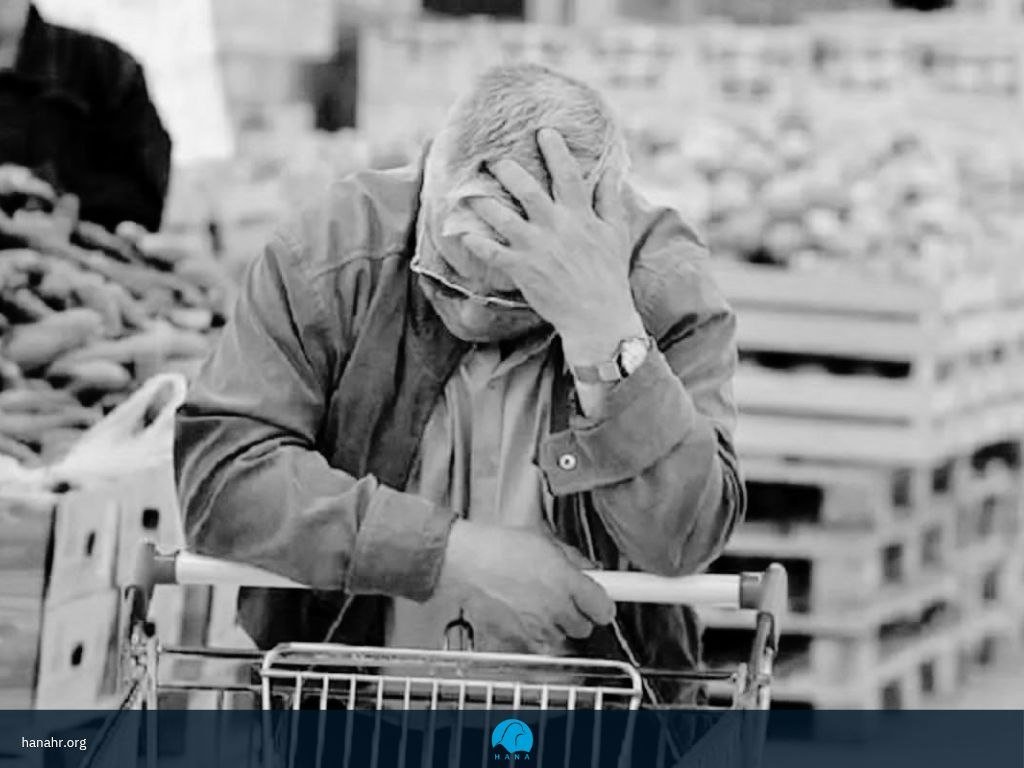
Based on field research, reports received from local sources, and continuous monitoring of the economic and social situation of citizens, the Hana Human Rights Organization expresses grave concern over the escalation of the livelihood crisis, the sharp increase in living costs, and its direct consequences on the economic and social rights of the people. Available evidence indicates that the continuation of war conditions, the collapse of economic governance capacity, rising inflation, the spread of poverty, and disruptions in access to basic goods and services have pushed the daily lives of a vast segment of citizens into a critical stage.
This situation is not merely an economic or managerial crisis; rather, from the perspective of international human rights law, it is directly related to the government’s obligations regarding the right to an adequate standard of living, the right to food, the right to housing, the right to health, the right to social security, and the principle of non-discrimination. As a state party to the 1966 International Covenant on Economic, Social and Cultural Rights, Iran is obligated to guarantee the economic, social, and cultural rights of its citizens in accordance with the provisions of this Covenant. Article 2 of this Covenant obliges states to use the maximum of their available resources to progressively but effectively guarantee the realization of economic and social rights. This obligation does not disappear in times of crisis, and the government remains duty-bound to maintain the basic minimums of human life, particularly for vulnerable groups.
According to Hana’s field data, the poverty line crossing the threshold of 70 million Tomans and the continuous rise in the prices of basic goods have severely restricted the access of many households to the minimum standards of a decent life. This situation has particularly severe impacts on workers, retirees, female-headed households, children, the elderly, persons with disabilities, the unemployed, low-income families, and residents of underprivileged areas. From a human rights perspective, the government must not only refrain from policies that lead to the widespread deprivation of the people’s basic needs, but it must also take immediate, targeted, and measurable actions to prevent citizens from falling further into poverty and livelihood insecurity.
The increase in the price of food and other essential items has drastically reduced the purchasing power of households and has placed the community’s food security under threat. The right to adequate food is recognized in Article 11 of the International Covenant on Economic, Social and Cultural Rights (ICESCR) as part of the right to an adequate standard of living. The UN Committee on Economic, Social and Cultural Rights, in General Comment No. 12, emphasized that the right to food does not merely mean receiving a minimum number of calories; rather, it requires sustainable physical and economic access to adequate, safe, acceptable, and nutritious food consistent with human dignity. Therefore, when inflation, declining real income, and market instability prevent families from procuring adequate and appropriate food, the issue transcends mere “high prices” and becomes a serious threat to the fundamental right to food.
In the sphere of housing, the sharp increase in mortgage and rental costs has confronted a large segment of households with the risks of forced displacement, residential instability, debt, marginalization, or deprivation of adequate housing. Article 11 of the Covenant identifies the right to adequate housing as one of the core elements of an adequate standard of living. The Committee on Economic, Social and Cultural Rights, in General Comment No. 4, clarified that adequate housing does not simply mean having a roof over one’s head; it must be acceptable in terms of security of tenure, affordability, access to essential services, habitability, suitable location, and human dignity. The unchecked rise in rents, the normalization of heavy mortgage amounts, and the lack of effective support for low-income tenants indicate that the right to housing is effectively being undermined for a significant portion of citizens.
The rising costs of treatment, medicine, insurance, and medical services have also placed serious limitations on the right to the enjoyment of the highest attainable standard of physical and mental health. Article 12 of the Covenant obliges states to create conditions that ensure all individuals can enjoy accessible, affordable, and non-discriminatory health services. The Committee on Economic, Social and Cultural Rights, in General Comment No. 14, emphasizes that the right to health is not limited to medical treatment; it also encompasses the fundamental determinants of health, including food, nutrition, housing, safe water, economic conditions, and genuine access to healthcare services. Accordingly, when rising costs prevent people from visiting a doctor, purchasing medication, paying for insurance, or continuing treatment, the government faces the risk of a serious violation of its obligations regarding the right to health.
Simultaneously, the increase in public expenditures, the reduction or suspension of operations in certain production and industrial units, the rising costs of construction materials and durable goods, the emergence of informal markets for items such as fuel, and limitations on access to bank liquidity are indicators of expanding structural instability in the daily economy of citizens. This instability has direct impacts on the right to work, the right to just and favorable conditions of work, the right to social security, and the right to protection against poverty and unemployment. Article 9 of the Covenant recognizes the right to social security, and the Committee on Economic, Social and Cultural Rights, in General Comment No. 19, emphasized that this right must protect individuals against the lack of income caused by unemployment, illness, disability, old age, unaffordable healthcare costs, and the lack of adequate family support.
The Hana Human Rights Organization emphasizes that under conditions of economic crisis, the government cannot shirk its human rights responsibilities by making general references to resource shortages or war conditions. According to General Comment No. 3 of the Committee on Economic, Social and Cultural Rights, states have immediate obligations even within the path of progressive realization of economic and social rights; these include the obligation of non-discrimination, taking concrete steps, and utilizing the maximum of available resources to guarantee the core minimum of rights. Therefore, the reduction in people’s access to food, housing, treatment, insurance, fuel, liquidity, and basic services—in the absence of effective and fair compensatory policies—can be considered a sign of a widespread and structural violation of economic and social rights.
The principle of non-discrimination is also of fundamental importance in this context. Article 2, Paragraph 2 of the Covenant obliges states to guarantee the exercise of economic and social rights without discrimination. The Committee on Economic, Social and Cultural Rights, in General Comment No. 20, identified the prohibition of discrimination as an immediate and cross-cutting obligation. Consequently, economic policies, resource distribution, social protections, and access to essential goods, healthcare, fuel, housing, and liquidity must be designed and implemented in such a way that vulnerable groups, marginalized regions, and underprivileged communities do not bear the heaviest burden of the crisis.
The Hana Human Rights Organization believes that the continuation of the current trend could have widespread human and social consequences. Extreme poverty, food insecurity, inability to pay rent, deprivation of medical treatment, reduced access to medication, unemployment, household debt, and financial instability are all indicators that the livelihood crisis has reached the level of a direct threat to human dignity. Economic and social rights are not “second-class” rights or mere welfare demands; these rights are part of the binding obligations of states under international law and are directly linked to the life, dignity, health, and human security of citizens.
Accordingly, the Hana Human Rights Organization calls upon the responsible authorities to immediately place the following measures on their agenda in a transparent and evaluable manner: curbing inflation for basic goods; guaranteeing equal and fair access to food, medicine, fuel, and healthcare services; providing direct support to low-income households; implementing effective rent control and preventing homelessness; strengthening the insurance and social security systems; guaranteeing public access to liquidity and banking services; monitoring informal and corruption-prone markets; and publishing public data regarding prices, reserves of basic goods, and support policies.
Furthermore, the Hana Human Rights Organization emphasizes that transparency, accountability, and public participation are integral parts of the government’s obligations in the field of economic and social rights. Citizens have the right to know how public resources are being spent, what policies have been adopted to support vulnerable groups, and what mechanisms exist for complaints, compensation, and independent oversight. Neglecting the current situation will not only exacerbate the economic crisis but could also lead to broader deprivation, deeper inequality, and the systematic violation of the fundamental rights of citizens.
In conclusion, the Hana Human Rights Organization publishes the list of price changes over the past 10 days as an appendix to this report to further clarify the objective and daily dimensions of the livelihood crisis for public opinion, human rights organizations, and international mechanisms.
Appendix: List of Price Changes Over the Past 10 Days (All figures in Iranian Tomans)
The following data illustrates the rapid inflation and drastic increase in the cost of living over a 10-day period, highlighting the severe economic pressure on households:
- Grocery and Food Items
Chicken (per kg) | 290,000 – 340,000 Toman
Pakistani Rice (10kg bag) 2,500,000 – 3,000,000 Toman
Indian Rice (10kg bag) 1,900,000 – 2,400,000 Toman
Iranian Rice (10kg bag) 4,500,000 – 6,000,000 Toman
Red Meat (per kg) | 1,300,000 – 1,300,000 Toman (Stable)
Cooking Oil (5kg container) 1,600,000 – 2,000,000 Toman
Pasta (per pack) 50,000 – 75,000
Sugar (per kg) 90,000 – 100,000 Toman
Eggs (per tray) 300,000 – 500,000 Toman
Bananas (per kg) 400,000 Toman
Bread (per loaf) 1,000 Toman - Household Appliances and Construction Materials
(Comparison of prices before the conflict vs. current status)
Tiles (per meter): Increased from 600,000 to 1,200,000 Toman.
Heating Units (Package): Increased from 40,000,000 to 80,000,000 Toman.
Doors: Increased from 17,000,000 to 35,000,000 Toman.
12-Meter Carpet: Currently 60,000,000 Toman.
Refrigerators: Starting from 90,000,000 Toman and above.
Television: Average price of 80,000,000 Toman.
Cement (per bag): Currently 320,000 Toman.
Construction Rebar (per kg): Currently 75,000 Toman.
PVC Windows (per meter): Increased from 300,000 to 1,200,000 Toman. - Essential Services and Housing
Medical Consultation: Increased from 320,000 to 780,000 Toman.
Insurance (Monthly Premium): Increased from 4,000,000 to 6,800,000 Toman.
Monthly Rent (100sqm House): Increased from 7,000,000 to 15,000,000 Toman. - Transportation and Fuel
Due to the acute shortage of iron and manufacturing halts, vehicle prices have more than doubled:
Entry-level vehicle (Previously 300M range): Now 700,000,000 Toman.
Dena Plus: 2,700,000,000 Toman (2.7 Billion).
Samand: 1,700,000,000 Toman (1.7 Billion).
Fuel (Black Market): Gasoline prices have reached 40,000 to 50,000 Toman per liter.