
HANA Human Rights Organization
39th Anniversary of the Chemical Bombing of Sardasht
28 June 2026
Thirty-nine years after the chemical bombing of Sardasht, thousands of survivors continue to suffer its devastating physical and psychological consequences while remaining deprived of their internationally recognized rights to truth, justice and effective reparation.
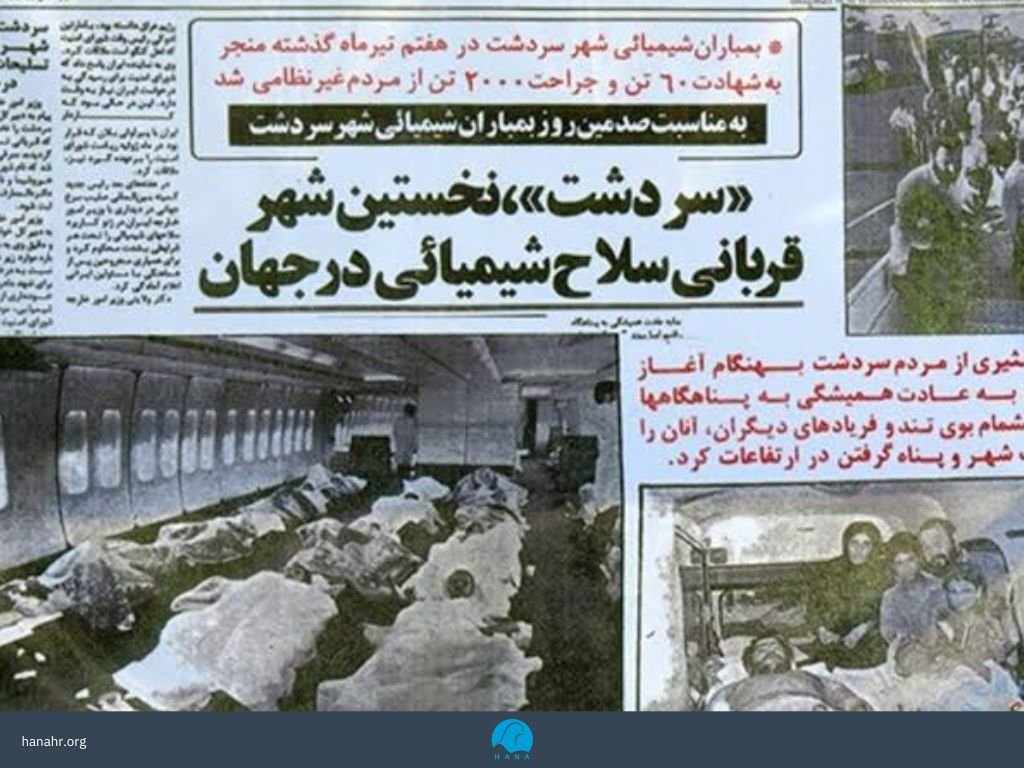
On 28 June 1987, Iraqi military aircraft under Saddam Hussein’s Ba’ath regime dropped mustard gas bombs on densely populated civilian areas of Sardasht in northwestern Iran, striking residential neighborhoods, the central market and other public spaces. At least 110 civilians were killed and more than 8,000 people were exposed to chemical agents, many of them women, children and older persons.
Sardasht is widely recognized as the first city since the Second World War to suffer a large-scale chemical attack against its civilian population. Nearly four decades later, survivors continue to experience chronic respiratory disease, severe ocular injuries, skin disorders, immune system complications and lasting psychological trauma.
Responsibility for the attack rests with the Iraqi Ba’ath regime, which systematically employed chemical weapons during the Iran-Iraq War. United Nations investigations repeatedly confirmed Iraq’s use of chemical agents, while subsequent judicial proceedings in Europe exposed parts of the international supply network that enabled Iraq’s chemical weapons programme.
Under international humanitarian law, the intentional use of chemical weapons against civilians constituted a serious violation of the laws and customs of war, breaching the prohibition on chemical weapons and the fundamental principles of distinction, proportionality and the prohibition of unnecessary suffering. These acts amount to war crimes under customary international law. Considered within the broader and systematic campaign of chemical attacks carried out by the Iraqi regime against civilian populations in both Iran and Iraq, including Halabja and other Kurdish areas, they may also constitute crimes against humanity.
Despite the gravity of these crimes, accountability has remained limited. The conviction of Dutch businessman Frans van Anraat for supplying chemical precursors represented an important application of individual criminal responsibility but addressed only a small part of the broader chain of responsibility and provided little meaningful justice for the victims of Sardasht.
The international responsibility of Iraq likewise remains unresolved. Under the law of state responsibility, Iraq remains under an obligation to acknowledge its internationally wrongful conduct, provide full and effective reparation to victims, and adopt guarantees of non-repetition. No comprehensive mechanism has yet been established to fulfil these obligations.
The obligations of the Islamic Republic of Iran toward survivors are equally significant. International human rights law requires states to ensure effective access to healthcare, rehabilitation, social protection and effective remedies for victims of gross human rights violations. Many survivors continue to face serious obstacles in obtaining specialized treatment and long-term medical and social support. These obligations are continuing in nature and cannot be satisfied through symbolic commemoration alone.
Survivors of Sardasht are entitled not only to medical care but also to the rights to truth, justice and reparation, as reflected in the 2005 UN Basic Principles and Guidelines on the Right to a Remedy and Reparation. These rights encompass restitution where possible, compensation, rehabilitation, satisfaction, including official acknowledgment and preservation of historical memory, and guarantees of non-repetition.
On the thirty-ninth anniversary of the chemical bombing of Sardasht, HANA Human Rights Organization commemorates those who lost their lives and expresses its solidarity with the survivors and their families. HANA calls upon the Government of Iraq to acknowledge its international legal responsibility and establish an effective reparations mechanism.
It further urges the Government of Iran to strengthen medical, rehabilitation and social support for survivors and to pursue accountability and victims’ rights more effectively through available international legal mechanisms.
HANA also calls upon the United Nations, the Organisation for the Prohibition of Chemical Weapons (OPCW), and the broader international community to recognize Sardasht not merely as a historical tragedy but as an unresolved case of international justice requiring continued attention.
The passage of time neither extinguishes international responsibility nor diminishes the victims’ enduring rights to truth, justice and full reparation.