
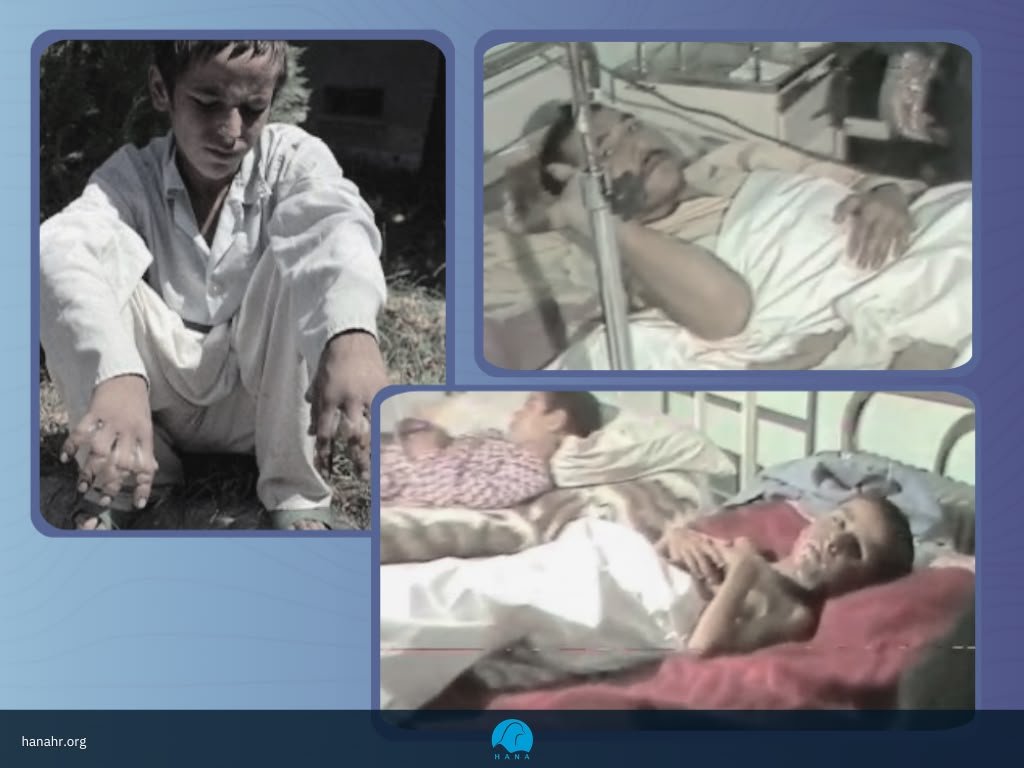
In the early hours of August 2, 1988, the city of Oshnavieh and the residential areas around it came under chemical aerial attack by the armed forces of Ba’athist Iraq. A UN Secretary-General’s expert mission that visited the site, examined the wounded, and analyzed environmental samples confirmed the use of mustard agent.
According to information recorded during the UN mission, 2,680 people were exposed to the chemical agent, and 910 were hospitalized. The victims were overwhelmingly civilians, caught in their homes and neighborhoods with no way to detect the contamination, no respiratory protection, and no means of safe evacuation. Thirty-eight years on, no comprehensive figures have ever been published on how many people ultimately died from the attack’s delayed effects, or how many now live with chronic respiratory, eye, and skin conditions as a result.
Using mustard agent against residential areas was a clear violation of the prohibition on chemical weapons, the principle of distinguishing between military and civilian targets, and the obligations to protect civilian populations in armed conflict. Under international criminal law, this attack qualifies as a war crime. Treating it as a crime against humanity would additionally require establishing its connection to a broad, organized policy by the Ba’athist government of using chemical weapons against civilians, Kurds in particular.
The fall of the Ba’athist government in 2003 did not erase Iraq’s international responsibility. A change in government does not dissolve a state’s legal personality, and Iraq’s current government remains obligated to account for these acts, cooperate in establishing the truth, and provide redress for harm caused by the actions of Iraqi armed forces.
And yet, the Islamic Republic of Iran has never pursued any public, effective, assessable process to hold the Iraqi government accountable, identify the chain of command behind the attack, or secure compensation for the victims of Oshnavieh. This inaction cannot be dismissed as mere bureaucratic oversight. Neglecting the case of these Kurdish victims, while prioritizing political relations with Iraq over their right to truth, justice, and reparation, is part of a broader pattern of discriminatory policy the Islamic Republic has pursued toward Kurdistan.
HANA Human Rights Organization is calling for the preservation and consolidation of medical records, administrative documents, death certificates, and survivor testimony, for accurate casualty figures to be published, and for an independent examination of the attack’s long-term effects. The Iraqi government, for its part, must make available to an independent inquiry information regarding the military unit involved, the base of origin, the type of munitions used, and the chain of command that ordered the attack.
The passage of time has not erased responsibility. The victims of Oshnavieh have the right to see the full truth of this attack finally documented, to see those who carried it out and those who ordered it identified, and to receive effective redress for the physical, psychological, and material harm they suffered.