
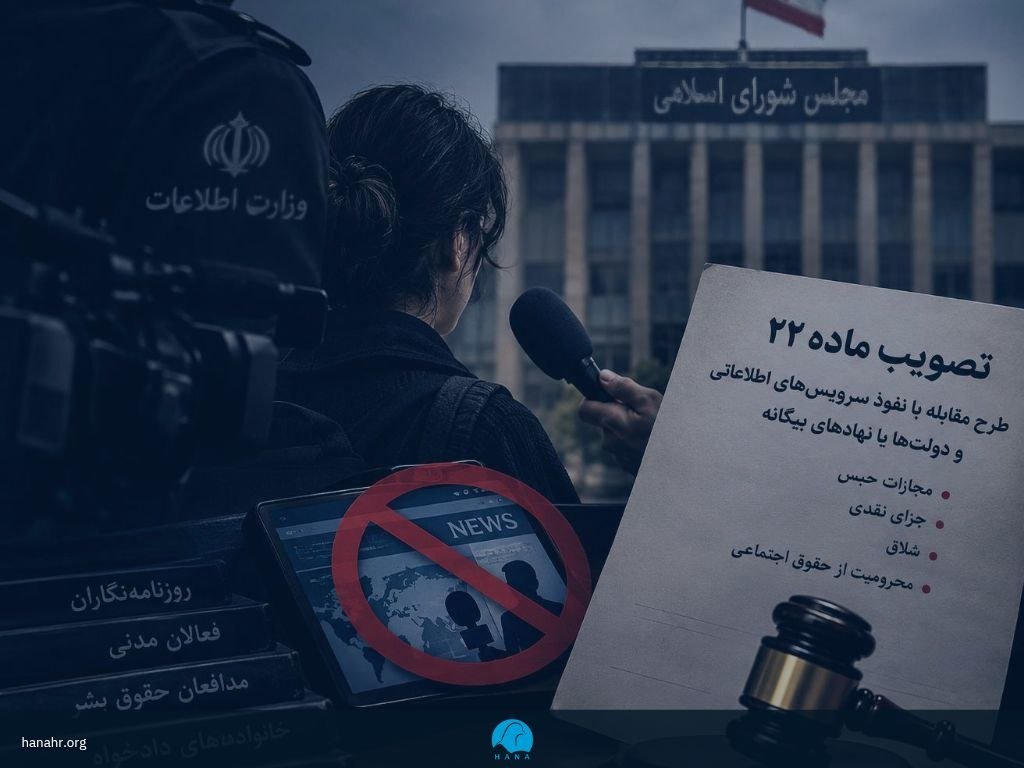
Iranian state media have announced that Parliament has passed Article 22 of the bill known as “Countering the Infiltration of Foreign Intelligence Services and Governments or Institutions,” a measure under which Iranian nationals will be barred, on pain of punishment, from giving interviews to or taking part in conversations with media outlets or “human media,” individuals acting as media conduits in their own right, that the Ministry of Intelligence designates and publicly declares “hostile.”
Under this measure, the ban also extends to media outlets owned or run by individuals connected to certain foreign governments, or financed by them. Violating this article can bring one or more Category Six penalties under Article 19 of the Islamic Penal Code, including imprisonment ranging from more than six months to two years, fines, flogging, and the loss of social rights. Islamic Republic officials, meanwhile, have been explicitly exempted from this ban.
Parliament has, at the same time, passed provisions under which passing on unpublished official information, reports, data, or statistics to individuals labeled “foreign agents” under this bill can carry a Category Four prison sentence and permanent removal from the relevant profession. These provisions mark a considerable expansion in the scope of criminal liability for media contact and the sharing of information.
The central danger of this measure lies in the fact that simply speaking with a media outlet can become grounds for prosecuting a citizen, without the person necessarily having committed any other independent criminal act. Leaving the designation of “hostile” media to the Ministry of Intelligence, moreover, hands sweeping discretion to a security agency, one that can place journalists, civil activists, human rights defenders, families seeking justice, experts, and news sources all at risk of detention and prosecution.
Provisions of this kind can fuel wider self censorship, sever contact between sources inside Iran and media outlets abroad, and restrict the flow of information about detentions, protests, and human rights violations. The use of broad, open to interpretation concepts such as “hostile,” “human media,” and “foreign agent” deepens the concern that this law will become a fresh tool for securitizing the flow of information and pressuring the very citizens who bring independent information to public attention.