1. Summary of Findings
HANA’s research indicates that pressure on religious or belief minorities in Iran has intensified since the twelve-day war of June 2025 and the subsequent renewed hostilities involving Iran, the United States and Israel that began on 28 February 2026. Wartime conditions and the expanded authority of security bodies have created an environment in which religious identity, family contact with persons abroad, access to faith-based media, and even the possession of religious books or symbols may be treated as grounds for security suspicion.
During this period, Baha’is have again been accused of links to Israel; Christian converts have been prosecuted under labels such as “Zionist Christianity”; Jewish citizens have been summoned and questioned because of contact with relatives in Israel; and a number of Sunni clerics and citizens have faced security and judicial restrictions. The common feature of these measures is the replacement of individual criminal responsibility with collective suspicion based on religion or denomination.
The adoption of broadly framed provisions on espionage and cooperation with hostile states has further aggravated this situation. These provisions do not clearly distinguish criminal conduct from ordinary activities such as family communication, media activity or the transmission of images, while certain forms of conduct may attract extremely severe penalties, including capital punishment and confiscation of property. Their application by the Revolutionary Courts, together with restricted access to legal counsel and the absence of independent oversight, exposes religious minorities to a heightened risk of arbitrary security-related prosecution.
Internet shutdowns and disruptions, the authorities’ refusal to release information about individual cases, and families’ fear of the consequences of reporting have made comprehensive statistics unavailable. The figures in this report therefore reflect only the cases that HANA was able to review and document by the date of the report.
2. Situation of the Baha’i Community
Baha’is continue to experience the most extensive form of structural exclusion among Iran’s religious minorities. The Baha’i faith is not recognized under the Constitution, and its adherents face continuing restrictions in higher education, public employment, access to certain professions, property ownership, economic activity and the burial of their dead. In the period following the war, these longstanding forms of exclusion have been coupled with renewed security allegations.
HANA’s findings indicate that, following the 2025 war, more than 200 Baha’i citizens were subjected to arrest, summonses, searches of their homes, closure of businesses or seizure of personal property. In addition to religious books and objects, the items seized during searches included cash, gold, title deeds, passports and work equipment. By the end of July 2026, at least 57 Baha’is remained in detention or prison.
In a number of cases, detainees were held incommunicado for prolonged periods and denied access to counsel of their own choosing and visits with their families. HANA also documented reports of beatings, electric shocks, mock executions, threats against family members and pressure to endorse pre-written confessions. In some cases, those confessions were subsequently broadcast by state media.
The presence of the Baha’i World Centre in Haifa, or the residence of a Baha’i citizen’s relatives outside Iran, does not in itself establish any connection with the State of Israel. The collective attribution of a religious community to a foreign government is incompatible with the principle of individual criminal responsibility. A security allegation can provide a lawful basis for prosecution only where it rests on identifiable conduct, the requisite criminal intent and evidence capable of examination before an independent court.
3. Situation of Christians and Churches
On 12 July 2026, security agents removed the remaining residents from the St Peter Evangelical Church compound in Tehran and prevented their return. Founded in 1876, the church is one of Iran’s oldest Protestant churches. Before this operation, approximately 20 Armenian and Assyrian families had reportedly been pressured to vacate their homes, while offices belonging to the church had been placed at the disposal of security agents.
An order transferring the church compound to the Execution of Imam Khomeini’s Order was issued in 1998, but church officials learned of its existence only years later. The government’s refusal to renew the legal registration of the church entity further deprived them of an effective opportunity to challenge the order. In June 2026, a historic evangelical church in Mashhad was also demolished without prior notice. These measures form part of a continuing pattern in which numerous Protestant churches have been closed, confiscated or prohibited from holding services in Persian.
Restrictions on Christians extend beyond church property. In 2025, at least 254 Christians were arrested because of their faith or religious activity, compared with 139 documented in the preceding year. The aggregate prison terms imposed during 2025 reached approximately 280 years, and at least 11 people received sentences of ten years or more. By July 2026, at least 79 Christians, most of them converts, were in detention or prison.
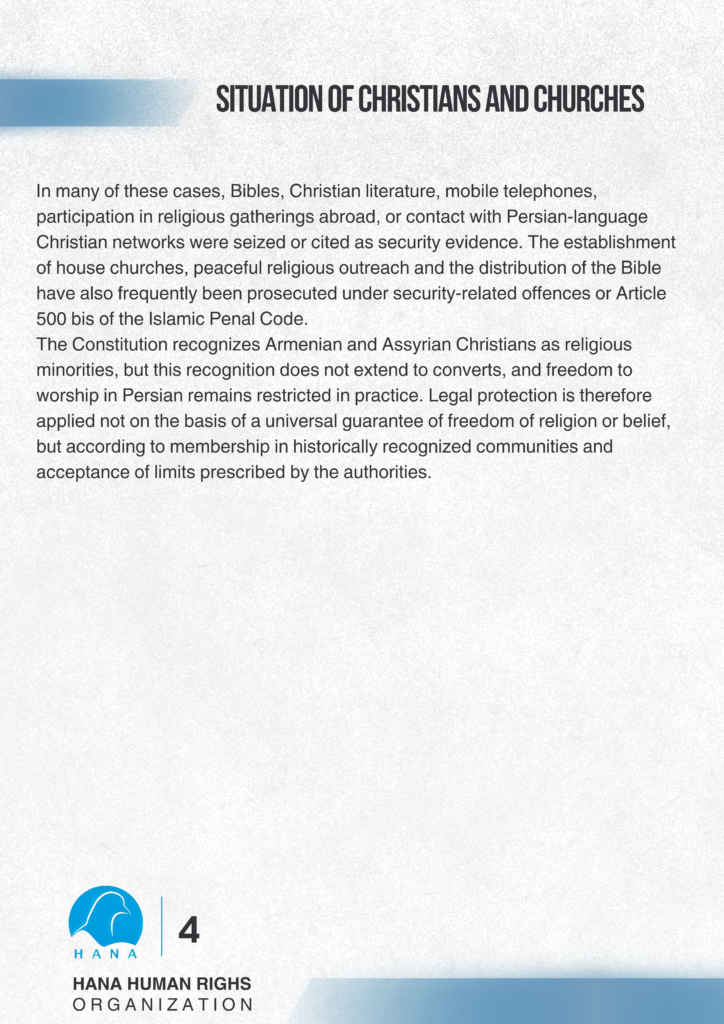
Following the 2025 war, the Ministry of Intelligence announced the arrest of 53 persons described as “trained elements”. In many of these cases, Bibles, Christian literature, mobile telephones, participation in religious gatherings abroad, or contact with Persian-language Christian networks were seized or cited as security evidence. The establishment of house churches, peaceful religious outreach and the distribution of the Bible have also frequently been prosecuted under security-related offences or Article 500 bis of the Islamic Penal Code.
The Constitution recognizes Armenian and Assyrian Christians as religious minorities, but this recognition does not extend to converts, and freedom to worship in Persian remains restricted in practice. Legal protection is therefore applied not on the basis of a universal guarantee of freedom of religion or belief, but according to membership in historically recognized communities and acceptance of limits prescribed by the authorities.
4. Situation of the Jewish Community
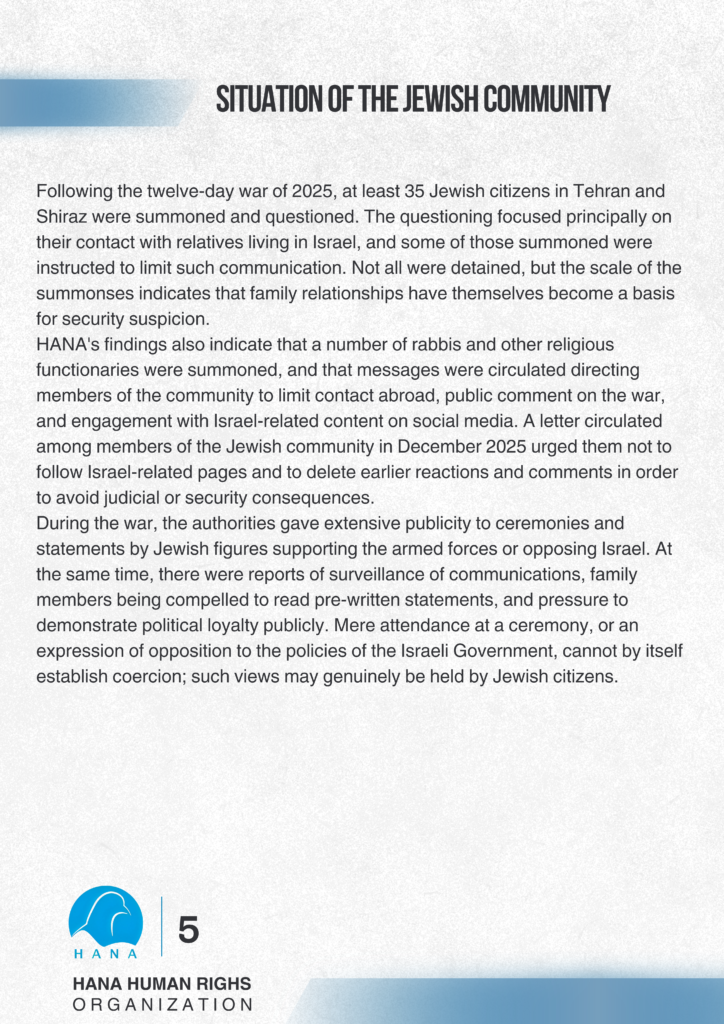
Following the twelve-day war of 2025, at least 35 Jewish citizens in Tehran and Shiraz were summoned and questioned. The questioning focused principally on their contact with relatives living in Israel, and some of those summoned were instructed to limit such communication. Not all were detained, but the scale of the summonses indicates that family relationships have themselves become a basis for security suspicion.
HANA’s findings also indicate that a number of rabbis and other religious functionaries were summoned, and that messages were circulated directing members of the community to limit contact abroad, public comment on the war, and engagement with Israel-related content on social media. A letter circulated among members of the Jewish community in December 2025 urged them not to follow Israel-related pages and to delete earlier reactions and comments in order to avoid judicial or security consequences.
During the war, the authorities gave extensive publicity to ceremonies and statements by Jewish figures supporting the armed forces or opposing Israel. At the same time, there were reports of surveillance of communications, family members being compelled to read pre-written statements, and pressure to demonstrate political loyalty publicly. Mere attendance at a ceremony, or an expression of opposition to the policies of the Israeli Government, cannot by itself establish coercion; such views may genuinely be held by Jewish citizens. A human rights concern arises where a political position is accompanied or secured by summonses, threats, restrictions on communication or other forms of compulsion.
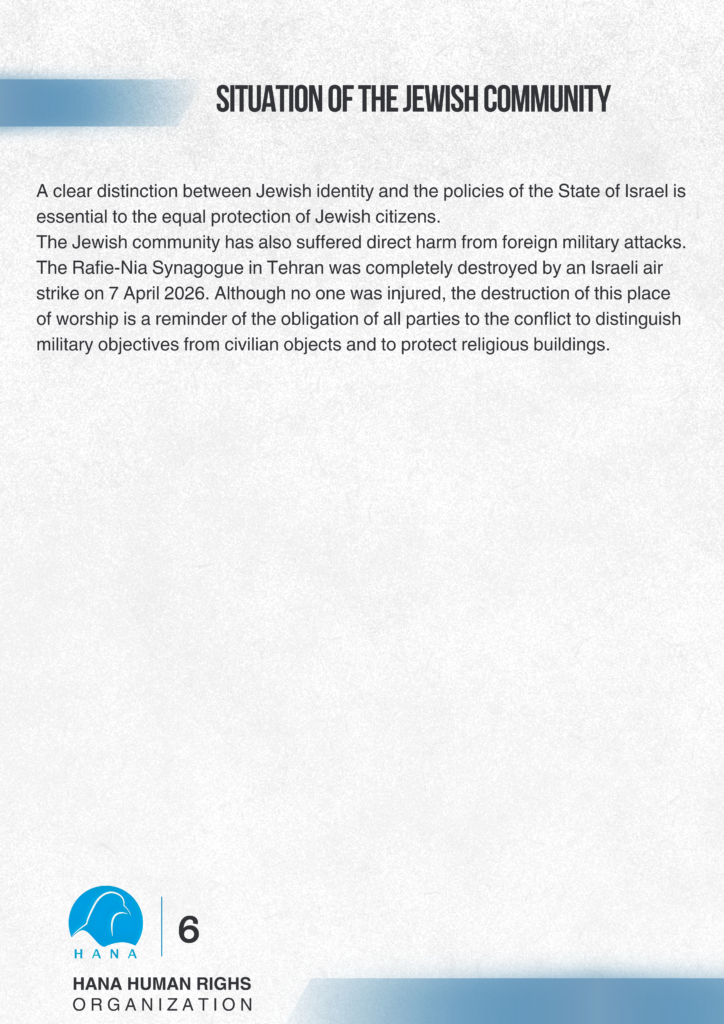
Judaism is recognized under the Iranian Constitution, yet this recognition has not prevented members of the Jewish community from being subjected to collective suspicion because of their religion or family relationships. A clear distinction between Jewish identity and the policies of the State of Israel is essential to the equal protection of Jewish citizens.
The Jewish community has also suffered direct harm from foreign military attacks. The Rafie-Nia Synagogue in Tehran was completely destroyed by an Israeli air strike on 7 April 2026. Although no one was injured, the destruction of this place of worship is a reminder of the obligation of all parties to the conflict to distinguish military objectives from civilian objects and to protect religious buildings.
5. Sunni Muslims and Other Religious or Belief Communities
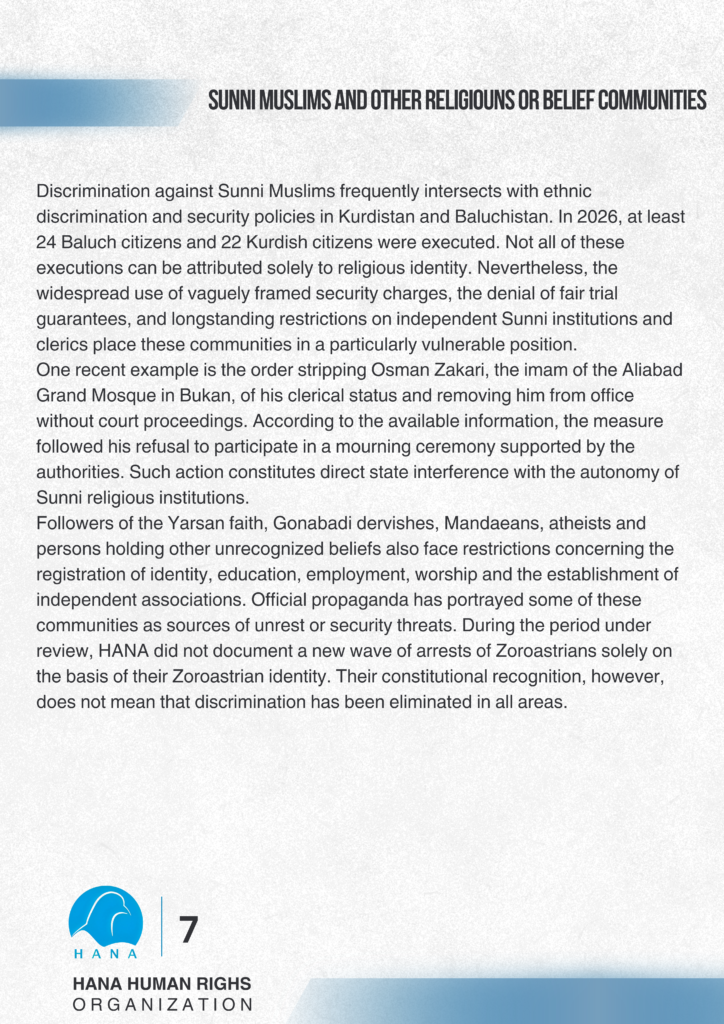
Discrimination against Sunni Muslims frequently intersects with ethnic discrimination and security policies in Kurdistan and Baluchistan. In 2026, at least 24 Baluch citizens and 22 Kurdish citizens were executed. Not all of these executions can be attributed solely to religious identity. Nevertheless, the widespread use of vaguely framed security charges, the denial of fair trial guarantees, and longstanding restrictions on independent Sunni institutions and clerics place these communities in a particularly vulnerable position.
One recent example is the order stripping Osman Zakari, the imam of the Aliabad Grand Mosque in Bukan, of his clerical status and removing him from office without court proceedings. According to the available information, the measure followed his refusal to participate in a mourning ceremony supported by the authorities. Such action constitutes direct state interference with the autonomy of Sunni religious institutions.
Followers of the Yarsan faith, Gonabadi dervishes, Mandaeans, atheists and persons holding other unrecognized beliefs also face restrictions concerning the registration of identity, education, employment, worship and the establishment of independent associations. Official propaganda has portrayed some of these communities as sources of unrest or security threats. During the period under review, HANA did not document a new wave of arrests of Zoroastrians solely on the basis of their Zoroastrian identity. Their constitutional recognition, however, does not mean that discrimination has been eliminated in all areas.
6. Legal Assessment
Iran’s principal obligation in this area arises under Article 18 of the International Covenant on Civil and Political Rights, which guarantees freedom of thought, conscience and religion. This right includes the freedom to have or adopt a religion and to manifest it, individually or in community with others, in public or in private. Under Article 4(2) of the Covenant, the protection afforded by Article 18 is non-derogable, including during a public emergency or armed conflict. The Human Rights Committee’s General Comment No. 22 further confirms that the freedom to have, adopt, leave or change a religion or belief is absolute and that no person may be subjected to coercion in this respect. Restrictions on the manifestation of religion are permissible only where they are prescribed by law and are necessary and proportionate to protect public safety, order, health or morals, or the fundamental rights and freedoms of others. National security is not among the listed grounds. A generalized invocation of national security therefore cannot justify the criminalization of worship, religious teaching, possession of religious texts or peaceful communication with members of the same faith.
Articles 26 and 27 of the Covenant guarantee equality before and equal protection of the law, prohibit religious discrimination, and protect the right of members of minorities to profess and practise their own religion. These protections are not confined to religions recognized by a state’s constitution. They extend to Baha’is, Christian converts, Yarsan adherents and persons holding other beliefs that lack official recognition. The 1981 United Nations Declaration on the Elimination of All Forms of Intolerance and of Discrimination Based on Religion or Belief and the 1992 Declaration on the Rights of Persons Belonging to National or Ethnic, Religious and Linguistic Minorities, although not treaties, provide recognized standards for interpreting these obligations. Under these instruments, the state must allow persons to worship, establish and maintain places of worship, teach and publish religious materials, observe ceremonies, and communicate with other members of their religious community without discrimination. The confiscation of churches, prevention of worship in Persian, seizure of religious books, or punishment of peaceful contact with religious communities abroad is incompatible with these standards.
The exclusion of Baha’is from higher education and employment, in addition to interfering with freedom of religion or belief, conflicts with the prohibition of discrimination in Article 2 of the International Covenant on Economic, Social and Cultural Rights and with the rights to work and education under Articles 6 and 13 of that Covenant. Articles 14 and 30 of the Convention on the Rights of the Child likewise recognize the child’s freedom of religion and the right of children belonging to minorities to profess and practise their religion. The arrest of parents, threats to separate a child from the family, or denial of education because of the beliefs of the child’s parents interfere not only with the rights of adults but also with the child’s independent rights.
Arbitrary detention, coerced confessions, torture, denial of access to legal counsel, unlawful interference with privacy, and arbitrary seizure of property may, according to the circumstances, violate Articles 7, 9, 14 and 17 of the International Covenant on Civil and Political Rights. Under domestic law, Article 13 of the Iranian Constitution recognizes certain rights of Zoroastrians, Jews and Christians in relation to religious ceremonies and personal status, while Article 23 prohibits the investigation of beliefs and any interference with or censure of a person solely because of belief. The Constitution’s limited recognition of three minorities does not displace Iran’s international obligation to protect other religions and beliefs on an equal basis. Treating religious identity as a security matter is incompatible even with the Constitution’s limited guarantees.
Where detention, torture, confiscation and severe deprivations of fundamental rights directed against a religious community form part of a widespread or systematic attack against a civilian population, and the perpetrators act with knowledge of that attack, the conduct may warrant examination as the crime against humanity of persecution. Establishing that classification requires an independent investigation into the scale and pattern of the conduct, the existence of a state policy, and the connection between each case and that policy.
7. Conclusion
HANA is deeply concerned by the use of religious identity as a basis for security suspicion and by the expansion of arrests, confiscations and other pressure against religious minorities under wartime conditions. HANA calls for an end to the prosecution of persons because of their beliefs or peaceful worship, the release of those detained solely on such grounds, and equal protection for the places of worship of all faiths.
HANA
16 August 2026