
Executive Summary
This report offers a condensed, documented picture of the human rights situation in Iranian Kurdistan between January 1 and June 30, 2026. Its figures rest on cases HANA Human Rights Organization has been able to confirm through solid evidence, local sources, victims’ families, witnesses, civil activists, and field reports.
What follows, then, represents a floor rather than a ceiling: the minimum number of verified incidents. As HANA’s research team continues its work, gains access to new documentation, or completes identity verification on additional cases, these figures may be revised upward in future reports.
The period under review coincided with extraordinary circumstances in Iran. Military hostilities involving Iran, Israel, and the United States, a hardening security climate, sweeping communications restrictions, and internet blackouts and disruptions all constrained the flow of information, families’ access to updates, victims’ contact with lawyers, public oversight, and independent documentation.
UN bodies issued repeated warnings throughout 2026 about the internet shutdowns, the use of security conditions to restrict civil society, and the need for Iran to uphold its international human rights obligations.
Over this period, HANA documented the execution of at least 45 Kurdish citizens, the arrest of at least 540 Kurdish citizens, kolbars killed and wounded, citizens killed by landmines left over from past wars, workers who died in unsafe conditions, recorded cases of suicide, and the confirmed identities of 277 victims of the January 2026 protests. Taken together, these findings point to a sustained situation in which the civil, political, economic, and social rights of Kurdish citizens in Iran have come under pressure on every front at once.
1. Methodology and Scope of the Report
This report examines the human rights situation across Iranian Kurdistan, spanning Kurdistan, West Azerbaijan, Kermanshah, and illam provinces, during the first half of 2026. Information was gathered through a network of local sources, victims’ families, witnesses, civil activists, existing documentation, field reports, and other reliable channels, and was verified against HANA’s documentation standards to the greatest extent possible before publication.
Every figure in this report reflects only those cases in which HANA was able to confirm, through solid evidence and an independent verification process, either the underlying human rights violation or the identity of the victim. None of these numbers should be read as final or complete tallies of the violations that occurred during the period covered.
Security pressure, threats against families and witnesses, victims’ fears about the consequences of speaking out, internet shutdowns and disruptions, and restricted access to independent sources all weighed on the documentation process.
In compiling this report, HANA drew a clear line between confirmed data and unverified claims, including in its final figures only those cases that met the organization’s own verification standards. The aim here is to document observable trends and patterns, not to substitute for independent, impartial judicial investigation. That said, the information gathered can serve as a foundation for further human rights, media, research, and international follow-up.
2. Overall Assessment of the Human Rights Situation
For Iran as a whole, and for Iranian Kurdistan in particular, the first half of 2026 brought a dense convergence of security, social, and human rights crises. Executions, security-related arrests, the use of firearms in border regions, landmine casualties, worker deaths, and a rise in social harms cannot be understood in isolation from this broader national context. War, restricted communications, and tightening security control did more than raise the risk of human rights violations; they also made these violations harder to record, verify, and pursue.
International human rights law gives no state license to set aside the core of fundamental rights on the grounds of crisis. The right to life, the prohibition of torture and inhuman treatment, the ban on arbitrary detention, the right to a fair trial, special protection for children, and the obligation to investigate suspicious deaths or deaths caused by state agents all retain their fundamental standing even in emergencies. Any restriction on freedom of expression, access to information, assembly, or communication must be lawful, necessary, proportionate, and limited to a legitimate aim.
The internet shutdowns and disruptions during this period were more than a communications inconvenience. They struck at the right to access information, at families’ ability to stay in contact with detained relatives, at victims’ contact with lawyers, at journalists’ ability to work, and at human rights organizations’ capacity to document what was happening. Reports from the Office of the UN High Commissioner for Human Rights and the Independent International Fact-Finding Mission on Iran in 2026 have made the same point: internet shutdowns heighten the risk of hidden violations, leave families in the dark, and deepen impunity.
3. The Right to Life and the Death Penalty
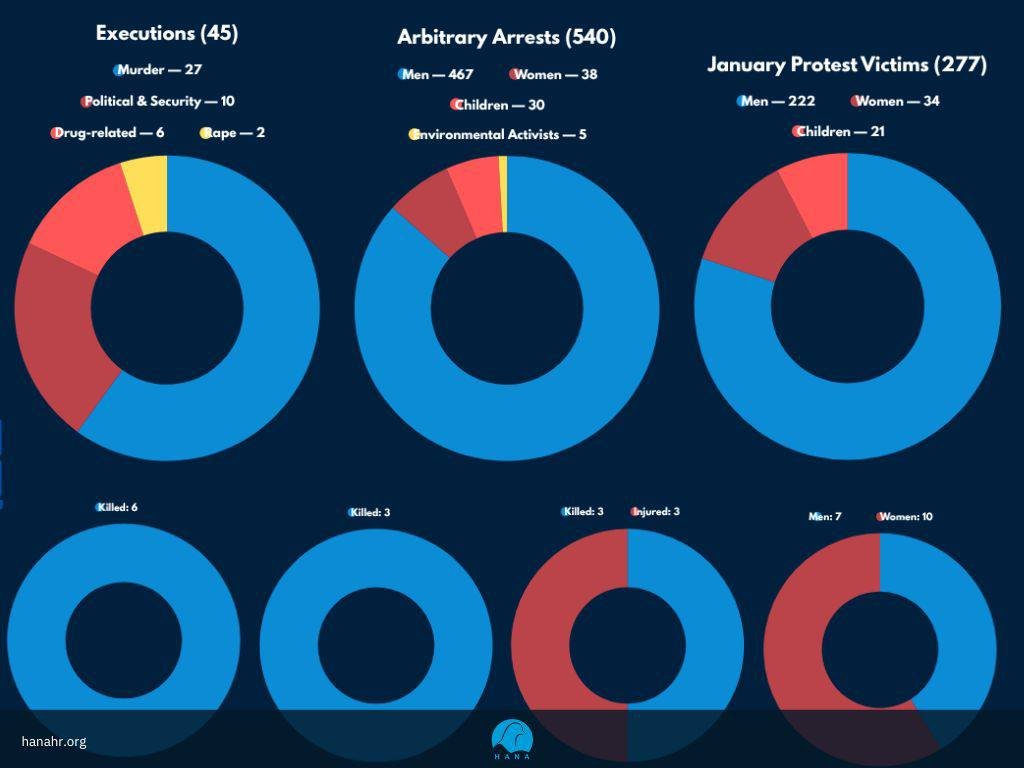
The right to life underpins the enjoyment of every other human right. Yet HANA’s data show that executions in Iran, including of Kurdish citizens, continued at a troubling pace through the first half of 2026. HANA documented the execution of at least 45 Kurdish citizens in Iranian prisons during this period: 27 on charges of premeditated murder, 6 in drug-related cases, 2 on rape charges, and 10 in political and security cases, including charges such as “moharebeh.”
The concern here goes well beyond the raw number of executions. In political and security cases, numerous reports point to restricted access to a lawyer of one’s choosing, detention under security conditions, pressure to confess, denial of regular family contact, and a lack of transparency in judicial proceedings. Under international law, carrying out an execution following a trial that failed to meet basic guarantees of justice can amount to an arbitrary deprivation of the right to life.
Iran is a party to the International Covenant on Civil and Political Rights and is bound under Article 6 to protect the right to life. The UN Human Rights Committee, in General Comment No. 36, has made clear that in states that have not yet abolished the death penalty, it may be carried out only in the most limited circumstances and only after full compliance with fair trial guarantees. Article 14 of the Covenant, for its part, guarantees the right to a fair trial, access to counsel, an independent tribunal, and a genuine opportunity to mount a defense.
Wartime and heightened security conditions compound these concerns around death penalty cases. In such periods, the risks multiply: rushed trials, weakened public scrutiny, tighter restrictions on access to counsel, and executions carried out with deterrent or security aims in mind. Every execution in a political or security case therefore demands particular scrutiny, measured against the most exacting standards of international law.
4. Arbitrary Detention and Fair Trial
HANA documented the arrest of at least 540 Kurdish citizens across the cities of Kurdistan during the first half of 2026. Among them were 38 women, 30 children under the age of 18, and 5 environmental activists. At least 6 of those detained during this period have since been sentenced to death.
Much of this fits a pattern long familiar from Iran’s security cases: arrests without a judicial warrant, families left in the dark about where their relatives are being held, restricted access to a lawyer in the early stages, transfer to security detention facilities, and no clear information about the charges involved. Taken together, these practices can turn what should be a lawful arrest into an arbitrary act that violates the right to liberty and personal security.
Article 9 of the International Covenant on Civil and Political Rights prohibits arbitrary detention and requires the state to inform every detainee of the reasons for their arrest and the charges against them, and to provide a genuine opportunity to challenge the lawfulness of that detention. The Human Rights Committee, in General Comment No. 35, has clarified that arbitrariness is not simply a matter of illegality; detention that is disproportionate, unnecessary, unpredictable, or lacking in basic safeguards can also be arbitrary.
The presence of 30 children among those detained adds a graver dimension to this picture. The Convention on the Rights of the Child requires that detaining anyone under 18 be a measure of last resort, kept as brief as possible, and accompanied by special safeguards. Holding children in security cases without prompt access to family and legal counsel can inflict lasting psychological and social harm and runs against the principle of the child’s best interests.
That environmental activists were also detained shows the security pressure of this period was not confined to political activity alone. Once civic, social, and environmental work is drawn into the same security dragnet, the space for ordinary civic participation narrows, and freedom of expression, association, and civic engagement are weakened in practice.
5. The Right to Life and Human Security in Border Regions and the Workplace
Some of the violations documented in this report bear directly on the right to life and human security in the ordinary course of people’s daily lives. Kolbars killed and wounded, citizens killed by landmines left over from earlier wars, and workers who died in unsafe conditions all show that the right to life is not endangered only in courtrooms and prisons, but along borders, in villages, at worksites, and on the paths people take simply to earn a living.
HANA documented the deaths of at least 3 kolbars and the wounding of 3 more during the first half of 2026, most of them, according to verified data, the result of direct gunfire from border forces. Whatever the legal status of the goods being carried, lethal force against kolbars can only be justified where there is an immediate, serious threat to the life of officers or others, and no less harmful option is available. The UN Basic Principles on the Use of Force and Firearms by Law Enforcement Officials insist on necessity, proportionality, and the use of lethal force strictly as a last resort.
Kolbari cannot simply be treated as a policing matter. Poverty, unemployment, the lack of stable job opportunities, and the underdevelopment of border regions have pushed many citizens into this dangerous line of work. Responding with security measures to a problem rooted in economic and social conditions, without addressing those underlying structures, does nothing to reduce the risk that more people will be killed or wounded.
HANA also recorded the deaths of 3 citizens from landmine explosions during this same period. Decades after the end of the Iran-Iraq War, the persistence of landmine danger in Kurdistan’s border areas points to inadequate clearance efforts, marking, public warning, and victim support. The state carries a positive obligation in the face of known, foreseeable dangers like these: it must act effectively to protect citizens’ lives and cannot simply allow threats inherited from the past to keep claiming victims.
The deaths of at least 6 workers in incidents tied to unsafe working conditions likewise point to weak oversight and lax enforcement of safety standards. Article 7 of the International Covenant on Economic, Social and Cultural Rights guarantees the right to just, safe, and healthy working conditions. Where workers die in unsafe environments because of missing equipment, inadequate training, or a lack of effective oversight, this is not merely an individual accident; it reflects a structural failure to protect workers’ right to work, their right to health, and their basic human dignity.
6. Suicide and the Right to Mental Health
HANA recorded at least 17 cases of suicide in Kurdistan during the first half of 2026: 10 women and 7 men. HANA’s research points to a combination of contributing factors, among them financial hardship, family conflict, psychological pressure, and other social harms.
Suicide cannot be understood purely as a matter of individual choice. In many cases it is bound up with poverty, social pressure, domestic violence, a lack of psychological support, limited access to healthcare, and the absence of social support networks. A rise in such cases, or their persistence, in any given region is a warning sign about the state of mental health, social security, and the level of support available to vulnerable groups there.
The right to the highest attainable standard of physical and mental health is recognized under Article 12 of the International Covenant on Economic, Social and Cultural Rights. This obligation requires the state to strengthen mental health services, preventive interventions, social support, and non-discriminatory access to healthcare. War conditions, economic uncertainty, disrupted communications, and mounting security pressure can all deepen people’s psychological vulnerability. Whether any individual case of suicide is directly linked to these factors would require separate examination, but their coincidence with a rise in social harms underscores the need for far more serious attention to mental health in Iranian Kurdistan.
7. Documenting the Victims of the January 2026 Protests
One of the most significant strands of HANA’s documentation work this period has been the ongoing effort to identify victims of the January 2026 protests. HANA has now confirmed the identities of 277 Kurdish citizens killed by direct gunfire from Islamic Republic forces during the protests, most of them in illam and Kermanshah provinces, with some cases elsewhere in Iran. Among the identified victims are 34 women and 21 children under the age of 18.
This figure includes only cases in which HANA was able to confirm both the victim’s identity and the circumstances of their death through solid evidence and an independent verification process. Families’ fear of security repercussions, restricted access to documentation, the security climate surrounding the sites where these events occurred, and widespread communications disruptions have all made the documentation process more difficult. As investigations continue, the number of confirmed cases is likely to grow.
Under international standards, firearms may be used against protesters only where no other effective option exists to counter an imminent threat to life. Even then, any use of force must be necessary, proportionate, and exercised with the utmost caution. Article 21 of the International Covenant on Civil and Political Rights guarantees the freedom of peaceful assembly, and the Human Rights Committee, in General Comment No. 37, has stressed that taking part in an assembly, even one marked by tension or disorder, does not in itself authorize the use of lethal force.
The state’s responsibility does not end once a death caused by its agents has occurred. International law requires it to carry out an effective, independent, impartial, and transparent investigation into any suspicious death or any death resulting from the use of force by officials, to prosecute those responsible, and to guarantee families’ right to truth, justice, and reparation. The Minnesota Protocol on the Investigation of Potentially Unlawful Death sets out these same standards.
Documenting these 277 victims is not simply a matter of recording names and numbers. It is part of a broader effort to preserve evidence, guard against forgetting, uphold families’ right to know the truth, and lay the groundwork for future accountability. At a time when internet restrictions and security pressure can conceal or destroy evidence, independent documentation plays an essential role in keeping the possibility of justice alive.
8. Conclusion
HANA’s six-month findings show a human rights landscape in Kurdistan during 2026 marked by a cluster of violations occurring simultaneously and feeding into one another. Executions, arbitrary detentions, shootings of kolbars, landmine casualties, worker deaths, suicides, and protest victims each represent a distinct area of concern, but together they tell the story of a broader, persistent pattern: one in which criminal, security, economic, and administrative tools have all borne down on citizens’ lives and fundamental rights at the same time.
None of this happened in a vacuum. War, an intensifying security climate, communications restrictions, and shrinking free access to information all raised the risk of human rights violations while simultaneously making it harder to document them, pursue them through the courts, or subject them to public scrutiny. Yet none of these circumstances relieves the state of its fundamental obligations: to protect the right to life, to refrain from arbitrary detention, to guarantee fair trials, to protect children, to safeguard workers, and to carry out effective investigations into deaths.
HANA stresses that the figures in this report represent only the minimum number of cases confirmed through solid evidence and independent verification, and that these numbers may well grow as investigations continue and new evidence comes to light. This report, then, stands both as a record of the current situation and as a call to keep watching, keep documenting, and keep pressing for accountability.