
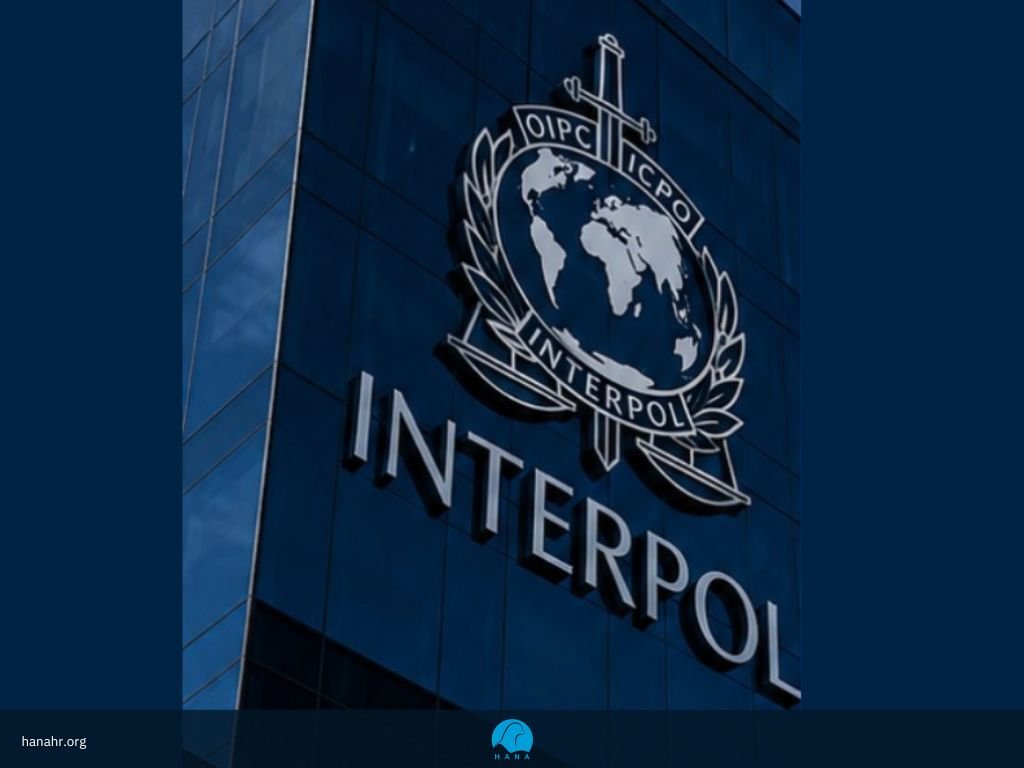
In recent days, media outlets affiliated with the judiciary of the Islamic Republic of Iran, including Mizan News Agency and Fars News Agency, have reported the issuance of Interpol Red Notices, international arrest warrants, and extradition requests against a number of leaders and members of Iranian Kurdish parties.
According to official statements, these measures followed the opening of criminal cases against these individuals and were pursued through Interpol, targeting the government of Iraq and several European countries.
Given the wide coverage these claims have received, it is necessary to examine their legal weight and validity under Interpol’s own regulations, the rules of international extradition law, and international human rights standards.
First, a distinction must be drawn between a request for a Red Notice, the actual publication of a Red Notice, provisional arrest, and extradition. These stages are legally independent of one another, and each requires its own procedures and conditions to be met. A judicial official’s mere announcement that a request has been sent to Interpol, or a claim that a Red Notice has been issued, therefore carries no legal effect whatsoever within the international criminal cooperation system on its own.
Under Interpol’s regulations, a Red Notice is not an international arrest warrant. It is simply a mechanism for requesting police cooperation among member states, aimed at locating and provisionally detaining a person pending review of a possible extradition request. Its enforcement is not mandatory for member states, and the decision on detention or extradition always remains within the jurisdiction of the competent authorities of the requested state, governed by that state’s domestic law and international obligations.
The legitimacy of any request within Interpol’s framework also depends entirely on its full compliance with the organization’s constitution. Under Article 3 of that constitution, Interpol is prohibited from any intervention or activity in cases of a political, military, religious, or racial character. Furthermore, Interpol’s Commission for the Control of Files (CCF) has the authority to review the legitimacy of requests and their compliance with the constitution and the rules protecting fundamental rights, and to block the publication or continuation of a notice found to be inconsistent with them.
The mere submission of a request by a state therefore neither means it has been accepted by Interpol nor implies that it complies with the organization’s rules.
Interpol’s own practice confirms this understanding. The organization has, on numerous occasions, declined to accept requests it deemed to be political in nature. Among these, Interpol did not accept the Islamic Republic’s request for a Red Notice against certain United States officials in connection with the Qasem Soleimani case. This practice demonstrates that the decisions or claims of a single member state are not, on their own, sufficient grounds for Interpol action, and that the organization is obligated to assess every request against its fundamental principles before taking any action.
Even where a Red Notice is published, this creates no obligation to extradite. Extradition is an independent judicial process that must be examined by the courts of the requested state. Before reaching any decision, these courts are required to assess the risk of torture, the death penalty, enforced disappearance, violations of the right to a fair trial, and other fundamental rights violations, in light of their international obligations, including the principle of non-refoulement, the Convention Against Torture, and other binding human rights instruments.
Furthermore, a distinction must be drawn between a state’s political characterization of an entity and the actual legal status of individuals or groups within the international system.
A review of the official lists maintained by the UN Security Council and the European Union shows that the main Iranian Kurdish parties, including the Democratic Party of Iranian Kurdistan, Komala, the Kurdistan Freedom Party (PAK), and other Kurdish parties, do not appear on the UN or EU lists of terrorist organizations. The Islamic Republic’s characterization of these groups as “terrorist organizations” therefore carries no binding legal effect for other states on its own and cannot substitute for recognized standards of international law.
By contrast, the Islamic Revolutionary Guard Corps has been designated a foreign terrorist organization by the United States, and the European Parliament has, through multiple resolutions, called for its inclusion on the EU’s list of terrorist organizations, although the Council of the European Union has not yet taken a decision on the matter.
Moreover, the acceptance of a request by Interpol, even where this occurs, does not amount to a substantive endorsement of the charges or an international recognition of the criminal characterization attributed to the individuals concerned. Interpol is not a judicial body responsible for adjudicating cases or determining the criminal liability of individuals or groups; its role is limited to facilitating police cooperation among member states. Invoking Interpol’s mechanisms to lend an appearance of international legitimacy to the charges in question is therefore inconsistent with the scope and function of the organization.
An examination of Interpol’s regulations, the rules of international extradition law, and states’ international human rights obligations shows that the claims made by Islamic Republic officials reflect nothing more than the political position of that government, without legal grounding, and carry no legal effect within the international criminal cooperation system on their own. Even in the event a Red Notice is published, such a measure does not constitute a substantive endorsement of the charges attributed to these individuals, nor does it create any obligation for other states to detain or extradite them.
Furthermore, the practice of democratic states and their judicial authorities shows that extradition requests from the Islamic Republic, particularly in cases involving political opponents, have been subjected to heightened scrutiny due to well-documented concerns over widespread and systematic human rights violations, the lack of judicial independence, the risk of torture, the death penalty, and violations of the right to a fair trial, and in numerous instances have failed to produce the legal outcomes the Islamic Republic had anticipated.