
HANA Human Rights Organization Monthly Report on the Human Rights Situation in Kurdistan July 2026
The Statistics Division of the Hana Organization for Human Rights publishes documentation of human rights violations recorded in Kurdistan during July 2026. The information contained in this report has been compiled and verified through field investigations, interviews with victims and their families, document review, and information obtained from informed sources. Only incidents whose factual accuracy has been confirmed by Hana have been included in this report.
The recorded data for this month encompasses arbitrary detention, execution of capital punishment, shooting of kolbars, deaths resulting from landmine explosions, fatal workplace incidents, suicide, and femicide. Some of these cases result from direct action by state institutions, while others stem from governmental negligence in addressing known hazards and protecting citizens.
Arbitrary Detention and Deprivation of Liberty
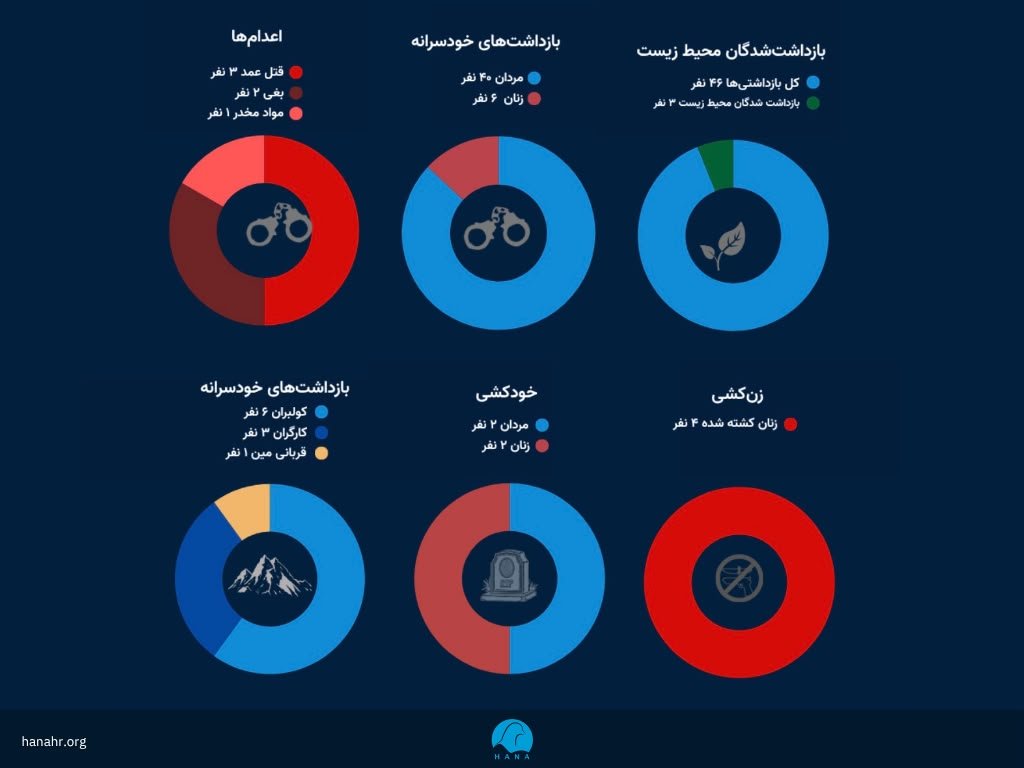
During July 2026, security forces of the Islamic Republic detained at least 46 Kurdish citizens across various cities and villages in Kurdistan. Among those detained, six were women and three were environmental activists.
The majority of these detentions occurred without summonses or judicial warrants. Cooperation with Kurdish opposition parties, civil and professional activities, media work, and posting of content on social media platforms were among the stated reasons for the detention of these citizens.
Detention without judicial warrant, without clear statement of charges, and without immediate access to legal counsel constitutes arbitrary detention and violates the right to liberty and personal security. By transferring citizens to detention facilities beyond public oversight, the Islamic Republic’s security apparatus denies individuals the right to challenge the legality of their detention and access to fair trial proceedings.
From the beginning of 2026 through the end of July, Hana has documented and verified the identities and information of 611 detained individuals. Compiled data indicates that the number of detentions during this period has exceeded 800, though information on all cases remains pending final verification.
Execution and Deprivation of the Right to Life
During July 2026, at least six Kurdish citizens were executed in various prisons. Two were executed on charges of “moharebeh” (enmity against God), one in connection with narcotics offenses, and three on charges of premeditated murder.
From the beginning of 2026 through the end of July, at least 52 Kurdish citizens have been recorded as executed in prisons of the Islamic Republic.
Capital punishment constitutes the intentional and irreversible deprivation of the right to life by the state. Through the continued execution of this penalty, the Islamic Republic has institutionalized the taking of life as a permanent instrument of its criminal and security policy.
The imposition of capital punishment in narcotics cases is incompatible with the limiting criterion of “most serious crimes.” The invocation of security charges such as “moharebeh” within an independent judiciary system exposes the condemned to execution based on proceedings that lack transparency and independent oversight.
The Hana Organization for Human Rights considers the execution of capital punishment a fundamental violation of the right to life and condemns its continuation.
Shooting of Kolbars and Arbitrary Deprivation of Life
During July, at least six kolbars lost their lives in the border regions of Kurdistan. Based on information verified by Hana, the majority of these individuals were killed as a result of direct gunfire from border guard forces.
The transport of goods, irrespective of their legal status, does not authorize the use of firearms or lethal force. Shooting at kolbars who posed no immediate threat to the lives of officials or others constitutes arbitrary deprivation of the right to life.
Border guard forces are obligated to restrict the use of weapons to exceptional and strictly necessary circumstances. The repeated shooting of kolbars demonstrates that armed confrontation, rather than apprehension, warning, or use of non-lethal methods, has become systematic practice in border regions.
Kolbari is a consequence of poverty, unemployment, underdevelopment, and the absence of sustainable employment opportunities in border areas. Rather than addressing the economic factors underlying this phenomenon, the government responds with lethal force against citizens forced to traverse dangerous border routes to secure their livelihoods.
The absence of independent investigations into these shootings and the immunity of officials from accountability have created conditions for the recurrence of these killings.
Lingering Consequences of War and Deaths from Landmines
During July 2026, one citizen died as a result of a landmine explosion in the mountains surrounding Sanandaj.
Mines and unexploded ordnance remaining from armed conflict continue to pose serious threats to the right to life and the security of Kurdistan’s inhabitants. The consequences of warfare extend far beyond the period of active conflict. Years later, transit, work, agriculture, animal husbandry, and the daily lives of citizens in contaminated areas remain fraught with risks of death and disability.
The continued toll of mine-related deaths results from inadequate demining efforts, incomplete marking of contaminated areas, and failure to provide effective public notification. State institutions are cognizant of contaminated areas and the hazards they present, yet measures undertaken to protect civilian lives have been disproportionate to the scale of the danger.
Deaths resulting from landmines are not merely a legacy of past warfare. These deaths result from the government’s continued failure to address a known and preventable hazard. The state is obligated to identify and clear contaminated areas, seal dangerous routes, install warning signage, and provide necessary medical and financial support to victims and their families.
The persistence of the lethal aftermath of war in Kurdistan exemplifies the systematic deprivation of citizens’ right to a safe environment and the right to effective protection of life.
Worker Deaths in Unsafe Working Conditions
During July, at least three workers died in workplace incidents.
Worker deaths resulting from the absence of protective equipment, inadequate training, and lack of effective oversight are not inevitable accidents. These deaths are preventable and constitute violations of the right to life and the right to safe and healthy working conditions.
Employers bear responsibility for providing safety equipment, training workers, and eliminating workplace hazards. State institutions are likewise obligated to ensure compliance with safety regulations through continuous inspection and to suspend operations of high-risk facilities.
The recurrence of fatal workplace incidents reflects employer indifference and serious inadequacy in governmental oversight. The failure to effectively address safety violations has left workers’ lives defenseless against employers’ economic interests and cost-reduction practices.
Suicide and Deprivation of Psychological and Social Support
During July 2026, at least four suicides were recorded in Kurdistan. Two of those deceased were women and two were men.
Hana’s investigations indicate that economic hardship, family disputes, psychological strain, and social harms played a role in these cases.
Suicide cannot be reduced to individual choice alone. Poverty, unemployment, domestic violence, social pressure, limited access to mental health services, and the absence of social support networks leave vulnerable individuals without assistance during critical moments.
The government bears responsibility for providing public mental health services, supporting individuals at risk, and establishing mechanisms for emergency intervention. Citizens’ deprivation of access to affordable and accessible psychological and psychiatric services has intensified personal and family crises and diminished the possibility of prevention.
Femicide and Gender-Based Violence
During July, at least four women were murdered by their spouses or members of their immediate family.
These killings constitute femicide and the most severe form of gender-based violence. Femicide typically represents the fatal endpoint of a prolonged process involving threats, control, physical and psychological abuse, and deprivation of a woman’s ability to safely exit an abusive relationship.
The legal structure of the Islamic Republic does not provide effective protection for women experiencing violence. The absence of emergency support mechanisms, insufficient shelters, disregard of domestic violence reports, and lack of deterrent accountability have left women defenseless against lethal violence.
The government’s responsibility extends beyond the punishment of the perpetrator after the crime. Law enforcement, judicial, and social support institutions are obligated to take prior threats and violence seriously, remove women from dangerous environments, and provide immediate access to legal protection and safe refuge.
The government’s failure to establish an effective protection system plays a direct role in the perpetuation of femicide and domestic violence.
Conclusion
During July 2026, the right to life, the right to liberty and personal security, the right to fair trial, the right to safe working conditions, and the right to access social and medical support were systematically violated in Kurdistan.
Arbitrary detention, execution of capital punishment, and shooting of kolbars result from direct actions of state institutions. Deaths from landmines, workplace incidents, suicide, and femicide are directly linked to governmental negligence in demining contaminated areas, oversight of workplace safety, provision of mental health services, and protection of women at risk of violence.
These are not isolated, disconnected incidents. The absence of independent oversight, immunity of officials from accountability, weakness of protective mechanisms, and victims’ denial of effective access to justice have created conditions enabling the continuation of these violations.
The Hana Organization for Human Rights condemns the policies and practices of the Islamic Republic in depriving citizens of the right to life, arbitrarily detaining citizens, suppressing the subsistence activities of border inhabitants, and failing to provide effective protection to vulnerable populations.
Hana Organization for Human Rights
Citation of statistics in this report is permitted with attribution to source.