
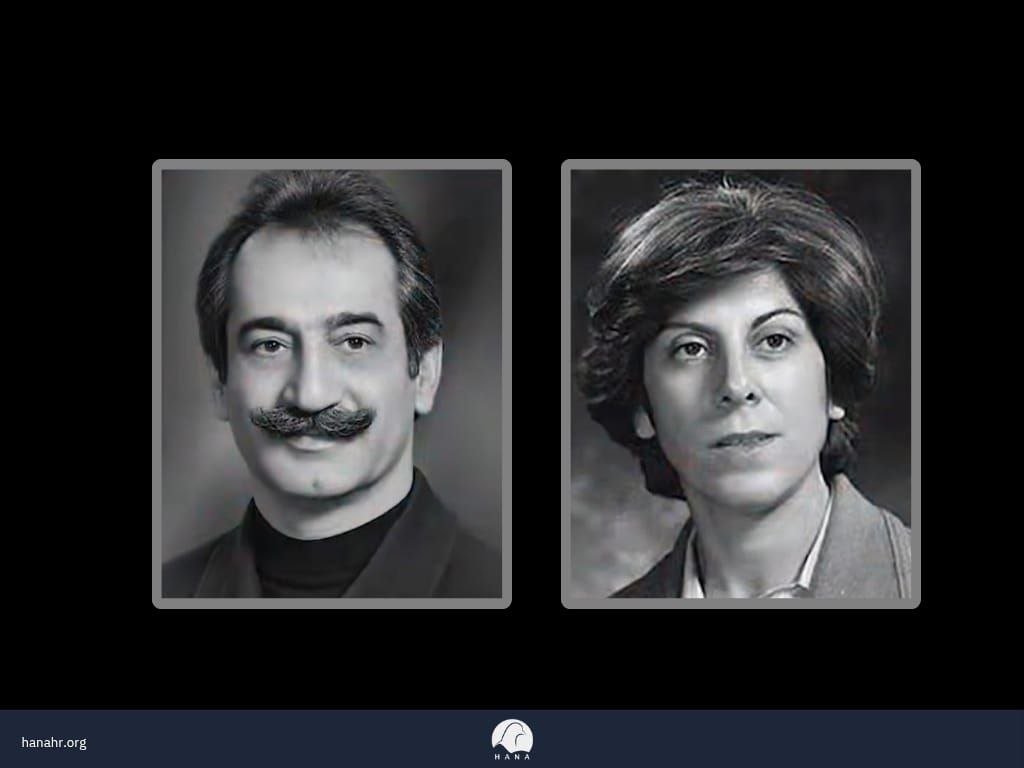
Twenty-eight years ago, on 22 November 1998, Dariush Forouhar and his wife, Parvaneh Eskandari (Forouhar), prominent opponents of the Islamic Republic and leaders of the Iran Nation Party, were brutally murdered in their Tehran home by agents of Iran’s Ministry of Intelligence. Their killings exposed a coordinated campaign of political assassinations that became known as Iran’s Chain Murders.
According to judicial records and testimonies subsequently disclosed by the victims’ families, intelligence operatives systematically planned and carried out the murders, stabbing both victims repeatedly. In one particularly disturbing account, an operative stated that overtime compensation for the assassination operation had been included in his regular government salary. Such testimony raised serious questions about the institutional organization of political killings within Iran’s security apparatus.
The assassinations were followed by the murders of writers Mohammad Mokhtari and Mohammad Jafar Pouyandeh in December 1998. Under mounting public pressure, the Ministry of Intelligence acknowledged the involvement of its personnel in January 1999, while characterizing them as rogue agents.
Although several operatives were subsequently prosecuted and convicted, proceedings took place behind closed doors and failed to establish accountability throughout the chain of command. Victims’ families and their lawyers, including Shirin Ebadi and Nasser Zarafshan, repeatedly challenged the limitations of the investigation. Zarafshan himself was later prosecuted and imprisoned.
These killings form part of a broader history of political assassinations targeting Iranian dissidents, including Kurdish opposition leaders. Among them were Dr. Abdul Rahman Ghassemlou, Secretary-General of the Democratic Party of Iranian Kurdistan, assassinated in Vienna in July 1989; Sedigh Kamangar, a prominent Komala leader and lawyer, killed in Iraqi Kurdistan in September 1989; and Dr. Sadegh Sharafkandi, assassinated alongside three others at Berlin’s Mykonos restaurant in September 1992. In its landmark 1997 judgment, a German court established the involvement of senior Iranian officials in the Mykonos assassinations.
Under international human rights law, the deliberate killing of political opponents by state agents constitutes an unlawful deprivation of life. Article 6 of the International Covenant on Civil and Political Rights, binding upon Iran, requires the protection of the right to life. States also have an obligation to conduct independent and effective investigations, establish accountability and provide victims’ families with access to truth and effective remedies.
The pursuit of justice remains ongoing. On the 28th anniversary, Parastou Forouhar, daughter of the murdered couple, reported renewed judicial threats concerning the commemoration of her parents.
HANA Human Rights Organization unequivocally condemns the extrajudicial killing of political opponents, the obstruction of accountability and the continued intimidation of victims’ families.
The passage of time cannot extinguish the right to truth, justice and effective remedy. Where political assassinations meet the legal elements of international crimes to which statutes of limitations do not apply, criminal accountability must remain possible.
Iran’s Chain Murders remain an unresolved matter of state responsibility and accountability. Establishing the full truth, identifying those who ordered and carried out these crimes, ensuring justice for victims and preventing recurrence must constitute essential pillars of any future transitional justice process in Iran.