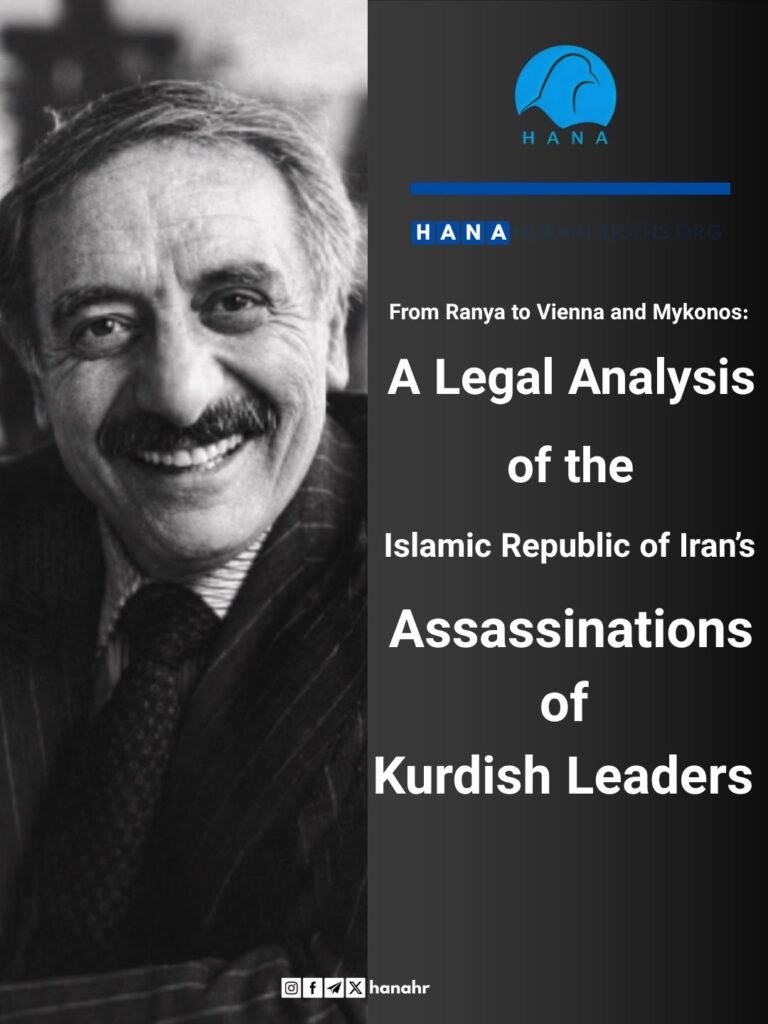

The assassination of Kurdish political leaders constitutes a long-standing pattern of transnational repression attributed to the Islamic Republic of Iran. The killings of Sediq Kamangar near Ranya, Dr. Abdulrahman Ghassemlou and his colleagues during political negotiations in Vienna in 1989, and Sadegh Sharafkandi and his companions at Berlin’s Mykonos restaurant in 1992 were not isolated criminal acts. Considered together, they exhibit recurring operational characteristics consistent with a state-directed policy to eliminate Kurdish political opposition beyond Iran’s territorial borders. In its landmark judgment of 10 April 1997, the Berlin Mykonos Trial Court found that the assassination of Dr. Sharafkandi and his companions had been ordered by the highest political leadership of the Islamic Republic and executed through organs of the Iranian intelligence apparatus. That judgment remains one of the most authoritative judicial determinations linking senior state officials to politically motivated extraterritorial assassinations.
The Vienna assassinations raise particularly serious legal concerns because they were carried out under the guise of official political negotiations. Available evidence indicates that members of the Iranian delegation travelled to Austria on an officially authorized mission and allegedly used diplomatic status and official channels to facilitate the commission of the killings and their subsequent departure from Austrian territory. If established, such conduct would constitute intentional homicide under Austrian criminal law, while also amounting to a grave abuse of diplomatic privileges and immunities fundamentally incompatible with the object and purpose of the Vienna Convention on Diplomatic Relations and the principle of good faith governing diplomatic relations.
The available evidence further raises serious concerns regarding Austria’s compliance with its obligation to ensure an effective criminal investigation and prosecution. Despite substantial grounds for pursuing key suspects, diplomatic and political considerations reportedly prevailed, enabling the principal suspects to leave Austrian territory without judicial determination of their criminal responsibility. This failure significantly contributed to a broader culture of impunity surrounding state-sponsored extraterritorial assassinations. Particularly troubling is the fact that several individuals alleged to have participated in or facilitated the Vienna operation subsequently occupied some of the highest political, military, and security offices within the Islamic Republic, reinforcing the appearance of institutional protection rather than criminal accountability.
From the perspective of international human rights law, the case remains legally actionable. Austria retains territorial criminal jurisdiction over offences committed within its territory, and intentional homicide punishable by life imprisonment is not subject to statutory limitation under Austrian law. Furthermore, Article 2 of the European Convention on Human Rights imposes a continuing procedural obligation to conduct an independent, effective, prompt, and impartial investigation into unlawful deprivation of life. That obligation may require renewed investigative measures where credible new evidence or significant investigative opportunities arise, particularly where allegations of state involvement or political interference may have compromised the original proceedings.
Beyond Austria’s domestic obligations, the Vienna assassinations engage fundamental principles of international law, including the protection of the right to life, respect for state sovereignty, and the prohibition of unlawful extraterritorial violence. They also form part of a broader pattern of transnational repression directed against political dissidents abroad, a practice that has attracted increasing attention within the United Nations human rights system and other international accountability mechanisms.
Justice for Dr. Abdulrahman Ghassemlou has been delayed, but the legal obligation to pursue accountability has not lapsed. Austria’s continuing duty to investigate and, where the evidentiary threshold is satisfied, to prosecute those responsible remains engaged. More broadly, the Vienna assassinations continue to represent a significant test of the international legal order’s capacity to respond effectively to state-sponsored political assassination and to uphold the principle that impunity for such crimes cannot be justified by the passage of time, diplomatic considerations, or the political status of those implicated.
Legal Office of HANA Human Rights Organization
12 July 2026