
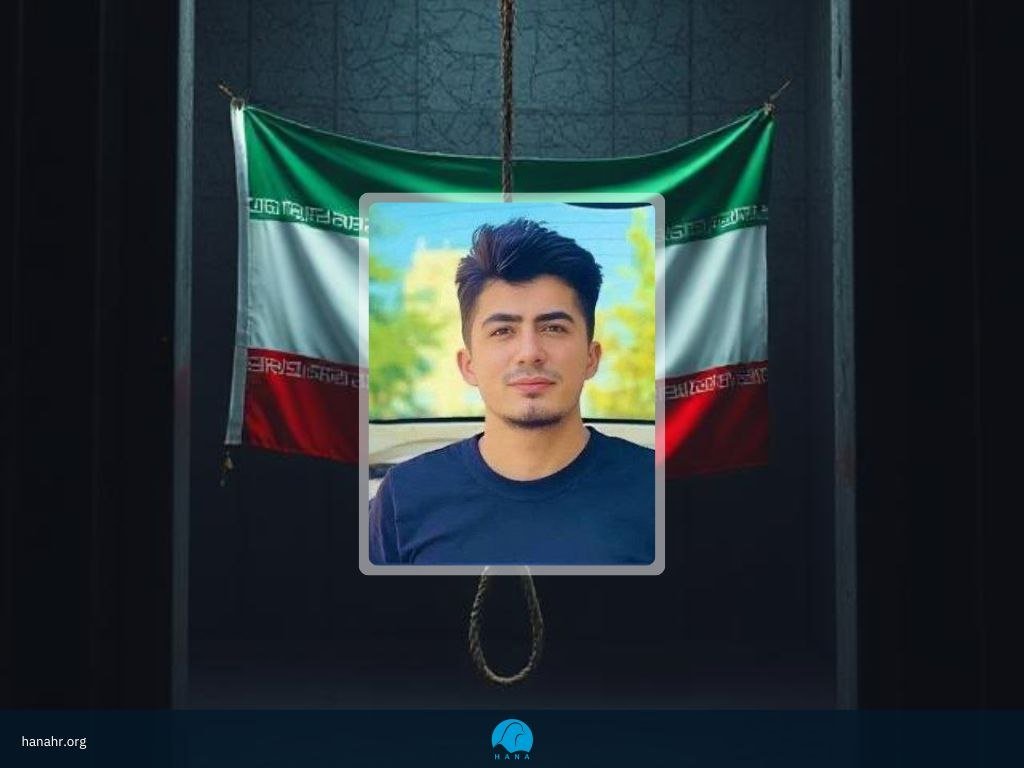
According to reports received by the Hana Human Rights Organization, the death sentence of Mehrab Abdullahzadeh, a Kurdish political prisoner and one of the detainees of the “Woman, Life, Freedom” revolutionary uprising, was carried out this morning, Sunday, May 3, 2026, by the judiciary of the Islamic Republic of Iran. Following the execution, media outlets affiliated with the judiciary announced his execution by attributing charges related to the death of a member of the Basij.
Mehrab Abdullahzadeh, born on March 15, 1998, son of Mohammad Amin, was from Orumiyeh and a resident of the Valiasr neighborhood. He was arrested on October 22, 2022, during the nationwide protests following the state murder of Jina Mahsa Amini, at his workplace by forces of the IRGC Intelligence Organization and transferred to their detention center in Orumiyeh.
From the moment of his arrest, Mehrab Abdullahzadeh’s case was fraught with severe legal violations. According to available information, he was subjected to intense physical and psychological pressure during interrogation to force a self-incriminating confession. Reports indicate that the confessions attributed to him were extracted under torture, threats, and security pressure. During the critical stages of his detention, interrogation, and trial, he was deprived of effective access to an independent lawyer, regular family visits, and the possibility of a genuine defense.
Branch 1 of the Islamic Revolutionary Court of Orumiyeh, presided over by Judge Najafzadeh, sentenced Mehrab Abdullahzadeh to death in a case related to the death of Sayyed Abbas Fatemieh, a member of the Basij. In reports concerning this case, the charges against him were framed as “Baghi” (armed rebellion), “Corruption on Earth,” and “participation in premeditated murder.” However, what is prominent in this case is not merely the nature of the charges, but the distorted quality of the proceedings, the heavy reliance on security reports, the disregard for torture allegations, and the lack of an independent and transparent investigation into the defense evidence.
The death sentence of Mehrab Abdullahzadeh was upheld by the Supreme Court, and his request for a retrial was rejected. In any case leading to the deprivation of life, any claim of torture, forced confession, deprivation of counsel, ambiguity in evidence, or interference by security agencies should halt the execution and lead to a new, independent, and effective trial. Nonetheless, the judiciary of the Islamic Republic not only failed to address these fundamental flaws but proceeded to carry out a sentence rooted in coercion, ambiguity, and security dominance.
The execution of Mehrab Abdullahzadeh took place after his transfer to solitary confinement in an environment of isolation and a lack of transparent communication. It was previously reported that after protesting the insulting treatment of prisoners’ families in the visitation hall of Orumiyeh Central Prison, he was transferred to solitary confinement in handcuffs and shackles by order of the prison warden. Such a method on the eve of an execution is not only a violation of the prisoner’s human dignity but also demonstrates that death in political and security cases has been transformed into a tool for state discipline, intimidation, and revenge.
The Hana Human Rights Organization condemns the execution of Mehrab Abdullahzadeh in the strongest possible terms and considers it a clear manifestation of the arbitrary deprivation of the right to life. An execution carried out following security detention, torture, disputed confessions, deprivation of an independent lawyer, a non-independent court, and non-transparent proceedings holds no legal validity. Such a verdict is not the administration of justice, but rather the conversion of a security decision into a seemingly judicial form.
Hana holds the Islamic Republic of Iran directly responsible for the death of Mehrab Abdullahzadeh.
In this case, the judiciary acted not as a guarantor of the right to life, the presumption of innocence, the right to defense, and the prohibition of torture, but as the executive arm of the security structure. The execution of a Kurdish political prisoner, specifically one of the detainees of the “Woman, Life, Freedom” uprising, is a continuation of the dangerous policy of the judicial elimination of protesters, political prisoners, and Kurdish citizens a policy aimed not at discovering the truth or administering justice, but at producing fear, silencing protest, and imposing power through death.
The Hana Human Rights Organization calls for the immediate halt of all death sentences, an independent and effective investigation into allegations of torture and forced confessions, the guarantee of access to independent lawyers for defendants, an end to the interference of security agencies in judicial cases, and the accountability of judicial, security, and prison officials in the process of the arrest, interrogation, trial, transfer to solitary confinement, and execution of Mehrab Abdullahzadeh.