
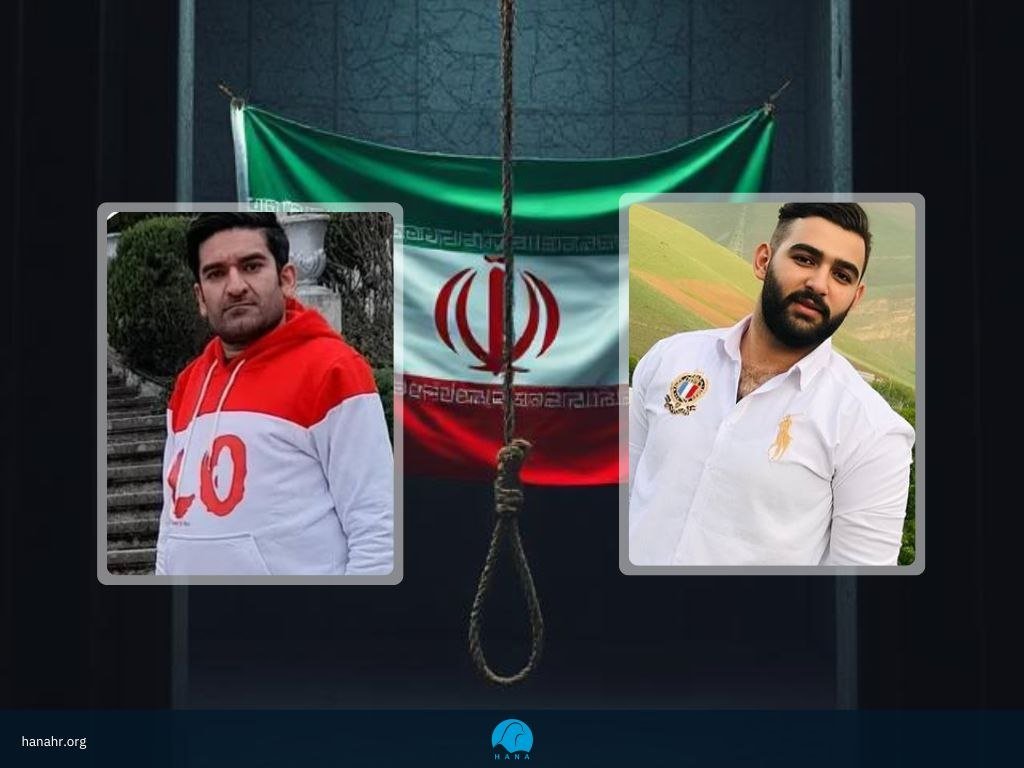
According to reports received by the Hana Human Rights Organization, the death sentences of Nasser Bakerzadeh and Yaghoub Karimpour, two political prisoners held in Urmia Central Prison, were secretly carried out this morning, Saturday, May 2, 2026, by the judiciary of the Islamic Republic of Iran. Mizan News Agency, affiliated with the Islamic Republic’s judiciary, also announced the execution of these two prisoners under the charge of “espionage for Israel.”
These executions were carried out while both prisoners had been removed from their holding wards and transferred to unknown locations in recent days. The Hana Human Rights Organization had previously warned about these transfers, the lack of information regarding their status, and the imminent risk of their sudden executions.
Yaghoub Karimpour, 41 years old, a graduate in public law from Miandoab, was a Turkic citizen and a follower of the Yarsan faith. He was arrested during the 12-day Iran-Israel war and sentenced to death by Branch 1 of the Orumiyeh Revolutionary Court on the charge of “Corruption on Earth through espionage for Israel.” This sentence was upheld last month by Branch 9 of the Supreme Court.
Nasser Bakerzadeh, 26 years old and from Orumiyeh, was held for a period in the IRGC Intelligence detention center in Orumiyeh under interrogation following his arrest in January 2024. According to reports from sources close to his family, during his detention and interrogation, he was deprived of his basic rights, including effective access to a lawyer, regular phone calls, and family visits.
Nasser Bakerzadeh’s case had previously been overturned by the Supreme Court. In a case leading to the deprivation of life, the overturning of a sentence should result in a retrial, an independent and meticulous review of the evidence, the resolution of procedural and substantive defects, and the full guarantee of the accused’s right to defense. However, the re-issuance and confirmation of the death sentence in a process marked by ambiguity, haste, a lack of transparency, and the deprivation of basic defense guarantees demonstrates that this case did not proceed within the framework of a fair and independent trial.
According to information received by Hana, on Saturday, April 25, 2026, Nasser Bakerzadeh was summoned to the sentence execution office of Orumiyeh Central Prison, where he was notified of the Supreme Court’s confirmation of his death sentence. It is reported that the prison’s sentence execution official threatened him with imminent execution while delivering the verdict, and after Bakerzadeh protested this treatment, the official subjected him to disrespect and physical assault.
Furthermore, the confirmation of Nasser Bakerzadeh’s death sentence occurred only about 10 days after the case was referred to the Supreme Court. Such haste in a case resulting in the death penalty, which already had a history of being overturned, is incompatible with any serious standard of fair trial, effective appellate review, and independent judicial oversight. In cases leading to execution, any ambiguity in the evidence, deprivation of an independent lawyer, security pressure, lack of opportunity for an effective defense, keeping the family uninformed, and transferring the prisoner to an unknown location, fundamentally renders the execution of the sentence illegitimate and constitutes an arbitrary deprivation of the right to life.
The Hana Human Rights Organization strongly condemns the execution of Nasser Bakerzadeh and Yaghoub Karimpour, considering it a blatant violation of the right to life, fundamental principles of a fair trial, and human dignity. According to Article 6 of the International Covenant on Civil and Political Rights (ICCPR), the right to life is an inherent and fundamental right, and no one shall be arbitrarily deprived of it.
Moreover, Article 14 of the same Covenant emphasizes the right to a fair, public, and independent trial with defense guarantees. The Islamic Republic of Iran is a state party to this Covenant and is obligated under international law to comply with it.
From Hana’s perspective, such executions are fundamentally unjustifiable by any valid legal, judicial, or humanitarian standard and cannot be termed the administration of justice. These executions are not the result of an independent judicial process, but rather the systematic use of death as a government tool for political revenge, inciting public terror, and imposing silence on society.
Hana emphasizes that the judiciary of the Islamic Republic of Iran, particularly in security cases, utilizes broad and severe charges such as “espionage” and “Corruption on Earth” as a legal cover for the physical elimination of defendants, the suppression of protests, and the generation of social fear. The hasty execution of these two sentences following the prisoners’ transfer to unknown locations, their deprivation of defense guarantees, and serious ambiguities in the judicial process once again demonstrate that the judiciary of the Islamic Republic is not an independent institution for administering justice, but rather a part of the government’s machinery of repression and intimidation.
The Hana Human Rights Organization believes that carrying out these executions in a post-war environment, amidst the government’s anxiety over growing public anger, carries a significance far beyond two individual cases. These executions serve as a threatening message to society; a message aimed at creating terror, silencing potential protests, and restoring lost state authority through judicial violence. When a government loses its ability to respond legally, politically, and socially to public dissatisfaction, it resorts to executions, imprisonment, security charges, and naked repression.