
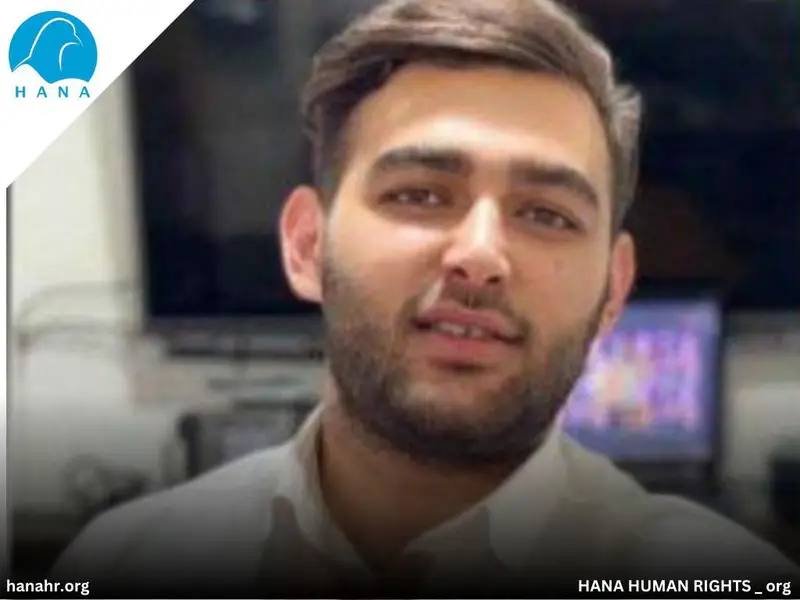
According to information obtained by the Hana Human Rights Organization, the death sentence of Naser Bakerzadeh, a Kurdish political prisoner held in Orumiyeh Central Prison, has been upheld by the Supreme Court. This sentence was previously issued by Branch 2 of the Orumiyeh Islamic Revolutionary Court on charges of “espionage for Israel.” With the confirmation of this ruling, the risk of his imminent execution has critically increased.
Hana had previously reported on April 15, 2025, that Bakerzadeh’s initial death sentence—issued by Branch 3 of the Orumiyeh Revolutionary Court on charges of “espionage for Israel and collaboration with the Mossad”—had been overturned by the Supreme Court. In that report, Hana warned about the prolonged legal limbo facing this political prisoner and the risk of the death sentence being reissued. Hana also noted that following his arrest in January 2024, Bakerzadeh was interrogated for a period at the IRGC Intelligence detention center in Orumiyeh. According to sources close to his family, he was deprived of his fundamental rights during his arrest and interrogation, including access to legal counsel and contact or visitation with his family.
The recent re-confirmation of the death sentence indicates that Hana’s previous concerns regarding the reproduction of the capital punishment without addressing fundamental flaws in the judicial process have materialized. The initial overturning of the sentence by the Supreme Court necessitated a genuine retrial, an independent review of the evidence, the resolution of procedural and substantive defects, and the effective guarantee of the defendant’s right to a defense. Instead, the death sentence was reissued and upheld in a process that continues to appear hasty, ambiguous, and lacking in adequate transparency.
According to information received by Hana, on Saturday, April 25, 2026, Naser Bakerzadeh was summoned to the Sentence Implementation Office of Orumiyeh Central Prison, where he was formally notified of the Supreme Court’s confirmation of his death sentence. Reports indicate that Abdollahzadeh, the official in charge of sentence implementation at the prison, threatened him with imminent execution while delivering the notification. After Bakerzadeh protested the treatment and the notification process, he was reportedly subjected to severe disrespect and physical assault by the aforementioned official.
If accurate, the behavior attributed to the official, in addition to violating the human dignity of the prisoner, constitutes the mistreatment of a person deprived of liberty and a violation of the legal duty of prison authorities to safeguard the health, safety, and dignity of inmates.
The confirmation of Naser Bakerzadeh’s death sentence occurred only about 10 days after the case was referred to the Supreme Court. Such haste, particularly in a capital case with a history of being overturned, raises serious questions regarding the quality of the appellate review, the effective examination of the defense’s objections, the careful evaluation of evidence, and adherence to fair trial standards.
From the perspective of Iranian domestic law, Articles 34, 35, 38, and 39 of the Constitution guarantee the right to seek justice, the right to legal counsel, the prohibition of torture, and the prohibition of affronts to the dignity of detained or imprisoned individuals. Furthermore, under Articles 6 and 14 of the International Covenant on Civil and Political Rights (ICCPR), to which Iran is a state party, the right to life and the right to a fair trial must be fully respected. Issuing or executing a death sentence in a case marred by allegations of torture, denial of legal counsel, restrictions on family contact, ambiguous evidence, and rushed proceedings constitutes a serious violation of the state’s human rights obligations.
While strongly condemning the confirmation of Naser Bakerzadeh’s death sentence, Hana issues an urgent warning regarding the risk of its imminent execution.
The organization calls on the authorities of the Islamic Republic of Iran to immediately halt the execution, conduct an independent and effective investigation into the allegations of defense rights violations and physical assault during the sentence notification, and retry the case in a transparent, independent, and fair process.
Hana also urges international human rights bodies, including the UN Special Rapporteur on the situation of human rights in Iran, the Special Rapporteur on extrajudicial, summary or arbitrary executions, Amnesty International, and other human rights organizations, to react immediately to this case.
Following the notification of his sentence, Naser Bakerzadeh published an open letter addressed to the public and human rights organizations, appealing for international support to overturn his execution:
Open Letter from Naser Bakerzadeh
Greetings to my dear compatriots and my honorable Kurdish-speaking people,
I am Naser Bakerzadeh, and you are hearing my voice from Orumiyeh Central Prison. This may be my last voice. I am the son of Mullah Mansour, I am 26 years old, and I have two younger sisters. At the age of 23, at the peak of my dreams and desire for life, I was arrested.
From the first day of my arrest until today, my parents have died and come back to life every single day. The sorrow of distance and separation has weighed heavily on their shoulders, and in the prime of their youth, they have grown old and broken. They were once happy and dreamed of seeing their only son in a groom’s suit. We were supposed to go propose a few days before my arrest, and now, for 4 years, that girl has been waiting for me. Even right now, just a few hours after hearing the news of my death sentence being confirmed, I don’t know how to call her and tell her that my sentence has been upheld and I am going to be executed.
After finishing school, based on my father’s decision and my own interest, I began studying at the Salahaddin Ayubi Religious School in Piranshahr. After studying for two years, due to my family’s financial circumstances, I decided to take some of the burden off my father’s shoulders and opened a mobile phone shop in Orumiyeh.
I was arrested on January 2, 2024, and held in solitary confinement at the IRGC Intelligence detention center for 3 months, where I was subjected to the most severe psychological torture. After two court sessions in the summer of 2024, Branch 1 of the Orumiyeh Islamic Revolutionary Court issued my death sentence in the autumn of that year, without presenting sufficient evidence and documentation.
This sentence was overturned in April 2025 by Branch 39 of the Supreme Court due to the lack of legal evidence and documentation. The case was referred back to Branch 2 of the Orumiyeh Islamic Revolutionary Court for retrial, but that same court, in the shadow of the 12-day war, issued a death sentence for the second time. This sentence was once again overturned in the autumn of 2025 by Branch 39 of the Supreme Court, and my innocence was affirmed.
However, the case was returned for a third time to Branch 2 of the Urmia Islamic Revolutionary Court, but unfortunately, due to the conditions of the country in January 2026, for the third time, my death sentence was issued based on a letter copied from previous verdicts. This sentence was confirmed this morning by Branch 39 of the Supreme Court amid the wartime conditions prevailing in the country.
Hearing a death sentence might not be understandable for most people, but this sentence is such that no one and nothing can endure it. Execution has killed me, shattered me, and I see myself dying every moment; it has destroyed my family as well. Do not easily pass by this execution letter; today it is my turn, and tomorrow it will be someone else’s.
I beg my dear compatriots, the honorable Kurds inside the country and anywhere in the world, and the religious Mamostās (clerics) of whom I was a student, to be my voiceless voice.
Make my voice heard by human rights organizations, including Amnesty International, and the whole world.
Orumiyeh is different from the rest of Iran. I say this from the bottom of my heart: my first “crime” was being a Kurd, and after that, being a Sunni. Come to my aid. I am neither the first nor will I be the last.
Naser Bakerzadeh
April 25, 2026
Orumiyeh Central Prison