
Statement by the Legal Department of HANA Human Rights Organization
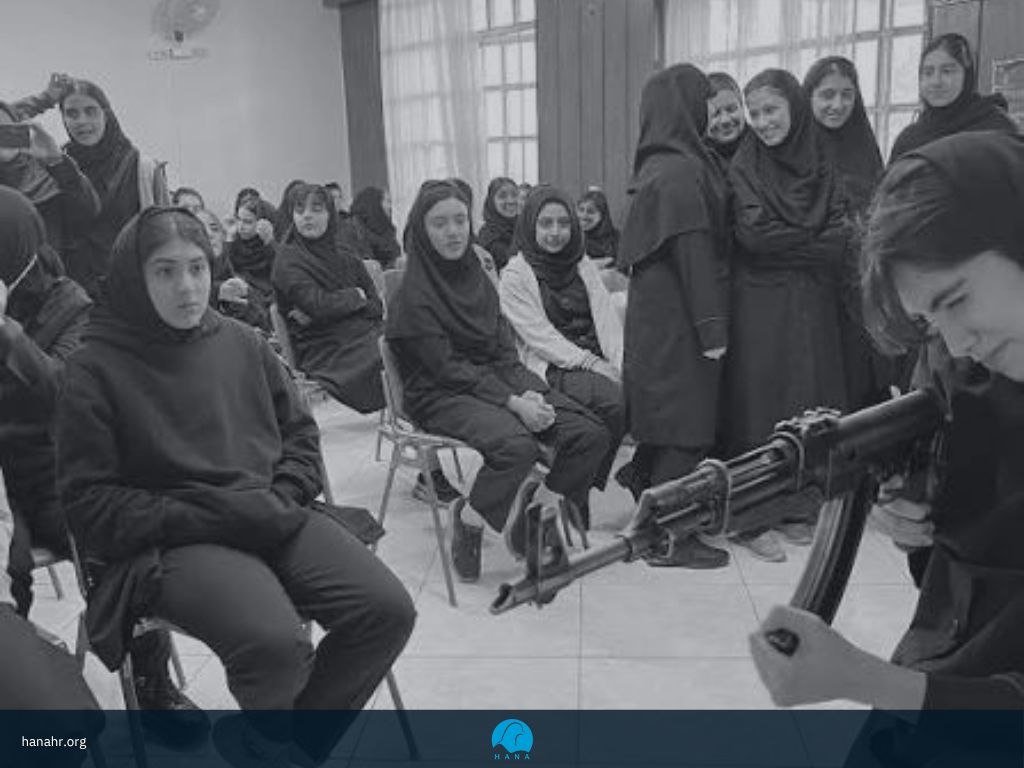
The Legal Department of HANA Human Rights Organization expresses serious concern over the expanding presence of the Islamic Revolutionary Guard Corps (IRGC) and its Student Basij organization in schools across Iran, particularly in Kurdistan, ahead of the state-organized commemorations of 4 November (13 Aban). The involvement of children in weapons training, their recruitment into paramilitary structures, and the use of educational institutions for political and security-related activities raise serious concerns regarding Iran’s obligations under international human rights law, particularly the Convention on the Rights of the Child (CRC).
Officially announced programmes for Student Basij Week, together with reports and footage documenting firearms training involving minors and initiatives such as the Young Fighter programme, indicate a growing institutional involvement of military and paramilitary organizations in the education system.
According to statements made on 29 October 2026 by Mansour Hashemi, head of the Student Basij in Kurdistan Province, approximately 950 Basij units operate within schools across the province, with nearly 80,000 students reportedly enrolled in the organization. He also announced plans to send more than 2,000 students to former military operational areas in southern Iran in cooperation with the IRGC’s Beit al-Moqaddas Corps and the Ministry of Education. At the national level, education authorities have announced programmes promoting the state’s official anti-American ideology, while Basij officials have outlined further initiatives involving paramilitary organizational activities, defence-related instruction, and the mobilization of schoolchildren.
These developments must also be considered in light of previously documented incidents involving the military use of educational facilities in Kurdistan. HANA has reported the deployment of IRGC personnel at Dastgheib School in Baneh while students were present, as well as the use of the dormitory of Shahid Motahhari Boarding School in Zarrineh, Divandarreh, to accommodate military personnel. The latter reportedly deprived students from surrounding rural communities of essential boarding facilities and disrupted their education. Such practices undermine the civilian character of educational institutions and expose children to additional security risks.
The annual commemorations of 4 November are associated with the seizure of the United States Embassy in Tehran in 1979, when a group of students occupied the diplomatic premises and took American diplomatic and consular personnel hostage. The subsequent endorsement of the occupation and continued detention of the hostages by Ayatollah Ruhollah Khomeini and other Iranian authorities constituted serious violations of international diplomatic law. In its judgment of 24 May 1980 in the United States Diplomatic and Consular Staff in Tehran case, the International Court of Justice found Iran responsible for violations of its international obligations, including those arising under the Vienna Conventions on Diplomatic and Consular Relations. The presentation of this incident to schoolchildren as an occasion for state-sponsored political mobilization, without acknowledging its unlawful character and the international responsibility of the Iranian state, raises additional concerns regarding the educational content promoted within public schools.
From an international human rights perspective, the legality of activities involving children cannot be established solely by reference to domestic legislation or authorization by state institutions. Iranian legislation establishing and expanding the Student Basij has facilitated the institutional presence of the IRGC within the education system.
Such domestic authorization, however, does not relieve the state of its obligations under the Convention on the Rights of the Child.
Articles 3, 12, 14, 19 and 29 of the Convention require states to give primary consideration to the best interests of the child, respect children’s right to express their views and their freedom of thought and conscience, protect them from physical and mental harm, and ensure that education promotes respect for human rights, peace and tolerance. These obligations are particularly relevant where educational authorities facilitate children’s participation in military-oriented activities or expose them to coercive political and ideological mobilization.
HANA emphasizes the fundamental distinction between legitimate civilian safety education and the provision of weapons training, paramilitary recruitment, or preparation of children for military and security-related activities. The use of educational authority to impose political conformity, normalize the handling of firearms, or encourage children’s involvement in security structures is incompatible with the protective purpose of education and may violate internationally recognized child rights standards. Neither political objectives nor national security considerations can justify exposing children to activities that endanger their safety, well-being, or development.
The Legal Department of HANA therefore calls for the immediate cessation of firearms training and military and security-related activities involving children in schools, the removal of military personnel and equipment from educational premises, and full public disclosure of programmes jointly conducted by the IRGC and education authorities. It further urges the Iranian authorities to guarantee that no child is compelled, pressured, or subjected to adverse consequences for refusing to participate in political ceremonies or military-affiliated organizations.
Schools must remain safe, civilian environments dedicated to education, independent thought, and the full development of children. They must not be transformed into sites of paramilitary recruitment, military indoctrination, or the instrumentalization of children to advance the political and security objectives of the state.