
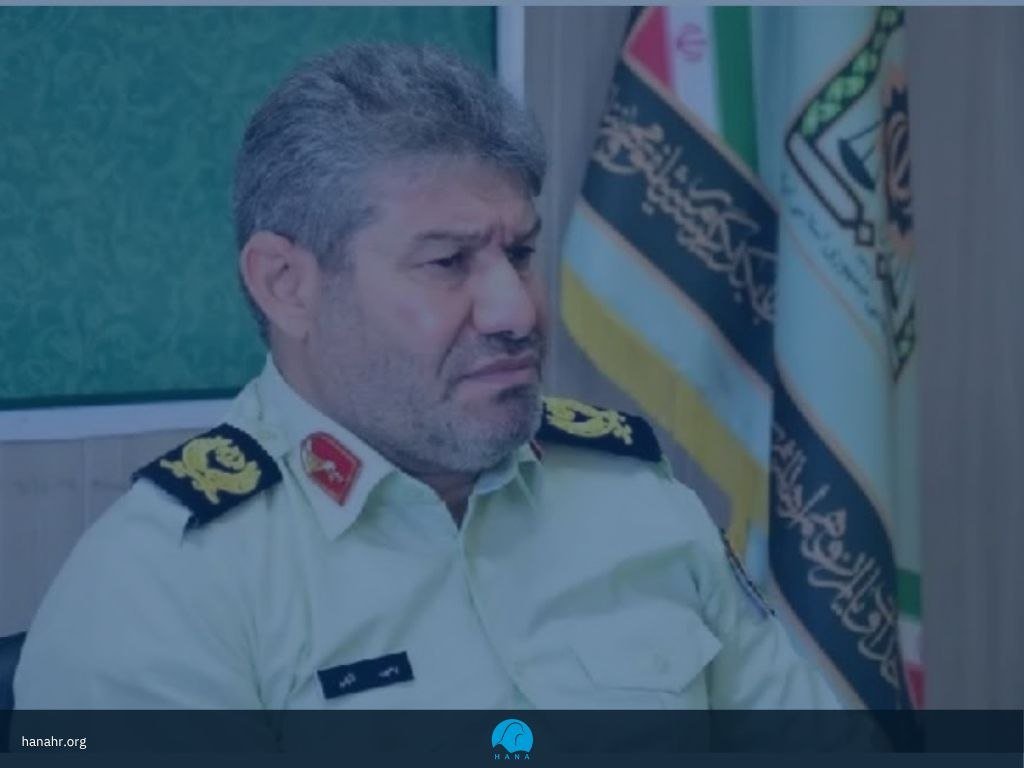
The Hana Human Rights Organization strongly condemns remarks by Brigadier General Yahya Elahi, the police commander of Kurdistan Province, regarding the arrest of 7,241 individuals, whom he described as “criminals,” “troublemakers,” and “norm breakers.” These remarks are not simply a slip of the tongue. They reflect an outlook in which the line between detention, accusation, and criminal conviction has effectively been erased, with the police cast as the arbiter of guilt.
Police are judicial officers, not a court. No police official has the authority to brand a detained person a criminal before judicial proceedings have run their course and a final verdict has been issued. Article 37 of the Constitution states explicitly that no one is to be considered guilty unless their crime is proven before a competent court. Articles 32 and 39 of the Constitution, together with Article 4 of the Code of Criminal Procedure, permit the deprivation of liberty only within the bounds of the law and with respect for individuals’ rights and dignity.
Hana likewise considers the use of vague terms such as “norm breaking” and “thugs and hooligans” to justify police action a departure from the principle of legality in crime and punishment. Vague social, moral, or security related concepts cannot substitute for an offense clearly defined by law, and the police have no right to expand their own authority on the strength of such labels. Public security, for its part, is no license to suspend the law or violate citizens’ fundamental rights.
The phrase “were struck and arrested” calls, in particular, for an immediate explanation. If this phrase refers to the use of force against individuals, the police commander is obligated to clarify the legal basis, necessity, and proportionality of such action. The use of violence cannot be turned into summary street punishment, and no police officer has the right to stand in for a court and its lawful sentence.
Language of this kind also conflicts with Iran’s international obligations, including Articles 9 and 14 of the International Covenant on Civil and Political Rights. The presumption of innocence and the prohibition on arbitrary detention require public officials to refrain from any statement that presumes a person’s guilt ahead of a court’s verdict.
Hana calls on Kurdistan Province’s Law Enforcement Command, rather than presenting detention figures as a mark of success, to state transparently what legal basis justified the detention of these 7,241 individuals, how many were merely detained or charged, how many cases were forwarded to a judicial authority, and how many ended in a final conviction by a court.
The Hana Human Rights Organization emphasizes that recasting a detainee as a “criminal” in official language, relying on vague concepts to justify police intervention, and normalizing the use of force together amount to a direct violation of the principles of the rule of law. A police force that regards itself as the arbiter of guilt, the setter of norms, and the dispenser of punishment has stepped outside the bounds of its lawful authority and placed citizens’ fundamental rights in direct jeopardy.