
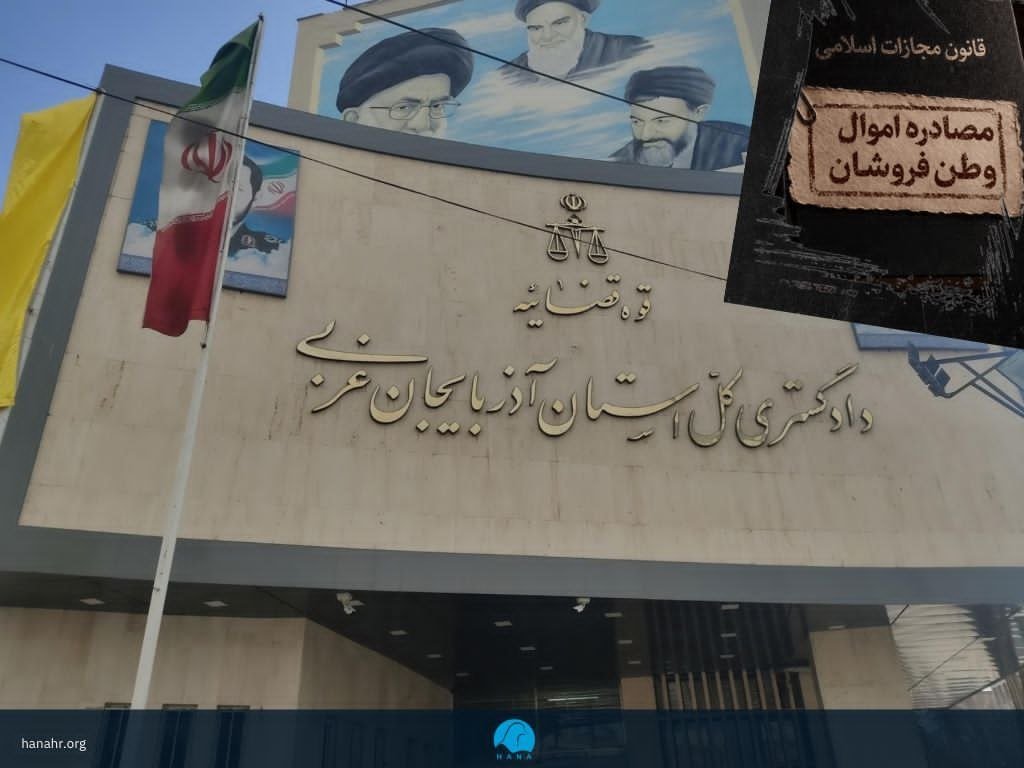
The Hana Human Rights Organization strongly condemns the Iranian judiciary’s seizure and confiscation of property belonging to 129 citizens in West Azerbaijan province. Hana views this move as a blatant act of judicial repression, politically motivated asset forfeiture, a grave violation of property and fair trial rights, and a form of collective punishment against citizens.
This action is not a standard judicial decision, but rather part of a well-established pattern by the Islamic Republic. The regime systematically weaponizes the courts, security charges, and asset forfeiture mechanisms to intimidate, punish, and eliminate political dissidents, civil activists, journalists, and their families.
Levying vague charges such as “acting against national security,” “cooperating with hostile states,” and “links to opposition groups” without presenting clear evidence, guaranteeing the right to a defense, or providing transparency regarding the proceedings—lacks legal validity and violates the core principles of criminal justice.
Under Article 17 of the Universal Declaration of Human Rights, no one shall be arbitrarily deprived of their property. The seizure and confiscation of assets can only be legitimate if carried out under clear laws, reasoned judicial rulings, an independent and impartial judiciary, adherence to the principle of proportionality, access to legal counsel, and the right to an effective appeal.
In this case, the total lack of transparency, the likelihood of trials in absentia, the denial of an effective defense, and the reliance on broad security pretexts render this action an act of arbitrary and punitive confiscation.
Hana emphasizes that confiscating the property of families, immediate relatives, or inherited assets of accused individuals, without proving individual liability, is a clear form of collective punishment. No fair legal system permits citizens to be penalized based on family ties, political affiliation, social identity, or alleged association with others. Criminal liability is strictly personal, and extending punitive measures to families and relatives is a flagrant violation of the principle of individual criminal responsibility.
This move also signals a dangerous expansion of economic repression targeting Kurdish citizens. Through the continuous securitization of Kurdistan, the Islamic Republic not only suppresses freedom of expression, association, political activity, and civic participation, but now also deploys asset confiscation to exert financial, social, and psychological pressure on families and political activists. This approach directly violates Articles 19, 21, and 22 of the International Covenant on Civil and Political Rights (ICCPR).
The Hana Human Rights Organization reiterates its warning over judicial authorities threatening severe punishments, including the death penalty, in security-related cases. Utilizing capital punishment in cases characterized by vague allegations, opaque proceedings, security apparatus pressure, and the denial of an effective defense constitutes a grave violation of the right to life and poses an irreversible threat to the fundamental rights of citizens.