
Note: By “Kurdish regions,” the Hana Human Rights Organization refers to all areas that are historically, socially, and demographically considered part of Kurdistan, even if they are designated under different provincial names within the current official administrative divisions of the Islamic Republic of Iran.
Citing official data published by the Statistical Center of Iran, the Hana Human Rights Organization considers the persistence of poverty, unemployment, and livelihood pressures in the Kurdish regions of Iran to be a direct consequence of the discriminatory policies, chronic securitization, and structural deprivation imposed by the Islamic Republic of Iran.
The misery index in the provinces of Kurdistan, Kermanshah, Lorestan, illam, and West Azerbaijan has reached a level that can no longer be viewed merely as a byproduct of Iran’s general economic crisis. This situation reflects an unjust distribution of resources, the systematic exclusion of Kurdish regions from development cycles, a institutionalized disregard for the right to work and livelihood, and the continuation of state policies that keep the inhabitants of these regions in a state of persistent poverty, economic insecurity, and permanent vulnerability.
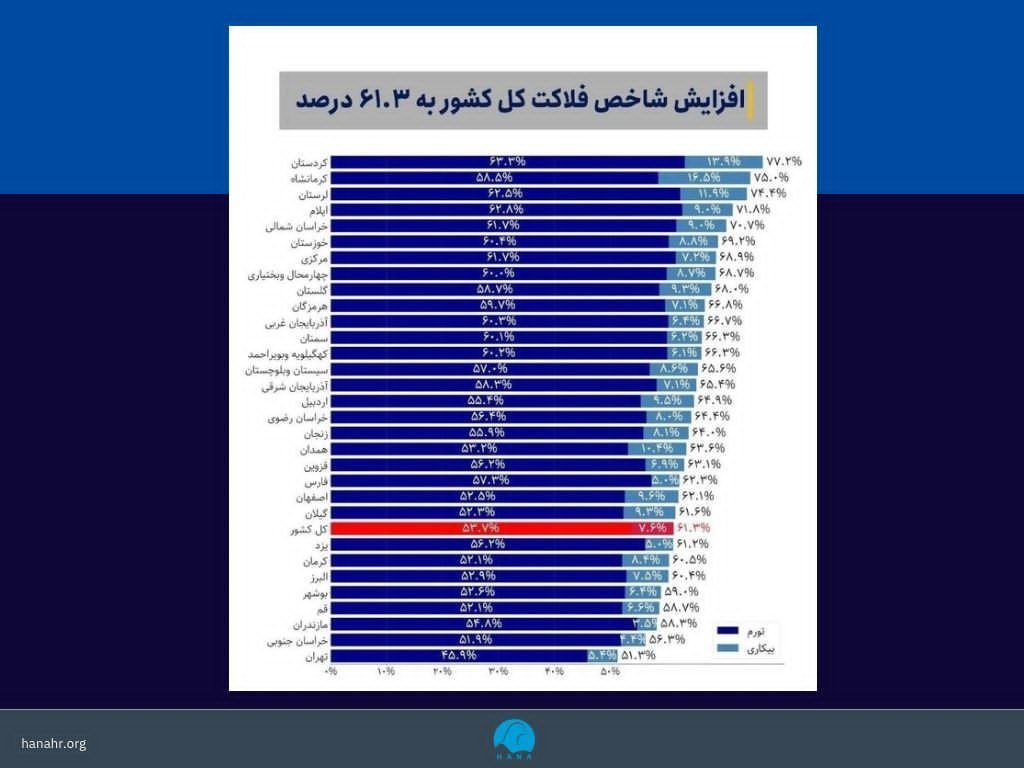
According to official statistics, the misery index stands at 77.2% in Kurdistan province, 75% in Kermanshah, 74.4% in Lorestan, 71.8% in illam, and 60.3% in West Azerbaijan.
The average index across these regions is approximately 71.74%. These figures are not merely indicative of economic stagnation, but serve as clear evidence of the government’s deliberate failure or, at the very least, flagrant disregard in fulfilling its human rights obligations.
Under the International Covenant on Economic, Social and Cultural Rights (ICESCR), the Islamic Republic of Iran is legally obligated to guarantee, without discrimination, the right of citizens to work, an adequate standard of living, social security, and equal development opportunities. However, the state’s performance in the Kurdish regions demonstrates that the government has not only failed to meet these obligations, but has actively reproduced structural inequality through the concentration of resources in central regions, the deliberate securitization of border zones, intentional underinvestment, and a total absence of effective compensatory policies.
From a human rights perspective, economic deprivation transforms into a violation of fundamental rights when it is sustained, predictable, and a direct result of public policy. The current situation in the Kurdish regions possesses precisely these characteristics. Widespread unemployment, a lack of developmental infrastructure, restricted access to sustainable employment, and expanding poverty have turned the daily lives of citizens into a permanent state of economic insecurity.
One of the most prominent consequences of these policies is the expansion of Kolbari (cross-border cargo carrying) in the border areas of Kurdistan. Kolbari is not a freely chosen occupation; it is the forced outcome of systemic poverty, a lack of legal employment opportunities, and historical exclusion from national development. Citizens forced into Kolbari to secure their most basic survival needs simultaneously face the risk of lethal shootings by state forces, fatal accidents, severe injuries, arbitrary detention, and human degradation.
The frequent killing and wounding of Kolbars highlights the direct responsibility of the Islamic Republic of Iran in violating the right to life, the right to personal security, and human dignity.
A government that refuses to create safe livelihood opportunities and subsequently adopts a heavy-handed, securitized approach toward the victims of poverty is not protecting its citizens, but rather exposing them to institutionalized state violence.
Hana emphasizes that the deprivation of Kurdish regions is not merely a consequence of passive developmental lagging.
This situation must be analyzed within the framework of indirect discrimination and structural deprivation.
Even if discrimination is not explicitly codified in text of the law, policies that consistently produce disproportionate and adverse effects on these specific regions cannot be justified under international human rights law.
The principles of equality and non-discrimination obligate the state to adopt specific, urgent, and effective measures to rectify historical and structural inequalities. Inaction in the face of widespread poverty, persistent unemployment, and a lack of investment in Kurdish regions constitutes a distinct violation of international human rights commitments.
The consequences of this situation extend far beyond the economic sphere. The perpetuation of poverty and unemployment in Kurdish regions directly threatens the right to an adequate standard of living, the right to work, the right to social security, the right to mental and social health, the right to development, and the right to human dignity. The forced migration of the labor force, the expansion of social anomalies, the erosion of public hope, and the reliance of citizens on high-risk occupations constitute part of the severe human cost of these state policies.
The Hana Human Rights Organization holds the Islamic Republic of Iran fully accountable for the continuation of this situation and emphasizes that structural deprivation in Kurdish regions is a blatant violation of the state’s obligations under economic and social rights frameworks.
The Iranian government is duty-bound to terminate its discriminatory and security-centered policies in these regions, distribute public resources equitably, create sustainable employment opportunities, halt all shootings and violence against Kolbars, and present an immediate, transparent, and verifiable plan to compensate for the historical deprivation of Kurdish regions.