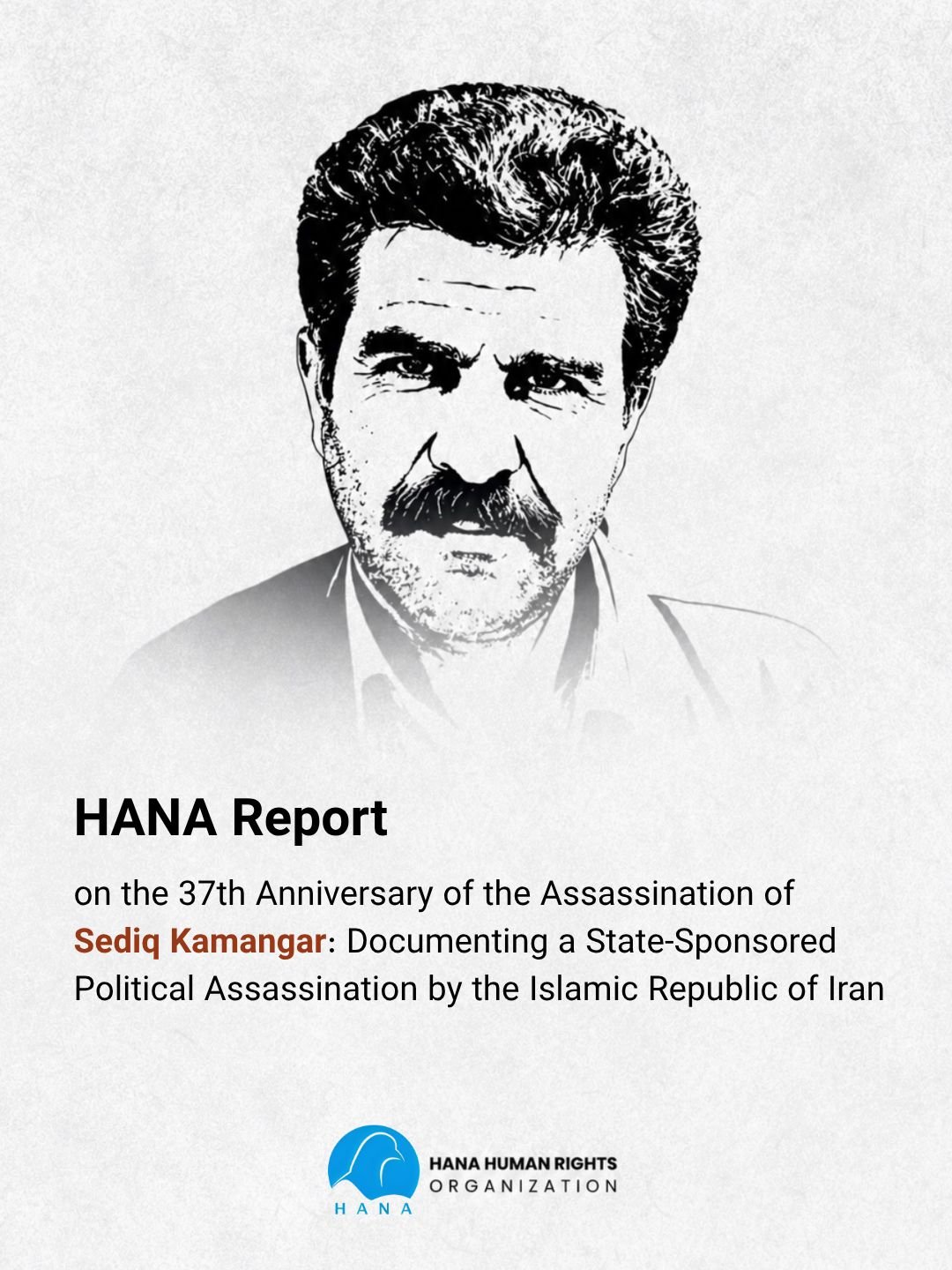
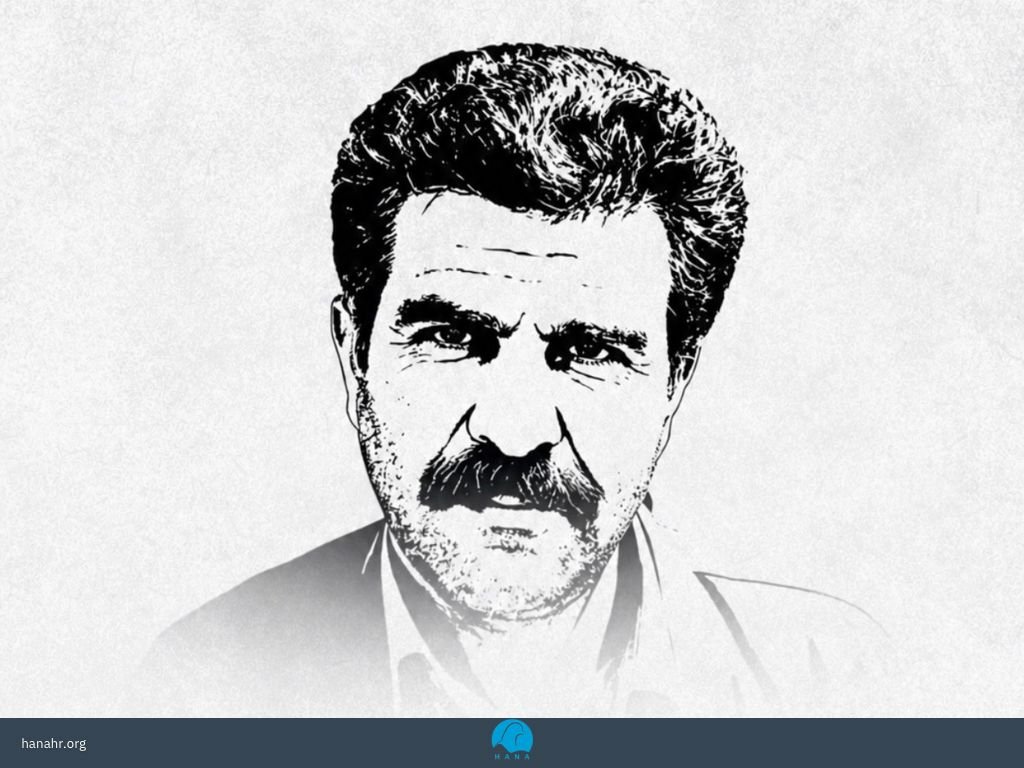
Thirty seven years ago, in the early hours of September 4, 1989, Sediq Kamangar, an attorney, jurist, and a leader of the Komala Party of Iranian Kurdistan (then one of the leaders of the Communist Party of Iran), was shot and killed at this organization’s base near Rania, in Iraqi Kurdistan. Nearly four decades later, those who ordered and planned this killing have never been held accountable before an independent judicial authority.
On the occasion of the thirty seventh anniversary of Sediq Kamangar’s assassination, the Hana Organization for Human Rights has assessed the available documents and accounts, the testimony of informed individuals, organizational sources, and oral investigations conducted into this case. The result of this review is the attribution of Kamangar’s killing to the Islamic Republic of Iran. The body of available evidence shows that he was not the victim of an individual or personal murder, but was killed as the result of a premeditated operation, carried out with the specific aim of political elimination, at the hands of an infiltration agent of the Islamic Republic.
Sediq Kamangar, before he became known as one of the Kurdish political leaders, was an attorney and jurist. He practiced law in Sanandaj, and the defense of peasants against unequal relations of land ownership and local power was among the well known aspects of his professional work. Kamangar was also active in legal, professional, and civic affairs, and, during the developments of 1979, played a role in articulating the political and civic demands of the people of Kurdistan.
The significance of his standing was not confined to his legal profession or his political role alone. At a time when human rights literature in Iran remained highly limited in terms of Persian language sources, translation, and university instruction, Kamangar spoke, in his writings and speeches, of fundamental freedoms, equality, freedom of expression and association, and the necessity of limiting political power. He was among those jurists who linked political and social demands to the concepts of rights, freedom, and justice. This very legal, social, and political standing had made him a prominent figure among the opponents of the Islamic Republic.
According to existing accounts, on the evening of September 3, 1989, Kamangar remained at his workplace to complete a text that was to be broadcast on the radio. At around two in the morning, his guard opened fire on him with an automatic weapon. The perpetrator left the scene immediately after the shooting and fled using a route that allowed for a rapid exit from the camp.
The direct perpetrator of the killing has been identified in numerous sources as Tawfiq Garzhali. He had previously been a member of Komala, had then left the organization and surrendered himself to the Islamic Republic. After some time, he rejoined the party’s ranks and was ultimately placed in the unit responsible for protecting the leadership. This position gave him direct access to Sediq Kamangar, knowledge of his movements, and familiarity with the security arrangements in place.
The perpetrator’s return following his time within the territory of the Islamic Republic, his path into the protective structure, his direct access to a specific victim, his prior familiarity with the location, his selection of a suitable opportunity to carry out the killing, and his planned escape after the shooting, are not disconnected events. These elements, together with testimony and Hana’s oral investigations concerning the perpetrator’s ties to the Islamic Republic’s security apparatus and his mission to kill Kamangar, reveal the structure of a targeted infiltration operation.
In terms of the legal assessment of the evidence, the significance of the case lies precisely in the connection between the perpetrator’s conduct prior to the killing, the nature of his access to the victim, and the manner in which the operation was carried out. The killing was carried out with premeditation. The victim was predetermined. The perpetrator placed himself within the protective structure in order to attain a position that would allow him to carry out the killing, and fled the scene once his objective had been accomplished. The mental element of the offense is manifest in the conscious intent to take the life of a specific individual and in the political aim of the operation. In this respect, the killing of Sediq Kamangar bore the character of an organized, state directed political assassination.
On this basis, the Hana Organization for Human Rights regards the attribution of the operation to the Islamic Republic of Iran as established. What continues to require judicial investigation is not the fundamental question of attribution, but rather the precise determination of the chain of command and the criminal responsibility of those individuals who played a role in ordering, planning, transmitting the mission, supporting, and carrying out the operation.
This distinction is of fundamental legal importance. The attribution of an act to a state is not the same as establishing individual criminal responsibility. The conduct of a person acting on the order, direction, or under the control of state institutions can be attributed to the state, but the criminal conviction of specific individuals requires identifying each person’s role and proving their knowledge and intent in the commission of the offense. The continued secrecy of the Islamic Republic’s security archives, and the absence of an independent judicial investigation, have, over the past decades, prevented the full identification of this chain of responsibility.
From the standpoint of international human rights law, the deliberate killing of a political opponent outside any judicial process constitutes a clear instance of arbitrary deprivation of the right to life and extrajudicial killing. Party membership, opposition to the government, or political activity creates no license to deprive a person of the right to life. When such a killing is carried out by an agent acting under the order or direction of the state, the international responsibility of the state arises in addition to the criminal responsibility of the perpetrators and those who ordered it.
The occurrence of the operation on Iraqi soil adds a further dimension to this case. The Islamic Republic possessed no authority to covertly exercise coercive power and physically eliminate a political opponent within the territory of another state. The carrying out of the killing on Iraqi soil constitutes, in addition to a violation of the right to life, an infringement upon that country’s territorial sovereignty. The Iraqi authorities of the time were likewise obligated to conduct an effective investigation into a killing that occurred within their territory, to preserve evidence, to question witnesses, and to identify the perpetrators and any possible accomplices. The absence of an effective judicial investigation has contributed significantly to the continued impunity of those responsible for this killing.
The assassination of Sediq Kamangar cannot be examined in isolation from the broader pattern of the Islamic Republic’s extraterritorial assassinations of Kurdish leaders and activists. The killing of Abdul Rahman Ghassemlou and his companions in Vienna in July 1989, the assassination of Sediq Kamangar that same September in Iraqi Kurdistan, the killing of Sadiq Sharafkandi and his companions in Berlin in 1992, and other similar operations, raise the necessity of examining a broader state policy of physically eliminating political opponents beyond Iran’s borders.
The Mykonos case is of particular significance in this regard. In that case, the role of senior Islamic Republic officials in the decision to assassinate Kurdish leaders was examined by an independent court. The findings of that case do not, in themselves, substitute for independent proof in the Kamangar case, but they are of fundamental importance in assessing the decision making structure, the manner in which such operations were carried out, and the pattern of the Islamic Republic’s conduct.
When the targeted selection of political leaders, operations carried out across different countries, the use of covert networks and infiltration agents, the persistence of these assassinations over time, and existing judicial findings are considered together, the examination of the existence of an organized state policy for eliminating opponents is no longer merely a political claim. This matter is legal in nature and must be made the subject of a comprehensive judicial investigation.
In Hana’s view, the killing of Sediq Kamangar forms part of the larger case file of the Islamic Republic’s organized state assassinations against Kurdish leaders and opponents. The examination of these cases must go beyond the level of the direct perpetrators and encompass the decision making structure, the security institutions involved, the methods of recruiting and directing agents, the support networks, and the chain of command.
Should a comprehensive investigation establish that these killings formed part of a widespread or organized attack against a population of civilian opponents, carried out in furtherance of a state policy, examining them within the framework of crimes against humanity would likewise become necessary. Such a characterization requires establishing specific elements of international criminal law, but the number and persistence of these operations, the targeted selection of victims, and the use of organized state capacities provide serious grounds for such an investigation.
The passage of nearly four decades has no exonerating effect for those who ordered and carried out this killing. Time cannot substitute for investigation, truth, and accountability. Should the elements of international crimes, particularly crimes against humanity, be established, the principle of non applicability of statutory limitations will become directly relevant. No individual should be able to exploit the secrecy of documents, state power, or the passage of time to convert de facto impunity into legal immunity.
For this reason, the case of Sediq Kamangar and the Islamic Republic’s other extraterritorial assassinations must constitute one of the central components of any future transitional justice mechanism in Iran. This requires the opening of security, intelligence, and diplomatic archives, the preservation and recording of witness testimony, the identification of the command structure, the determination of the criminal responsibility of those who ordered and carried out these acts, and the guarantee of the right of victims’ families and of society to truth and reparation.
Transitional justice with respect to these cases cannot be confined to the historical recording of events or to symbolic truth seeking. In the face of deliberate killings and grave human rights violations, truth seeking must lead to criminal accountability. Thirty seven years on, the case of Sediq Kamangar remains open. The passage of time has neither extinguished responsibility nor erased the right to truth and justice.