
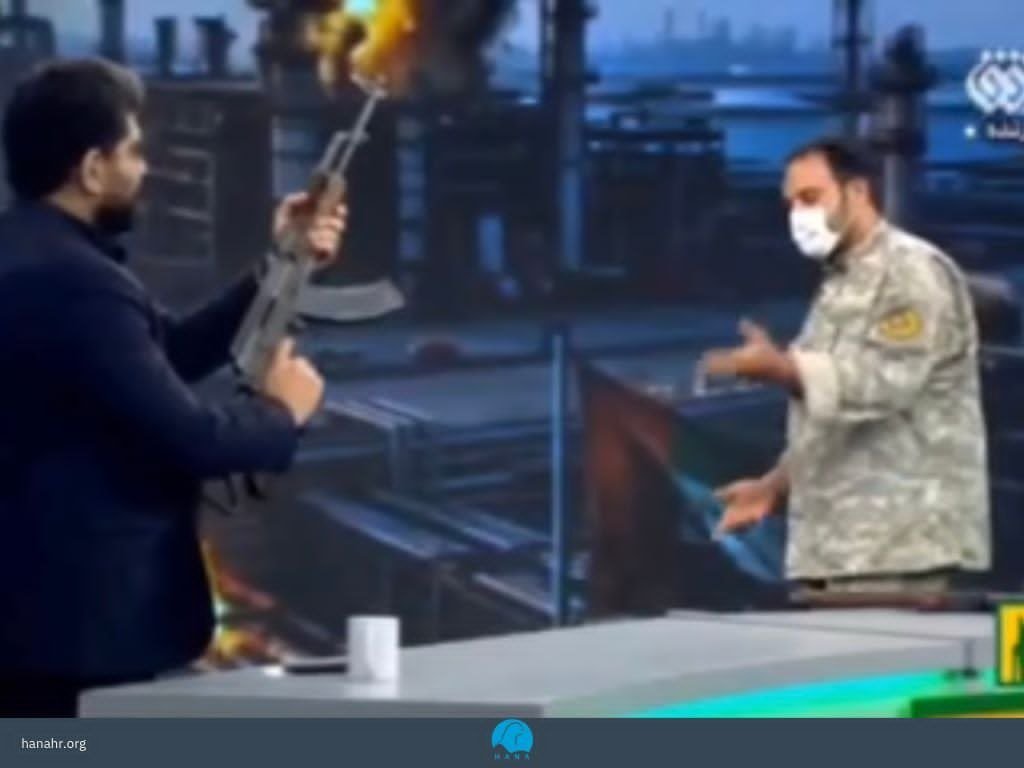
The Hana Human Rights Organization strongly condemns the broadcasting of Kalashnikov assault rifle training on the Islamic Republic of Iran Broadcasting’s (IRIB) Ofogh channel. Hana considers this act dangerous, irresponsible, and a blatant violation of child rights, public safety, social mental health, and the Iranian government’s international human rights obligations.
In the published video, an individual affiliated with the Islamic Revolutionary Guard Corps (IRGC) demonstrates how to use the military weapon on camera, followed by the show’s host firing the live weapon at the end of the segment. Broadcasting such content on state media without age restrictions, safety warnings, educational disclaimers on the dangers of firearms, or any preventative framework is a clear manifestation of the Islamic Republic’s systematic disregard for the psychological well-being of children and adolescents.
This program cannot be viewed merely as a media oversight. As a state propaganda apparatus, the IRIB has for years served to normalize violence, glorify military and security forces, and portray weapons as symbols of power and pride. The televised instruction on using a Kalashnikov rifle in a general audience program is a continuation of this perilous policy one that deliberately blurs the line between education, military propaganda, and the cultural incitement of violence.
From a human rights perspective, the Iranian government is obligated to protect the right to life, personal security, and the mental health of society. Article 3 of the Universal Declaration of Human Rights emphasizes everyone’s right to life, liberty, and security of person. However, instead of safeguarding public security, the state media showcases military weaponry in an exciting, easily imitable manner. Such an action stands in stark contrast to the state’s responsibility to prevent violence, protect children, and preserve the mental health of the community.
This incident constitutes a severe breach of international standards, particularly regarding children’s rights.
According to Article 3 of the United Nations Convention on the Rights of the Child (UNCRC), the best interests of the child must be a primary consideration in all actions concerning children. Furthermore, Article 17 of this convention mandates that states ensure children have access to information aimed at the promotion of their social, spiritual, and moral well-being, as well as physical and mental health. Broadcasting combat weapons training on state television operates in direct opposition to this commitment.
The Hana Human Rights Organization emphasizes that children and adolescents are exceptionally vulnerable to such content, especially within a society already grappling with repression, street violence, a heavy presence of security forces, and military propaganda. Presenting weapons in a television format, complete with live firing and media sensationalism, risks making armed violence appear ordinary, appealing, and imitable.
This not only threatens the mental health of youth but also steers public culture toward accepting organized violence.
Even from a domestic legal standpoint, this portrayal contradicts the broader message of the penal system regarding firearms. Under the Law on Punishing the Smuggling of Weapons and Ammunition and Holders of Unauthorized Weapons and Ammunition, the carrying, possession, and use of combat weapons by unauthorized individuals is strictly prohibited and criminalized in numerous instances. Therefore, romanticizing the use of a combat weapon on official state media undermines the boundary between criminal prohibition and media legitimization of armed violence, sending a contradictory and dangerous message to children, teenagers, and the general public.
The Hana Human Rights Organization views this move as part of a dangerous trend toward the militarization of public spaces, the desensitization of society to violence, and the abuse of state media to promote military and security models in daily life. A government that is itself responsible for the violent suppression of citizens, shooting protesters, and enforcing a securitized atmosphere across society cannot claim to protect public safety while utilizing its official broadcasting network to normalize military weapons.
Hana calls upon child protection organizations, mental health advocates, and media monitoring bodies to voice deep concern over the consequences of such programming and to prevent the production and broadcast of similar content. Public media outlets have a fundamental duty to refrain from any representation that portrays armed violence as attractive, honorable, educational, or worthy of imitation.
The Hana Human Rights Organization stresses that demonstrating and teaching military weapons on state television, freely accessible to children and youth, is neither entertainment nor public education. It is an explicit form of state-sanctioned media validation of organized violence and a direct threat to the psychological security of society.