
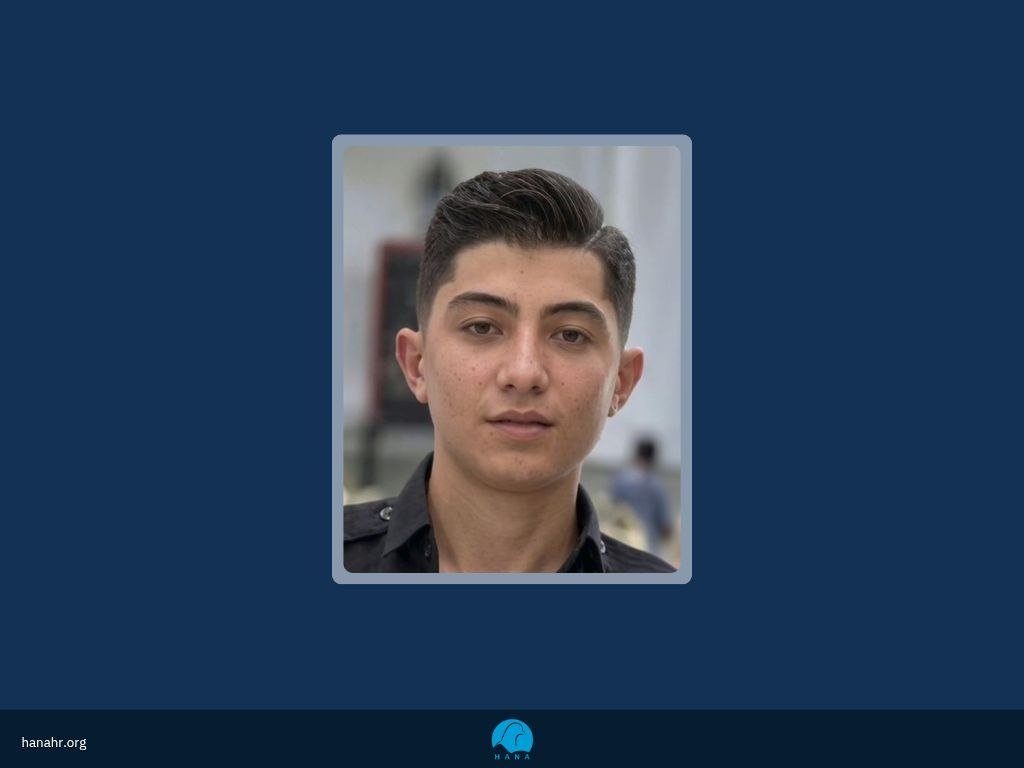
According to information received by the Hana Human Rights Organization, Arzhin Jondi, a 16 year old teenager from Piranshahr, was arrested on September 12, 2026, in connection with the killing of Islam Kak Darvishi, a member of the Islamic Revolutionary Guard Corps. Approximately ten days after his arrest, media outlets affiliated with government institutions published a video containing statements attributed to the teenager, in which he confesses to participating in Kak Darvishi’s killing. Hana has received information indicating that these statements were obtained under pressure and through mistreatment, without Arzhin having effective access to a lawyer.
Following the death of his father, Arzhin had been living with his uncle’s family in the village of Kawpar, in Piranshahr County. On the evening of September 11, 2026, Islam Kak Darvishi was shot by armed individuals in the village and died from his injuries. The following day, the public relations office of the West Azerbaijan Intelligence Organization of the IRGC announced the arrest of an individual in connection with the incident. Without disclosing the person’s name or age, it claimed that the arrested individual was responsible for the attack and that the weapon used had been recovered from him.
According to reports received by Hana, following the incident, Kak Darvishi’s family also accused Arzhin of participating in the killing, and his uncle’s home was destroyed. Hana has also received reports that Arzhin was subjected to pressure during his detention and was denied regular visits with his family and effective access to a lawyer. Given his age, the conditions of his detention, the manner in which he was interrogated, and the circumstances under which the statements attributed to him were obtained are of particular legal significance.
Arzhin was 16 years old at the time of the incident and is legally entitled to the special protections afforded to children and adolescents. Article 38 of the Constitution of the Islamic Republic of Iran prohibits torture for the purpose of obtaining confessions or information and considers confessions obtained through coercion invalid. The Islamic Penal Code also provides that a confession obtained through duress, coercion, torture, or physical or psychological abuse lacks the required legal value and validity. Therefore, if reports of pressure or mistreatment are substantiated, the statements obtained from Arzhin cannot be treated as a valid confession and used as the basis for his conviction.
Access to a lawyer in a case involving such serious allegations is not merely a procedural formality, but a fundamental safeguard of a fair trial. The Code of Criminal Procedure provides special protections in cases involving children and adolescents, particularly in offenses that may carry extremely severe punishments. The interrogation of a 16 year old without genuine and effective access to a lawyer, especially when his statements may be used against him, raises serious concerns regarding compliance with these safeguards.
The public release of images and statements attributed to Arzhin before judicial proceedings have also raised concerns. The presumption of innocence requires that no defendant be considered or presented as guilty before a final judgment has been issued. This protection is particularly important in the case of children, as safeguarding a child’s identity, privacy, and dignity throughout all stages of criminal proceedings is an essential requirement of juvenile justice. Publishing a teenager’s alleged confession before trial may not only violate his privacy, but may also affect the judicial proceedings and the presumption of innocence.
The Islamic Republic of Iran is also obligated under the Convention on the Rights of the Child and the International Covenant on Civil and Political Rights to protect children from torture, inhuman treatment, and coercion to confess against themselves. These obligations apply with particular importance to individuals under the age of 18, and authorities are required to ensure that any statements made by an accused child or adolescent are given freely, without pressure, and with full respect for his defense rights.
Arzhin’s age is also of fundamental importance in relation to the possibility of the death penalty. Although Article 91 of the Islamic Penal Code provides, in certain hudud or qisas offenses, for the possibility of not applying adult punishments to individuals under the age of 18, it does not establish an absolute prohibition on the death penalty for children. By contrast, the Convention on the Rights of the Child and the International Covenant on Civil and Political Rights prohibit the imposition and enforcement of the death penalty for an offense committed by a person before reaching the age of 18. The relevant criterion in this regard is the person’s age at the time of the alleged offense.
The Hana Human Rights Organization expresses concern over the physical and psychological condition of Arzhin Jandi, reports of pressure and mistreatment to obtain a confession, his deprivation of effective access to a lawyer and his family, and the public release of statements attributed to him.
Hana calls for the immediate guarantee of this teenager’s safety, free and confidential access to a lawyer and his family, an independent investigation into allegations of torture and mistreatment, and the rejection of any statements obtained under coercion.
Hana further emphasizes that, given that Arzhin was 16 years old at the time of the incident, the imposition or enforcement of any death sentence or qisas punishment against him would violate the international obligations of the Islamic Republic of Iran concerning children’s rights.