
Introduction
The Statistics Division of the Hana Organization for Human Rights publishes its monthly report on the human rights situation in Kurdistan for August 2026. The data and information contained in this report have been compiled through field investigations, interviews with victims of human rights violations and their families, and the review of documents and informed sources, and have subsequently been verified by independent sources. Although access to statistics and information in Iran is extremely difficult, Hana has made every effort to ensure that the information gathered is accurate and correct.
Accordingly, this report includes only those cases whose accuracy and reliability Hana has been able to confirm.
Arbitrary Detentions
In August 2026, Hana’s Statistics Division documented 77 instances of arbitrary detention of Kurdish citizens, carried out by security institutions of the Islamic Republic, in various cities and villages of Kurdistan. Of the 77 citizens detained, 11 were women, and a 16 year old child was among those detained. Three of the detainees, including two women, were sentenced to 74 lashes, and this sentence has been carried out. A combined total of 23 years’ imprisonment was handed down against 8 of the detainees, and a death sentence was issued against one individual.
The charges brought against the detainees included cooperation and membership with Kurdish parties opposed to the Islamic government of Iran, civil and professional activities, media activities, and the posting of content on social media.
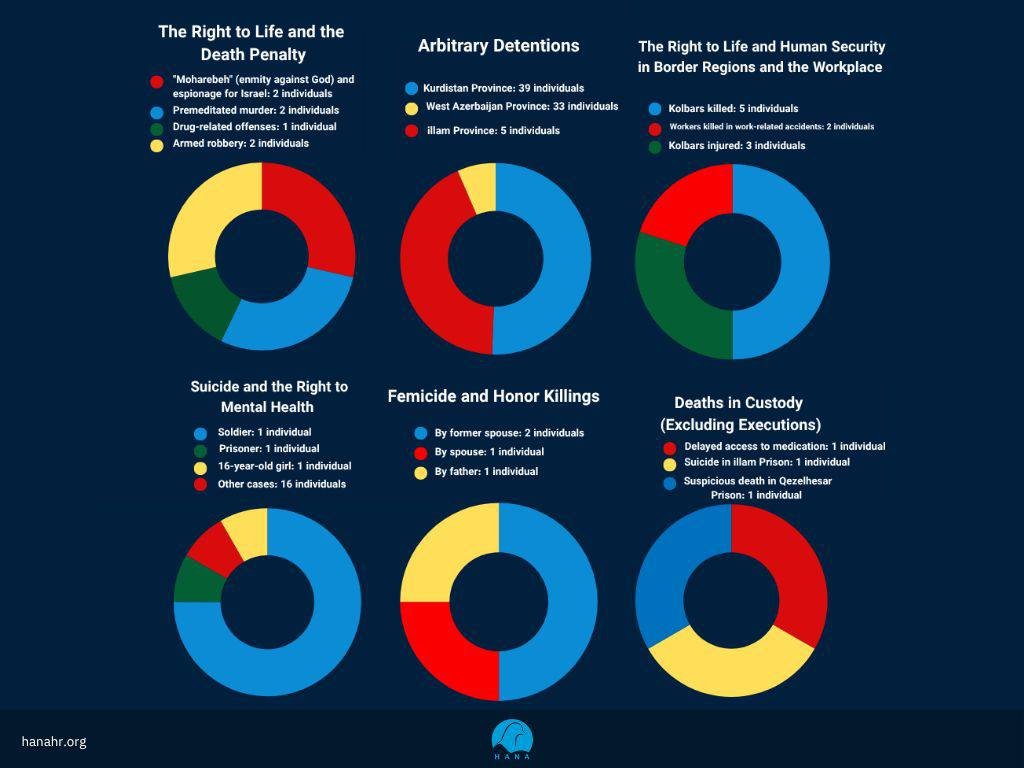
According to data from the Statistics Division of the Hana Organization for Human Rights, of the 77 citizens detained, 39 were detained in Kurdistan Province, 33 in West Azerbaijan Province, and 5 in illam Province.
The Right to Life and the Death Penalty
In August 2026, at least 7 Kurdish citizens were executed in various prisons across Iran. Among them, two were executed on charges of moharebeh and espionage for Israel, one on drug related charges, two on charges of premeditated murder, and two on charges of armed robbery.
It should be noted that, from the beginning of 2026 to date, at least 62 Kurdish citizens have been executed in various prisons across Iran. This month, three additional prisoners also died in prison. One prisoner died as a result of delayed access to medication. One prisoner died by suicide in Ilam Prison, and another died under suspicious circumstances in Qezel Hesar Prison.
The Right to Life and Human Security in Border Regions and the Workplace
Part of the violations documented in this report are directly connected to the right to life and human security in citizens’ daily lives. The deaths and injuries of kolbars, citizens falling victim to landmines left over from war, and workers losing their lives in unsafe working conditions, all three show that the right to life is endangered not only in courts and prisons, but is also under threat at the border, in villages, in the workplace, and along the routes people take to earn their livelihood.
In August 2026, Hana documented the deaths of at least 5 kolbars and the wounding of 3 kolbars. According to verified data, these cases occurred mainly as a result of direct gunfire by border guard forces. Regardless of the legal status of the goods being transported, the use of lethal force against kolbars can be justified only where there exists an immediate and serious threat to the life of officers or others, and no less dangerous alternative is available. The United Nations Basic Principles on the Use of Force and Firearms by Law Enforcement Officials emphasize necessity, proportionality, and the use of lethal force only as a last resort.
Poverty, unemployment, the absence of sustainable employment opportunities, and the underdevelopment of border regions have driven many citizens toward this high risk activity. A security response to a phenomenon rooted in economic and social causes, absent any reform of the underlying structural conditions, raises the risk that such deaths and injuries will continue to recur.
The deaths of at least 2 workers this month, in incidents arising from the lack of workplace safety, likewise reflect weak oversight and enforcement of safety standards. Article 7 of the International Covenant on Economic, Social and Cultural Rights guarantees the right to just, safe, and healthy working conditions. The deaths of workers in unsafe environments, where these result from a lack of equipment, inadequate training, or the absence of effective oversight, are not merely individual accidents; they are a sign of structural failure in protecting workers’ right to work, right to health, and human dignity.
Suicide and the Right to Mental Health
In August 2026, Hana recorded at least 12 instances of suicide in Kurdistan. Among those who died by suicide were a 16 year old girl, a soldier, and a prisoner. Hana’s investigations indicate that poverty, economic hardship, psychological and emotional pressures, and other social harms were contributing factors in these cases.
Suicide cannot be analyzed solely at the level of individual decision. This phenomenon is, in many cases, linked to poverty, social pressure, domestic violence, the absence of psychological support, limited access to healthcare services, and the lack of social support networks. An increase in, or persistence of, such cases within a region is a warning sign regarding the state of mental health, social security, and the level of support available to vulnerable groups.
Femicide and Honor Killings
In August as well, domestic violence, particularly violence against women, continued, and 4 women, including a 16 year old girl killed by her father, were murdered. All of these killings were carried out by a spouse or a first degree family member. In a society where women hold the fewest social and economic rights, and where no legal protection exists against domestic violence, women are the first victims of this system.
Overall Assessment of the Human Rights Situation in Kurdistan: August 2026
A review of this month’s data shows that the human rights situation in Kurdistan remains dire and unstable. According to the information gathered, a large number of citizens have been detained in connection with civil and political activities. These detentions have largely been carried out on a widespread basis and without regard for fair trial guarantees. The killing of kolbars and unlawful shootings directed at them continue, taking the lives of innocent people. Femicide and honor killings continue. Poverty, economic hardship, and depression and hopelessness about life have led to numerous suicides in Kurdistan.
Taken together, these events reflect a serious intensification of human rights violations and underscore the need for the prompt accountability of the perpetrators and those who ordered these actions, in accordance with the international obligations of the Islamic Republic of Iran.
Hana Organization for Human Rights August 1, 2026
The use of these statistics is permitted with attribution to the source.