
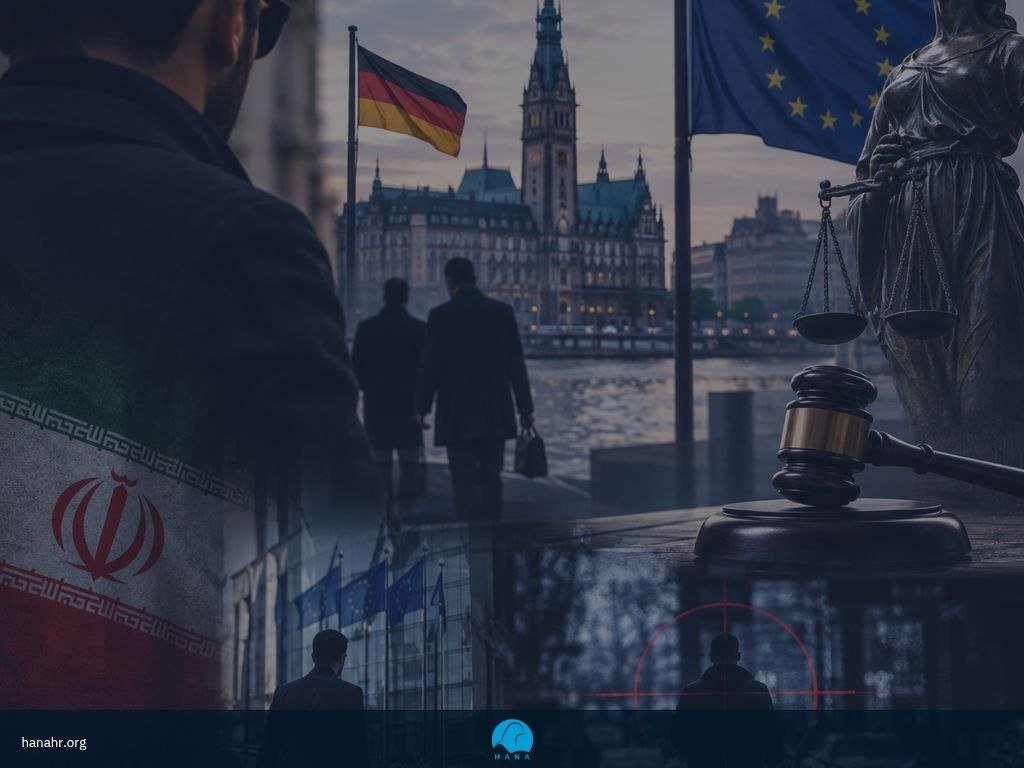
The conviction of two operatives linked to Iran’s Islamic Revolutionary Guard Corps (IRGC) Quds Force in Germany has renewed concerns over the reach of Iranian intelligence operations across Europe. On 15 October 2026, the Hamburg Higher Regional Court sentenced the two defendants to eight years and six months and four years and six months in prison, respectively. The court found that, acting under the direction of Quds Force operatives, they had participated in identifying prominent Jewish figures and supporters of Israel and preparing violent attacks on German soil. The case illustrates how Iranian intelligence operations abroad can be conducted through intermediary networks and individuals holding foreign citizenship.
Iran’s record of operations on European soil, particularly against Kurdish political leaders, is well documented in judicial proceedings. One of the most prominent cases was the 1992 assassination of Sadegh Sharafkandi, Secretary-General of the Democratic Party of Iranian Kurdistan, and three of his associates at the Mykonos restaurant in Berlin. In its landmark 1997 judgment, the Berlin court attributed responsibility for ordering the assassinations to senior Iranian officials. The subsequent conviction of Assadollah Assadi, a former Iranian diplomat stationed in Austria, who was sentenced to 20 years in prison in Belgium for his role in plotting a bomb attack against an Iranian opposition gathering in France, further exposed the risks associated with the misuse of diplomatic status to facilitate covert operations abroad.
A particular concern under international law is the potential abuse of diplomatic immunity and the inviolability of diplomatic premises. These extensive protections, intended to safeguard the legitimate functions of diplomatic missions, may be exploited to shield unlawful intelligence activities from scrutiny. Article 41 of the 1961 Vienna Convention on Diplomatic Relations requires diplomatic personnel to respect the laws of the receiving state and refrain from interference in its internal affairs. It also prohibits the use of diplomatic premises in any manner incompatible with the functions of the mission. The exploitation of these privileges for unlawful purposes is incompatible with the principle of good faith governing the performance of international obligations.
In light of Iran’s documented history of covert operations abroad, HANA Human Rights Organization reiterates the need to prevent diplomatic immunity from becoming a shield against accountability. European governments should make full use of the measures available under the Vienna Convention, including declaring diplomats personae non gratae, requiring the withdrawal of officials implicated in unlawful activities, restricting the size of diplomatic missions where justified, and reviewing diplomatic relations when serious abuses are established. Credible indications that diplomatic premises are being misused for intelligence operations must also be thoroughly investigated through lawful means. Respect for diplomatic inviolability must not be confused with tolerance of activities that violate the obligations of diplomatic missions.
HANA further expresses serious concern for the safety of Kurdish political party leaders, Iranian political activists, journalists, and human rights defenders residing in Europe. Surveillance, the identification of private residences, infiltration of personal communications, and intimidation of relatives in Iran can undermine their security and fundamental freedoms, even in countries where they have been granted asylum or international protection. These threats extend beyond the risk of physical attacks and may create a climate of fear that restricts legitimate political and human rights activities.
European states have obligations that extend beyond prosecuting perpetrators after an attack has occurred. They must take effective preventive measures, identify and investigate covert operational networks, examine credible links to Iranian state institutions, and provide appropriate protection to individuals facing foreseeable threats. International protection cannot fulfil its fundamental purpose if those who have fled political persecution remain exposed to intimidation, surveillance, or violence by the security apparatus of their country of origin.