
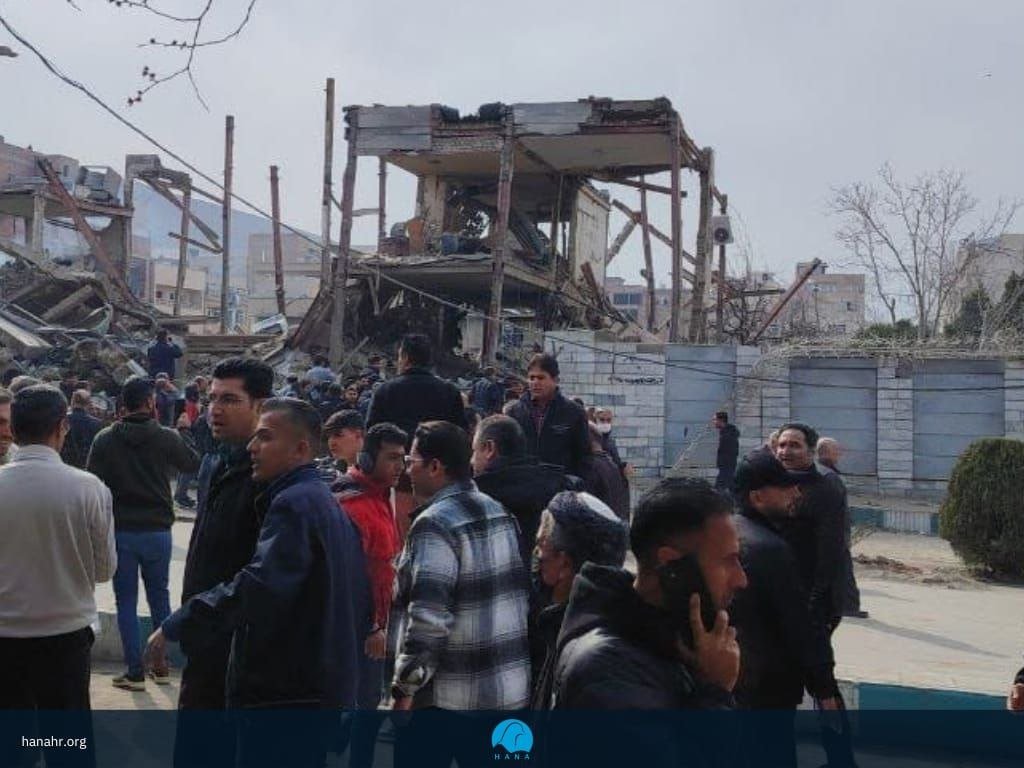
Special report on Sanandaj
The Hana Human Rights Organization, based on field data and information received from local sources, has released a new assessment of the humanitarian and security situation in Sanandaj.
According to field information, following heavy airstrikes by the United States and Israel on barracks, headquarters, and offices of military, police, and security forces, the level of security control in the city has significantly weakened. However, government forces have maintained a minimal operational structure and have established checkpoints within the city. Additional checkpoints have been set up along the Kamyaran–Kermanshah route, at Jihad Square, and on the Divandareh and Marivan roads. On the old Marivan road, checkpoints have been relocated closer to residential areas. On the Hamadan route, although traffic police remain in place, roads have been blocked with concrete barriers, severely restricting movement, with vehicle speeds effectively reduced to below 5 kilometers per hour.
At these checkpoints, semi-heavy weapons, including DShK machine guns, have been deployed, and in some locations these weapons are fixed in place. Several vehicles equipped with such weapons are continuously patrolling the city. The deployment pattern of forces has also changed, with scattered positioning across the city, surrounding highlands, and entry routes. Non-local forces have evacuated their families, and currently operational units, members of the Islamic Revolutionary Guard Corps, and pro-government auxiliary forces remain. Local sources state that these auxiliary forces operate under police command, which itself functions under the broader authority of the IRGC. Reports also indicate that the morale of these forces is unstable, with some avoiding active presence or relocating to lower-risk positions. There are also signs that field command has been centralized under the IRGC, while the role of administrative institutions has diminished. A significant portion of heavy weaponry has reportedly been transferred out of the city toward other areas, including regions near Kermanshah.
In addition, the deployment of forces in elevated positions and tall urban buildings has increased, and in some areas, including around squares and administrative centers, the presence of snipers has been reported. Local sources specifically report sniper deployment at Eqbal Square, including on top of buildings such as Bank Mellat and Bank Saderat Iran. Snipers have also been observed at city entrances and other elevated points.
Field reports indicate that some public spaces, including schools, have been repurposed as logistical support centers and for troop rotation. In the Baharan area and around Pavan intersection, several educational facilities are used for organizing and rotating personnel. A local school(Safei) near the electricity office has also been converted into a deployment site. According to local sources, troop movements are carried out by buses, with two buses bringing in new personnel while two others transport outgoing units. This rotation operates on a 24-hour duty and 24-hour rest cycle.
Following recent strikes, significant casualties among government forces have been reported. In the initial bombing at the provincial police command center, more than 64 personnel were killed. Another strike targeted a major IRGC camp used for housing forces, from which at least 12 bodies were reportedly removed in the early hours. Field sources estimate the total casualties to be higher and report dozens of additional injuries, although access to precise figures remains limited. In another airstrike on a militia base behind a mosque in the Baharan area, all individuals present were reportedly killed.
Reports indicate that these developments have had a noticeable impact on the morale of government forces. Local sources describe increasing levels of anxiety and declining morale, noting that the dispersion of forces and constant relocation reflect an unstable situation.
At the social level, despite ongoing attacks, the general atmosphere in the city is characterized by a mixture of anticipation and cautious optimism. Some residents view the weakening of government control as a sign of potential change and hold a positive outlook toward the future. At the same time, there are concerns that if the situation persists or stability is restored, civilians may face intensified security pressures.
In terms of livelihoods, despite severe inflation, access to food and essential goods remains available. However, prices have increased significantly: a 10-kilogram bag of Pakistani rice has risen from approximately 1,000,000 tomans to 2,860,000 tomans, five kilograms of sugar from 380,000 to 650,000 tomans, and one liter of cooking oil from about 280,000 to nearly 700,000 tomans.
The Hana Human Rights Organization considers the humanitarian consequences of recent developments in Sanandaj and their impact on civilians to be deeply concerning. The organization emphasizes the urgent need for attention from human rights and humanitarian institutions to the condition of residents and warns that the expansion of armed forces within urban areas and the use of public spaces increase risks to civilians. Given the nationwide internet shutdown and severe communication disruptions, Hana continues its efforts to report from Kurdistan cities, and these reports will be updated regularly.
Hana Human Rights Organization
16 March 2026