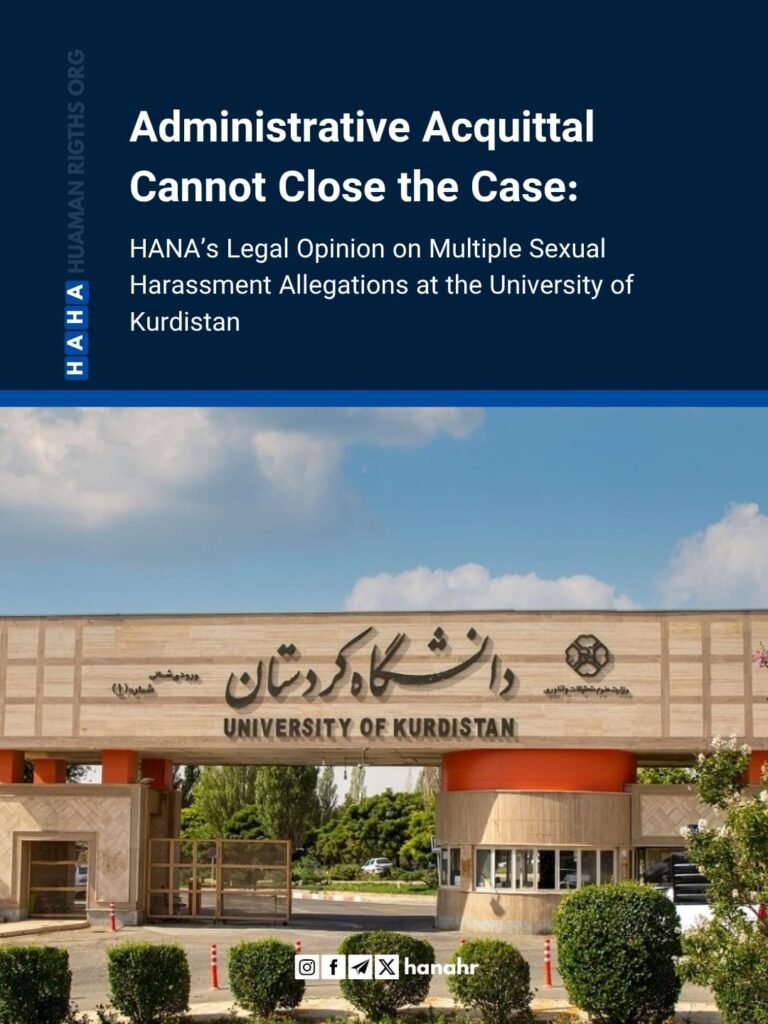
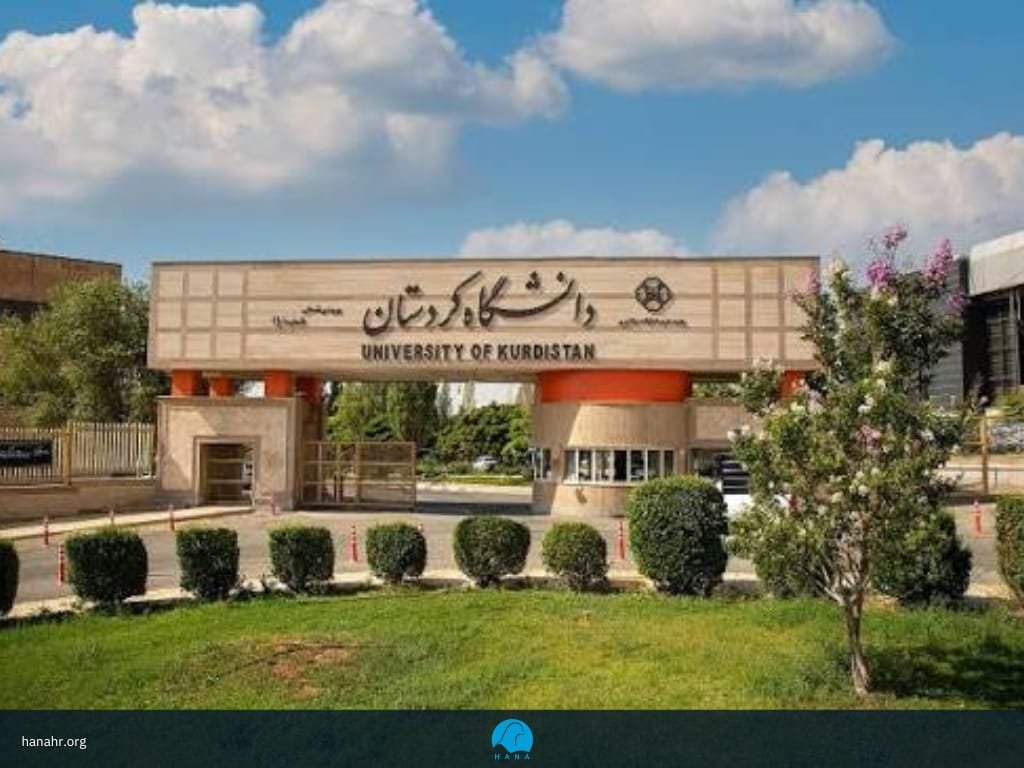
HANA Human Rights Organization has reviewed the publicly available information concerning multiple allegations of sexual harassment and assault against Jamal Mohammadi, a faculty member at the University of Kurdistan. HANA concludes that the disciplinary process conducted under the authority of Iran’s Ministry of Science did not satisfy the requirements of independence, specialist competence, transparency or procedural equality necessary for the credible examination of sexual misconduct allegations.
According to published reports, at least seventeen women, primarily students, submitted accounts concerning alleged conduct by Mohammadi. Their testimonies, correspondence and supporting materials were reportedly compiled in a file of approximately 300 pages. Several complainants were heard during the initial proceedings, which reportedly resulted in Mohammadi’s dismissal. That decision was subsequently replaced by an administrative finding of acquittal and permission to return to the university. The reasoning of either decision, the evidentiary assessment and the basis for this reversal have not been made public.
These facts do not establish Mohammadi’s individual responsibility as a final matter. They do, however, constitute sufficiently serious and cumulative grounds to prevent the case from being treated as closed. The number of allegations, the reported documentary record, the personal and academic risks assumed by complainants and the severity of the initial disciplinary decision require examination by an independent and properly qualified body.
The existing disciplinary framework for university faculty in Iran was not designed to address sexual harassment. It does not clearly define sexual harassment, consent, abuse of academic authority, hostile educational environments or retaliation against complainants. Such conduct is instead assessed through general concepts such as public morality or professional dignity. This approach treats sexual misconduct principally as an offence against institutional order rather than as a violation of bodily autonomy, dignity, equality and the right to a safe education.
The composition and procedure of disciplinary panels further weaken their legitimacy. The law does not require gender-balanced membership or the participation of independent lawyers, sexual-violence specialists, trained psychologists or student representatives. Faculty members are granted express rights to notice, defence, appeal and judicial review, while complainants are not guaranteed equivalent rights to receive reasons, challenge an acquittal, respond to material submissions or obtain protection against retaliation. The accused therefore appears as a formal party to the proceedings, while the woman reporting misconduct is largely treated as a source of information.
This imbalance is especially serious in sexual-harassment cases. Such conduct frequently occurs in private and within relationships marked by institutional dependency. A student may depend on a professor for grades, supervision, references and future academic opportunities. Delay in reporting, continued academic contact or the absence of physical evidence cannot therefore be treated as proof that an allegation is unreliable. A competent investigation must assess the accounts cumulatively, including their independence, timing, consistency, prior disclosure, digital communications and any recurring pattern of conduct.
HANA rejects the use of the administrative acquittal as proof that the complainants were dishonest or that no professional misconduct occurred. An administrative decision whose reasoning remains undisclosed cannot establish substantive innocence, particularly where the applicable procedure lacks specialised standards for examining sexual harassment.
HANA does not declare Mohammadi conclusively responsible for the alleged conduct. It nevertheless considers the allegations serious, the existing evidentiary indications substantial and the case legally unresolved. Any credible determination must be made by a body independent of both the University of Kurdistan and the Ministry of Science, with equal gender representation and meaningful participation by women with specialist knowledge of consent, trauma, academic dependency and sexual misconduct.
A procedure that hears women’s accounts but denies them effective participation, access to reasons and a meaningful right to challenge the outcome cannot be regarded as fair. An opaque administrative acquittal may alter an employment record, but it cannot lawfully extinguish unresolved allegations of this gravity.