
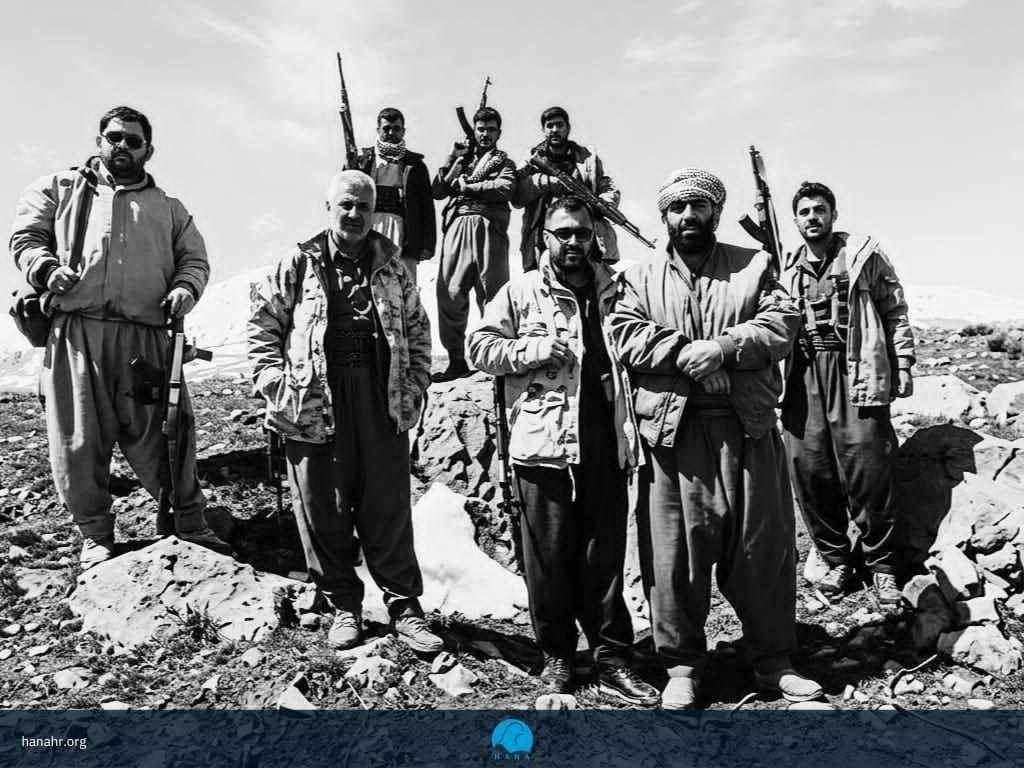
The Hana Human Rights Organization considers the rebroadcast of a video by state affiliated media in Iran, in which an armed individual identifies himself and his companions as “Muslim Peshmerga” and issues death threats against Kurdish parties, to be a deeply concerning sign of the revival of one of the most well known mechanisms of repression in Kurdistan.
For audiences unfamiliar with the political context of Kurdistan, it must be clarified that the term “Muslim Peshmerga” is not merely a symbolic or ideological label. It refers to a structure established and reinforced by the Islamic Republic of Iran in the early years following its consolidation of power, aimed at countering Kurdish political parties, including the Democratic Party of Iranian Kurdistan and the Komala Party of Iranian Kurdistan. Within the political and social discourse of Kurdistan, such individuals are commonly referred to as “Jash”, a term which, regardless of its literal meaning, denotes collaborators with the central government in the suppression of the legitimate demands of the Kurdish population.
The issue extends beyond a single threatening video. The reintroduction of this phenomenon by state media signals the reactivation of a security model in which the government seeks to internalize repression within Kurdistan by mobilizing local affiliates as instruments of pressure, intimidation, and violence against the Kurdish population. This policy has not merely been a security measure, but a strategy aimed at undermining social cohesion, deepening mistrust, eroding political life, and justifying serious human rights violations in the region.
At the same time, this phenomenon serves a clear symbolic and political function. By appropriating the label “Muslim Peshmerga”, the Islamic Republic of Iran attempts to strip the term “Peshmerga”, which in the collective memory of Kurdistan is closely associated with political struggle and resistance, from its historical, political, and social legitimacy, and to repurpose it within its own official narrative. In other words, the government is not only organizing armed affiliates, but also attempting to appropriate the language, symbols, and social legitimacy of the Kurdish people, thereby blurring the line between political resistance and collaboration with mechanisms of repression.
From a human rights and international law perspective, this model lacks any legitimacy. A state that, instead of guaranteeing the fundamental rights of its citizens, relies on affiliated actors to threaten, intimidate, and suppress segments of its population, not only fails in its obligations to protect the right to life, personal security, freedom of expression, and freedom of association, but also actively contributes to the reproduction of organized violence within society. Death threats against political opponents, whether issued directly by officials or through affiliated actors, are fundamentally incompatible with core human rights principles and with the state’s duty to protect civilians and prevent political violence.
The Hana Human Rights Organization emphasizes that the renewed promotion of this terminology and discourse in state media is not merely a media position, but a continuation of a broader logic of repression, one that views Kurdistan not as a political legal entity, but as a security issue to be engineered, controlled, and intimidated. Re legitimizing the so called “Muslim Peshmerga” effectively amounts to legitimizing one of the most destructive tools used by the state to localize repression in Kurdistan and to justify potential future crackdowns.
The Hana Human Rights Organization strongly condemns this development and considers it part of the continued policy of instrumentalizing pro government affiliates in Kurdistan to threaten, intimidate, and weaken Kurdish political and social life, particularly at a time when the Islamic Republic of Iran has been significantly weakened by war and has, in practice, lost effective control over parts of Kurdistan.