
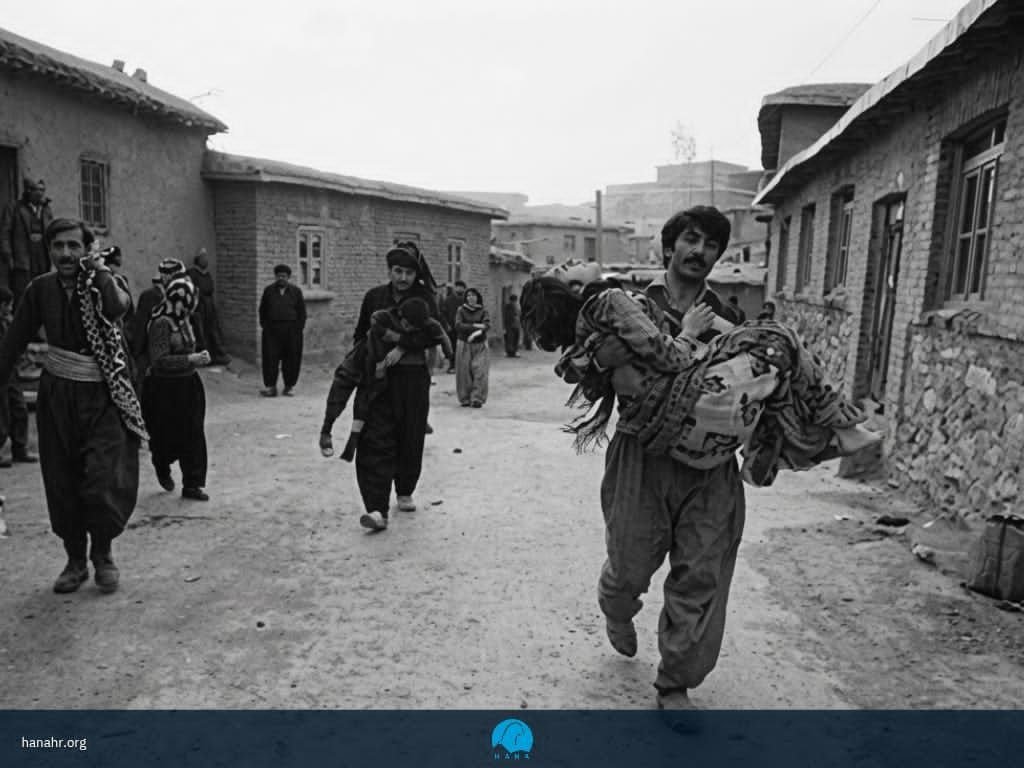
The Hana Human Rights Organization, on the anniversary of the massacre of civilians in the Piranjuq area in April-March 1983, documents this incident as part of a systematic pattern of gross human rights violations in Kurdistan. Although this crime has received little reflection in official sources, accounts from victims and survivors, along with some documents from Kurdish parties, remain the only available references.
According to investigations by Hana’s legal team, forces of the Islamic Revolutionary Guard Corps carried out operations between 23 and 28 March 1983 in the villages of Gicheh, Halaqush, Khalifalian, Gorkharn, Sufian, and Kanirash, located in the Orumiyeh region. As a result, more than 60 civilians were killed. Among the victims were children, pregnant women, and the elderly individuals with no involvement in armed conflict.
Multiple accounts describe the use of methods such as burning homes, throwing grenades into houses, and direct shootings of civilians. These actions not only led to widespread killings but also left deep physical, psychological, and social impacts on survivors and victims’ families.
This massacre is considered part of broader policies aimed at altering the demographic composition of the region against Kurds. Historical evidence indicates that in 1983, a policy of collective punishment against the Kurdish population was widely implemented, often accompanied by repression, forced displacement, and direct killing of civilians.
From the perspective of international human rights law, these acts constitute serious violations of Iran’s obligations under the International Covenant on Civil and Political Rights, particularly the right to life as set out in Article 6. Deliberate attacks on civilians and the failure to distinguish between military targets and civilian populations also represent clear violations of fundamental principles of international humanitarian law and, if the required elements are established, may qualify as crimes against humanity.
The Hana Human Rights Organization emphasizes that the lack of official documentation must not hinder the pursuit of truth, preservation of collective memory, and accountability for this crime. In this regard, Hana calls on all individuals who were affected, as well as families of victims, witnesses, and those with knowledge of the events, to share information, documents, and testimonies with the organization to support its legal documentation efforts. Accurate documentation of this crime is an essential step toward justice, accountability, and preventing the recurrence of such violations within the framework of transitional justice.
Hana Legal Team
Geneva, 28 March 2026