
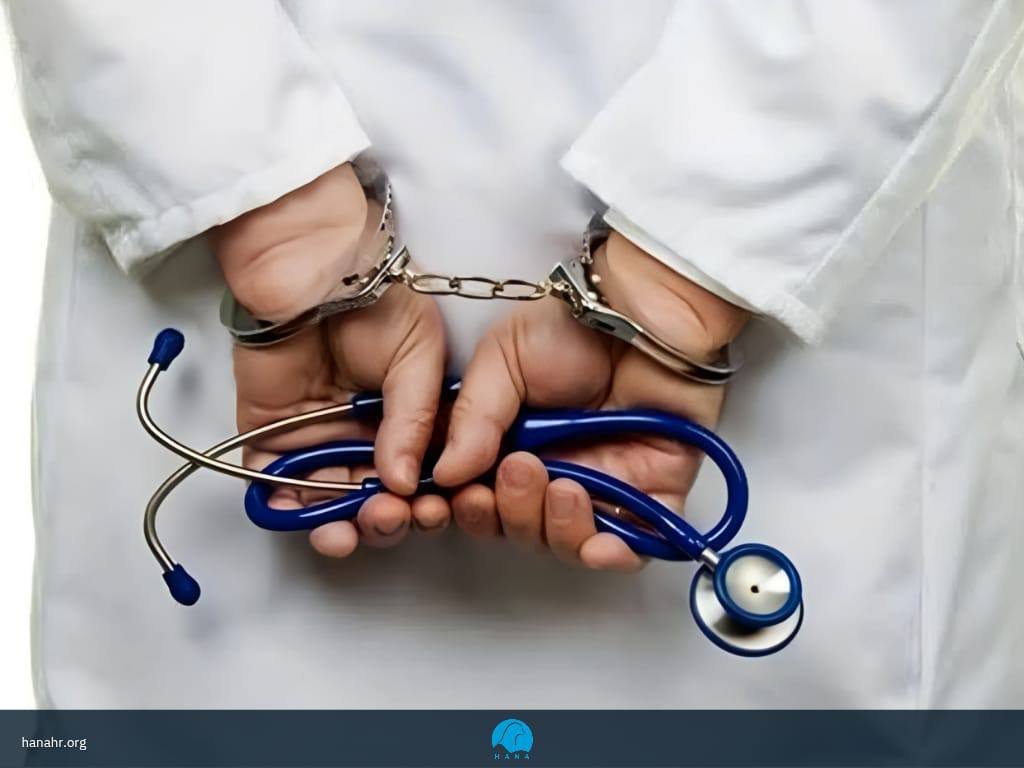
Based on field testimonies and reliable reports, the Hana Human Rights Organization has documented a consistent pattern of interference by security agencies in healthcare centers and the targeting of doctors and medical personnel during the nationwide January 2026 nationwide protests. According to these sources, security forces and plainclothes agents repeatedly entered hospitals, particularly emergency wards, creating an atmosphere of intimidation and turning the treatment of the wounded into a matter of “security.” This practice directly undermines the fundamental right to safe and immediate access to medical care and transforms hospitals from protective institutions into high-risk environments for patients, doctors, and medical staff.
A key aspect of security interventions was the coercion of medical personnel to record the identity and national ID numbers of the wounded and interfere with the documentation of medical injuries. These actions violate the right to privacy and the principle of confidentiality of medical information, weakening the trust between patient and doctor. Legally, creating fear of accessing hospitals—especially for injured individuals—has predictable and attributable consequences, potentially resulting in denial of urgent medical care, aggravation of injuries, or threats to the right to life.
Evidence also indicates that a number of doctors, nurses, and pharmacists were summoned, arrested, or prosecuted solely for performing their professional duties, namely treating the wounded. In multiple cases, general security-related charges were used to justify these actions, with no transparency regarding the legal basis for arrests, access to legal counsel, family contact, or effective judicial oversight. This situation violates the prohibition of arbitrary detention and fair trial guarantees under international human rights law and involves psychological pressure, intimidation, mistreatment, and coercion of family members. In some cases, the detention of close relatives was reported as a form of leverage.
These acts constitute torture and forms of collective punishment prohibited under peremptory norms and fundamental standards of international law. Additionally, the deterrent effect of this approach systematically undermines the health system’s capacity to provide impartial and timely care.
From a legal perspective, the aforementioned actions violate the state’s obligations under international human rights law, including the right to life, the right to health, the prohibition of torture and cruel, inhuman, or degrading treatment, the prohibition of arbitrary detention, the right to a fair trial, and the right to privacy. Furthermore, UN medical ethics standards prohibit forcing healthcare workers to breach professional ethics or participate in acts leading to mistreatment. The principle of medical neutrality under international humanitarian law, including the Additional Protocols to the Geneva Conventions and customary rules, emphasizes the prohibition of punishing individuals for performing medical duties in accordance with professional ethics and the necessity of protecting healthcare personnel. Even in cases of differing classifications, these standards provide a minimum common benchmark: states cannot criminalize medical treatment or interfere with professional medical decisions and must ensure the independence and safety of medical staff.
The geographic scope of the reports, with repeated focus on emergency departments and treatment of the wounded, provides strong evidence of coordinated policy rather than isolated violations. The continuation of such patterns indicates the use of the healthcare system as a tool for control and public intimidation and can be assessed as a severe human rights violation. In specific cases, and if elements such as scale, systematic nature, and connection to policy are established, these acts could be considered in the context of crimes against humanity.
Based on human rights obligations and medical ethics standards, the Hana Human Rights Organization calls for the following urgent measures:
• Immediate cessation of security forces’ presence and interference in hospitals, especially in emergency wards.
• Ending the criminalization of medical treatment and closing cases based solely on the provision of healthcare.
• Immediate release of detainees or clarification of their legal status, including clear charges, full observance of fair trial rights, immediate access to a lawyer, and ability to contact family.
• Ensuring the confidentiality of medical data and prohibiting any coercion to disclose the identity of the injured or manipulation of medical documentation.
• Establishing an independent, impartial, and effective investigation mechanism into claims of mistreatment, disappearance, and pressure on families, with accountability and reparations guaranteed.
List of healthcare personnel arrested or with uncertain legal status:
List of healthcare personnel arrested or with uncertain legal status:
Doctors released after temporary detention:
- Alireza Golchini – Surgeon, Oncology & Breast Specialist – Qazvin (released on bail)
- Farhad Naderali – General Surgeon, Faculty Member, Golestan University of Medical Sciences – Gorgan (released on bail)
- Dr. Iraj Barghi – Internal Medicine Specialist – Orumiyeh (released on bail)
- Dr. Mohebat Ghafoori – Pediatrician – Lar (released on bail)
- Dr. Hamid Barani – Bam (released)
- Dr. Hoorieh Ramyar – Bam (released)
- Dr. Majid Dehghan – General Practitioner (released)
- Dr. Ayoub Mir Hosseini – Dentist – Shiraz (released)
- Dr. Mahbubeh Zamiri – OB/GYN – Shiraz (released)
- Dr. Mohammad Sahami – Internal Medicine Specialist – Saveh (released)
- Dr. Shamsi Abbasali-Zadeh – OB/GYN / University Professor – Tabriz (released on bail)
Doctors in detention / status unclear:
- Saber Dehghan – Neurosurgeon – Sirjan
- Babak Pouramin – Emergency Medicine Specialist – Neyshabur
- Dr. Hossein Zarabian – Infectious Diseases Specialist – Isfahan (Baharestan)
- Dr. Masoud Ebadi-Fard Azar – Head of Pasteur Hospital – Qazvin
- Dr. Parisa Porkar – Ophthalmologist – Qazvin
- Dr. Fariba Hosseini – Dentist – Shiraz
- Dr. Golnar Naraqi – Emergency Medicine Specialist – Robat Karim
- Dr. Mohammad Jafar Khoshro – Pharmacist – Jannatshahr Darab
- Dr. Ghorbani – Pharmacist – Isfahan
- Amin Pourfarhang – Pharmacy Student – Mashhad
- Dr. Sobhan Esmaeilpour – Rasht (reports of torture and detention of mother)
- Dr. Abdolreza Hosseini – Golpayegan (with spouse)
- Alireza Rezaei – Urology Specialist – Tehran
- Dr. Ameneh Soleimani – Ardabil
- Ghazal Omidi – Physician – Abdanan
Nurses / medical staff
Nurses in detention / status unclear:
- Ahmad Khosravi – Nurse – Dehloran
- Mohammad Moradi – Nurse – Dehloran
- Ehsan Ahmadi – Nurse – Dehloran
- Hossein Karami – Nurse – Dehloran
- Hossein Karimi – Nurse – Dehloran
- Moein Moradian – Healthcare Staff – Mashhad
- Fatemeh Afshari – Nurse – Tehran
- Amir Khosravani – Nurse – Tehran
- Davood Zamani – Nurse – Isfahan
- Mr, Salehpour – Nurse – Tehran
- Reza Khodabandeh – Nurse – Mashhad