
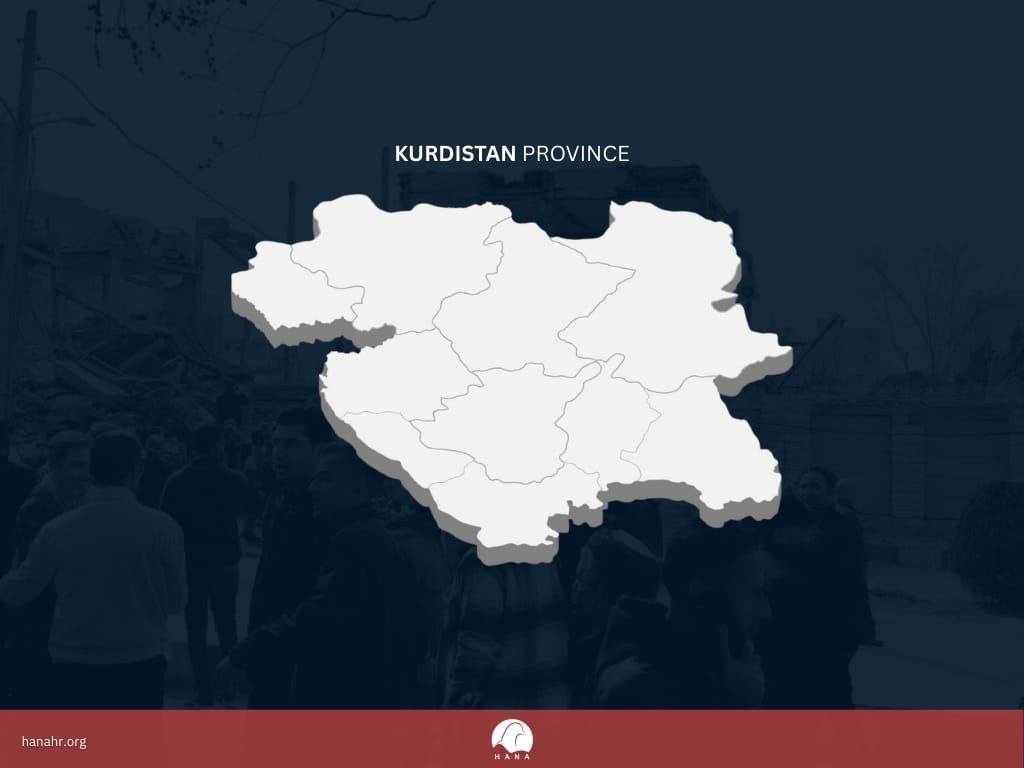
Special report on Divandareh
Continuing its reports on the humanitarian and security consequences of the wartime situation in cities across Kurdistan, the Hana Human Rights Organization—amid ongoing widespread communication disruptions and restricted access to independent information—publishes its special report on the situation in Divandareh based on field sources.
According to field assessments, following airstrikes carried out in recent days by the United States and Israel against military and security centers in Divandareh, the atmosphere of the city has become heavily militarized. Parts of the roads leading to military and security sites have been blocked, disrupting the daily movement of civilians and forcing residents to use longer alternative routes.
At the same time, reports indicate that during the initial strikes on facilities affiliated with military forces, a number of ordinary civilians were killed and injured. Although no precise casualty figures are currently available, strict restrictions on access to medical facilities and tight security control over hospitals have made independent verification of casualty numbers extremely difficult.
During the attacks and bombardments, parts of residential homes were damaged and several families were forced to leave their houses. Some residents have sought refuge in nearby villages, while others have temporarily moved into the homes of relatives. Families living near security and military centers have also left their homes due to fear of further attacks.
In terms of livelihoods, field information indicates a significant escalation of economic pressure. Although the market has not been completely closed, economic activity has sharply declined. The market is effectively shut down during nighttime hours, civilian presence has decreased significantly, and trade has largely shifted toward essential goods and food supplies.
According to local reports, prices have increased to unprecedented levels within a short period. The price of cooking oil has risen from 20,000 tomans to 200,000 tomans, red meat has reached up to 1,700,000 tomans, and chicken has risen to 285,000 tomans. The cost of utilities—including water, electricity, and gas—has also increased noticeably. These developments have severely weakened the purchasing power of a large portion of the population.
From a security perspective, Hana’s field investigations indicate that the deployment pattern of government forces in Divandareh has changed. Armed forces are increasingly using non-military locations for their presence and deployment. Some forces are stationed in administrative and public buildings—including the Agricultural Jihad office, the Imam Khomeini Relief Committee offices, schools, and both girls’ and boys’ dormitories—facilities that were reportedly evacuated under orders from security institutions.
At the same time, armed forces are reportedly using vehicles with civilian license plates to reduce the risk of identification. Reports also indicate that some commanders move around the city in civilian clothing and traditional Kurdish attire. Vehicles previously associated with military institutions and bearing official plates are now being seen with private license plates.
Available information further suggests that some deployed forces, due to concerns about being targeted at fixed locations, remain inside vehicles where they eat, rest, and frequently change their positions.
Permanent checkpoints in many areas have been removed; however, when security alerts are issued, they are temporarily re-established and later dismantled again after a short period.
In terms of social control, the authorities have reportedly attempted to pressure the public sphere through the widespread sending of threatening text messages. Reports indicate that between 10 and 15 messages are sent daily to citizens. Some of these messages contain propaganda claims and unverifiable statistics about wartime developments, while others include direct threats against any communication with foreign actors or the sharing of images, videos, or information.
In these messages, any form of independent media cooperation or information sharing is framed as a security offense, with explicit threats of severe punishments—including execution. Local sources report that this situation has significantly increased distrust and fear in everyday interactions among citizens.
Psychologically, reports suggest that women and children are bearing the greatest emotional burden caused by bombardments, the security atmosphere, and general uncertainty. At the same time, local sources also report signs of psychological pressure among some forces affiliated with the government.
Hospitals and emergency departments have at various times been placed under strict security control. During attacks, access for ordinary patients to certain medical sections has been restricted or temporarily suspended, raising serious concerns about citizens’ right to access emergency medical services.
The Hana Human Rights Organization warns about the intensifying humanitarian and security consequences of the current situation in Divandareh and calls for immediate attention from international human rights and humanitarian institutions regarding the condition of civilians, the protection of civilian facilities, and the guarantee of free access to medical care and basic necessities. Hana strongly condemns the misuse of civilian facilities by armed forces of the Islamic Republic, which places the lives of civilians at serious risk.
Hana Human Rights Organization
15 March 2026