
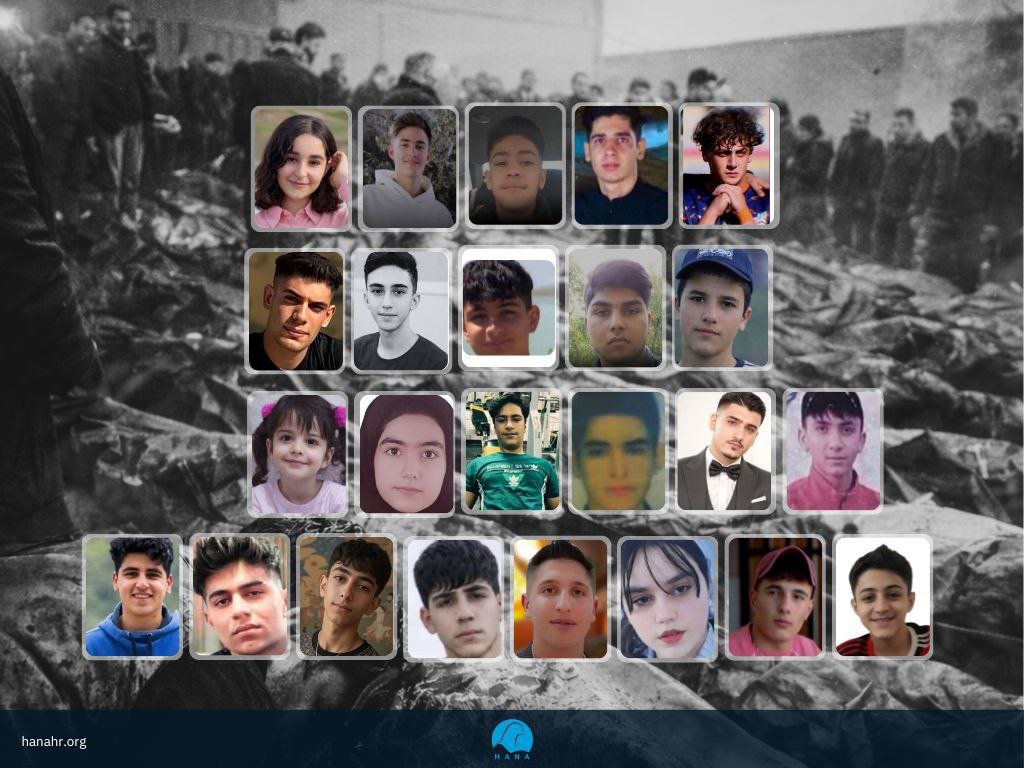
The Hana Human Rights Organization, based on field investigations, document review, and multi-source verification, has so far succeeded in identifying at least 24 children who were killed during the nationwide protests in Iran as a result of direct live-fire by government forces. The collected evidence shows that the use of military-grade weapons against children was not accidental or isolated, but occurred as part of a systematic, continuous, and lethal pattern, directly targeting one of the most vulnerable groups among the protesters.
The findings indicate that in numerous cases, deliberate and intentional shots were fired at vital parts of children’s bodies. Among the victims are very young children, including a three-year-old child.
The conduct of government forces in their use of firearms stands in serious contradiction to fundamental principles governing the use of lethal force—namely necessity, proportionality, and distinction—and constitutes compelling evidence of the intentional use of inherently lethal weapons. Hana Human Rights Organization emphasizes that the persistence and repetition of this practice elevates it beyond individual misconduct or isolated error, amounting instead to an organized pattern attributable to the structures responsible for suppressing protests.
The children documented in this report range from early childhood to late adolescence and, as part of the future generation of society, were subjected to deadly violence during the repression of protests. Based on verified data, the identified victims are as follows:
- Melina Asadi, 3 years old (Kermanshah)
- Sana Tunsagi, 12 years old (Kermanshah)
- Sam Sohbat-Zadeh, 14 years old (Khalkhal)
- Nazanin Zahra Salehi, 13 years old (Kermanshah)
- Asra Tavousi-Nia, 14 years old (Sonqor)
- Abolfazl Dehghani, 14 years old (Bijar)
- Taha Safari, 15 years old (Kermanshah)
- Erfan Ezati, 15 years old (Kermanshah)
- Mostafa Falahi, 15 years old (Azna)
- Heydarali Barati Kordkanlou, 15 years old (Quchan)
- Abolfazl Ghaleh-Gari, 16 years old (Kermanshah)
- Mohammadreza Abdolrahman-Zadeh, 16 years old (Salmas)
- Alireza Seyedi, 16 years old (Abdanan)
- Mohammad Taha Sepahvand, 16 years old (Khorramabad)
- Mohammad Matin Bagheri, 16 years old (Kermanshah)
- Amir Mohammad Arbab-Pouri, 16 years old (Harsin)
- Amir Ali Heydari Jafarabadi, 17 years old (Kermanshah)
- Sina Maleki, 17 years old (Kermanshah)
- Reza Ghanbari, 17 years old (Kermanshah)
- Rêbin Moradi, 17 years old (Salas-e Babajani)
- Zhivar Rahmani, 17 years old (Paveh)
- Amir Mehdi Moradi, 13 years old (Nurabad)
- Amir Mohammad Safari, 15 years old (Mamulan)
- Hossein Kaidi, 17 years old (Andimeshk)
From the perspective of international human rights law, including obligations arising from the Convention on the Rights of the Child, the state is required to guarantee the right to life of children and to prioritize the best interests of the child in all actions. The direct shooting of individuals under the age of 18, particularly in the context of crowd control, constitutes a grave violation of the right to life and of the state’s protective obligations toward children. When such conduct is widespread or repeated within the framework of a widespread or systematic attack against the civilian population, it may amount to crimes against humanity. Hana emphasizes that no security justification and no unproven accusation can absolve the state and responsible officials of accountability for these killings.
Hana Human Rights Organization stresses that the registration and identification of these 24 children marks the beginning of the path toward justice and accountability. The consequences of these killings—from the suffering and deprivation endured by grieving families to the broader social and educational impacts of the violent removal of children from collective life—reflect a form of repression that has targeted the right to life and the future of an entire generation.
This organization holds the governing structure and security institutions of the Islamic Republic of Iran responsible for these killings and calls for independent and effective international investigations, guaranteed access for families to truth and justice, and the criminal prosecution of those who ordered and carried out these crimes before competent international bodies.