
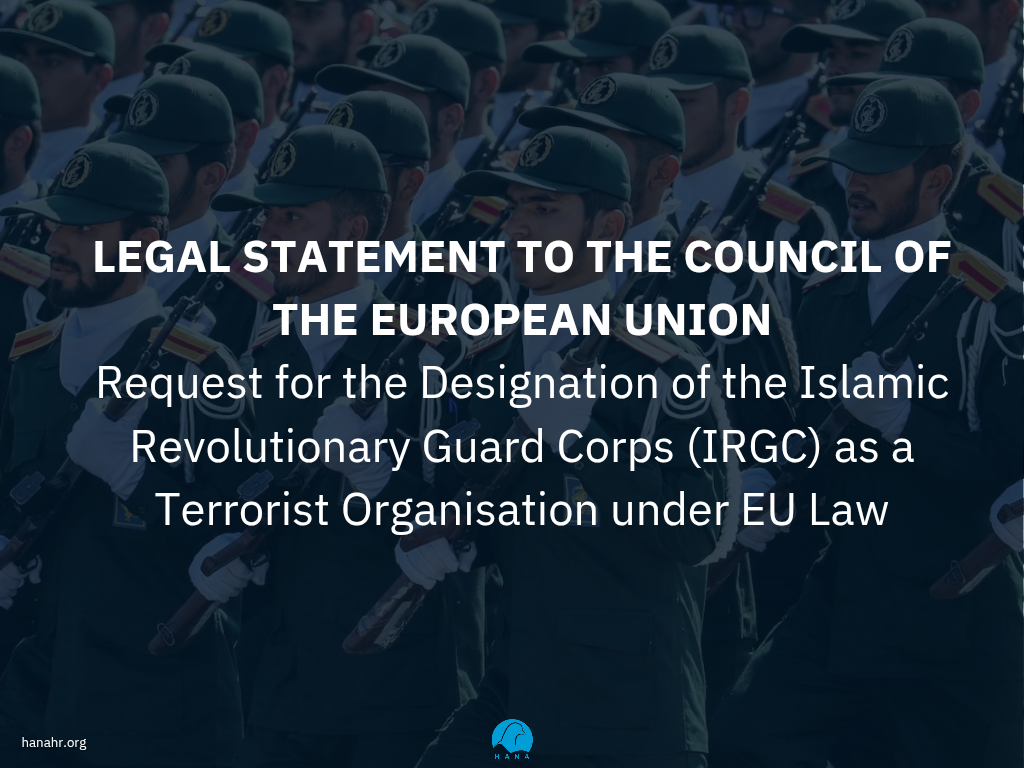
Request for the Designation of the Islamic Revolutionary Guard Corps (IRGC) as a Terrorist Organisation under EU Law
Submitted by: Hana Human Rights Organization (HANA)
Date: 16 January 2026
Addressed to: The Council of the European Union
I. Executive Summary
Hana Human Rights Organization (HANA) respectfully submits this legal statement urging the Council of the European Union to designate the Islamic Revolutionary Guard Corps (IRGC) as a terrorist organization under the EU’s counter-terrorism listing regime, in particular Council Common Position 2001/931/CFSP and Council Regulation (EC) No 2580/2001.
This request is grounded in a cumulative and convergent evidentiary record, including:
1. The institutional nature of the IRGC as a constitutionally empowered coercive apparatus with an explicit mandate to protect the Islamic Republic’s ideological and security order.
2. Its longstanding operational involvement in terrorism-related activity and extraterritorial violence, including sustained support structures that enable armed operations beyond Iran’s borders.
3. Independent judicial findings, including German proceedings (notably the Mykonos case), evidencing state-linked violent operations in Europe; and
4. The recent mass killing of Iranian protesters in January 2026, in which extensive reporting describes a large-scale lethal crackdown carried out through the state’s integrated security apparatus, including the IRGC and Basij structures, as principal actors.
II. The Legal Nature, Mandate, and Structure of the IRGC
The IRGC is not an ordinary military unit. It is a constitutionally entrenched institution under Article 150 of the Constitution of the Islamic Republic of Iran, with statutory foundations adopted by the Iranian Parliament on 6 September 1983.
Under its governing statute, the IRGC’s primary mission is the protection of the ‘guardianship of the Islamic Revolution’ and the preservation of the regime’s ideological order. Its mandate is thus structurally oriented toward regime preservation rather than neutral defence functions.
In practice, the IRGC operates as a multi-domain coercive organisation combining:
- internal security and intelligence structures that facilitate repression and surveillance;
- expeditionary and covert operational capabilities (including the Quds Force); and
- extensive economic and logistical networks that sustain, fund, and enable operations domestically and internationally.
III. The IRGC’s Terrorism Nexus and Pattern of Extraterritorial Violence
The IRGC’s operational footprint extends beyond Iranian territory through support, coordination, training, financing, and arms provision to armed non-state actors. HANA’s prior documentation details sustained links to entities widely recognised for terrorist activity, including Hezbollah and Hamas.
The IRGC’s conduct has repeatedly been characterised as a pattern of state-enabled organised violence, including covert operations and institutional support structures that facilitate attacks on civilian targets, political opponents, and diaspora communities. This pattern reflects not isolated misconduct, but an operational logic embedded in the organisation’s mandate, capabilities, and external networks.
IV. EU Legal Framework for Terrorist Listing
The Council’s legal competence to list persons, groups, and entities involved in terrorist acts is established under:
- Council Common Position 2001/931/CFSP; and
- Council Regulation (EC) No 2580/2001.
The Common Position requires that listings be grounded in a decision by a competent authority, which may include judicial or administrative bodies, and that listings be supported by sufficiently reliable and reviewable material forming a defensible factual basis.
EU jurisprudence affirms: (i) the Council’s obligation to observe fundamental rights and due process guarantees when adopting restrictive measures, including effective judicial protection; and (ii) the permissibility, in principle, of relying on competent authority decisions and supporting evidence for counter-terrorism listings, subject to appropriate safeguards and review.
V. Evidentiary and Judicial Grounds Supporting IRGC Designation
HANA recalls that the EU listing mechanism exists to address entities whose operational identity is inseparable from terrorist activity and facilitation.
The evidentiary record supporting the designation of the IRGC includes multiple judicial and administrative determinations, including:
- Germany (Mykonos proceedings): German judicial proceedings widely understood to have established responsibility of the Islamic Republic’s security apparatus for targeted political killings on European soil, constituting a landmark instance of state-linked extraterritorial assassination;
- United States: the IRGC’s designation as a Foreign Terrorist Organization (FTO) in 2019, alongside related litigation cited in earlier documentation; and
- Canada (2024): governmental listing measures grounded in terrorism-related conduct and grave rights violations.
Taken together, these determinations reinforce the functional rationale of the EU framework: to prevent the financing, facilitation, and operational reach of terrorism-linked entities through EU-wide restrictive measures.
VI. Updated Emergency Context: January 2026 Mass Killing of Protesters and the Central Role of the IRGC
Since late December 2025, Iran has witnessed a renewed nationwide protest wave met with a severe escalation of lethal repression. This crackdown has been accompanied by sweeping restrictions on communications, including widespread internet shutdown measures that obstruct documentation, verification, and accountability.
International reporting has described:
- security forces firing directly into crowds across multiple cities, suggesting indiscriminate or unlawful use of lethal force;
- severe restrictions on internet access deployed as a governing tactic to suppress visibility and impede evidence collection; and
- compelling casualty indicators, including verified footage showing bodies accumulating at a morgue near Tehran.
Critically, reporting on the crackdown describes the mobilisation and operational presence of Revolutionary Guards and Basij militia, indicating that the IRGC’s structures form a central component of the machinery of violence.
On these facts, the IRGC cannot credibly be presented as a neutral state institution detached from atrocity crimes. Rather, it appears as a principal institutional enabler and executor of organised lethal repression, operating within a security architecture that treats protest as an existential threat.
VII. Request and Legal Consequences
For the reasons set out above, HANA respectfully urges the Council of the European Union to:
1. Designate the Islamic Revolutionary Guard Corps (IRGC) as a terrorist organisation under Council Common Position 2001/931/CFSP and Council Regulation (EC) No 2580/2001;
2. Apply the full range of restrictive measures associated with designation, including asset freezing and the prohibition on making funds or economic resources available, directly or indirectly, to the IRGC; and
3. Treat the January 2026 mass killing of protesters as a contemporaneous and aggravating factual basis demonstrating the IRGC’s present role as a central engine of organised violence and repression.
VIII. Conclusion
The EU’s counter-terrorism listing framework is not merely declaratory. It is a preventive legal mechanism designed to disrupt networks of organised violence, deny operational capacity, and uphold the Union’s foundational commitments to human dignity, legality, and accountability.
The IRGC’s institutional design, its operational record, and the updated evidence emerging from the January 2026 killings together satisfy the legal and factual threshold for designation. Continued non-designation risks normalising an entity whose functions, in practice, include the domestic and transnational organisation of terror, coercion, and lethal force.
Hana Human Rights Organization (HANA)
16, January 2026