
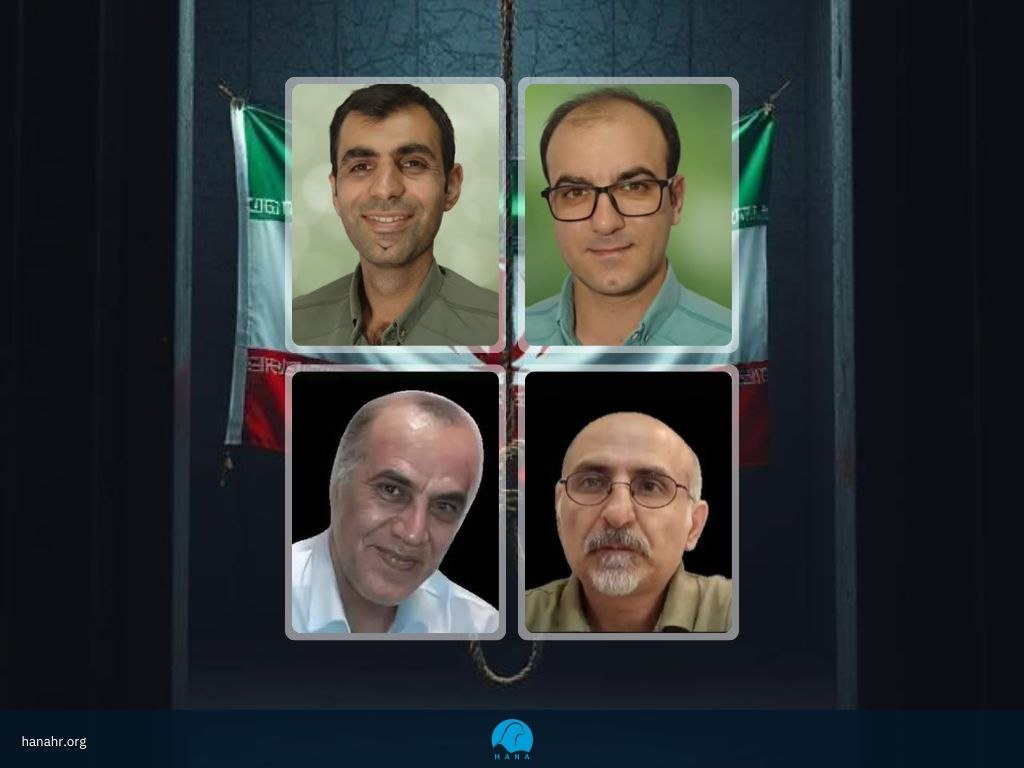
The Hana Human Rights Organization expresses grave concern over the continued implementation of death sentences against political and security-related defendants in Iran. It states that the Islamic Republic of Iran continues to carry out executions amid peak wartime conditions and widespread instability, despite reports indicating serious violations of fair trial standards in these cases. Following the execution of Akbar Daneshvar Kar and Mohammad Taghavi Sangdehi in the early hours of Monday, 30 March 2026, Babak Alipour and Pouya Ghabadi Bistouni were also executed on Tuesday, 31 March 2026. All four had been accused by authorities of membership in the People’s Mojahedin Organization of Iran and involvement in armed and security-related activities.
According to available information, the death sentences of these four individuals, along with Vahid Bani Amerian and Abolhassan Montazer, were issued in December 2024. However, the judicial process in these cases has been accompanied by serious human rights concerns from the outset. Mai Sato, the United Nations Special Rapporteur on human rights in Iran, stated in November 2025 that the proceedings were inconsistent with fair trial standards, citing delayed access to chosen legal counsel, reliance on confessions allegedly obtained under torture, and failure to investigate claims of torture.
From the perspective of international human rights law, particularly Article 14 of the International Covenant on Civil and Political Rights, these issues constitute clear violations of the right to a fair trial. Defendants in criminal cases—especially those facing the death penalty—must be guaranteed prompt and effective access to independent legal counsel, the right to remain silent, the right to challenge evidence obtained under torture, the right to a public and independent hearing, and the right to full examination of evidence by an impartial tribunal. Available evidence suggests that these fundamental guarantees were not upheld in the cases in question.
Moreover, the use of confessions attributed to the defendants under circumstances involving allegations of torture and coercion is in direct contradiction with the absolute prohibition of torture and the inadmissibility of statements obtained under such conditions. In addition, the lack of transparency regarding court proceedings, the evaluation of evidence, and the quality of access to an effective defense has further deepened concerns about the legitimacy of the issued sentences.
Hana emphasizes that carrying out these executions at a time when the country is facing war, crisis, and increasing instability reinforces concerns that the Islamic Republic of Iran is using the death penalty not merely as a criminal sanction, but as a tool to intensify intimidation and eliminate political activists and security-related defendants. Resorting to executions in such a closed and opaque environment further indicates the political use of the criminal justice system under wartime conditions.