
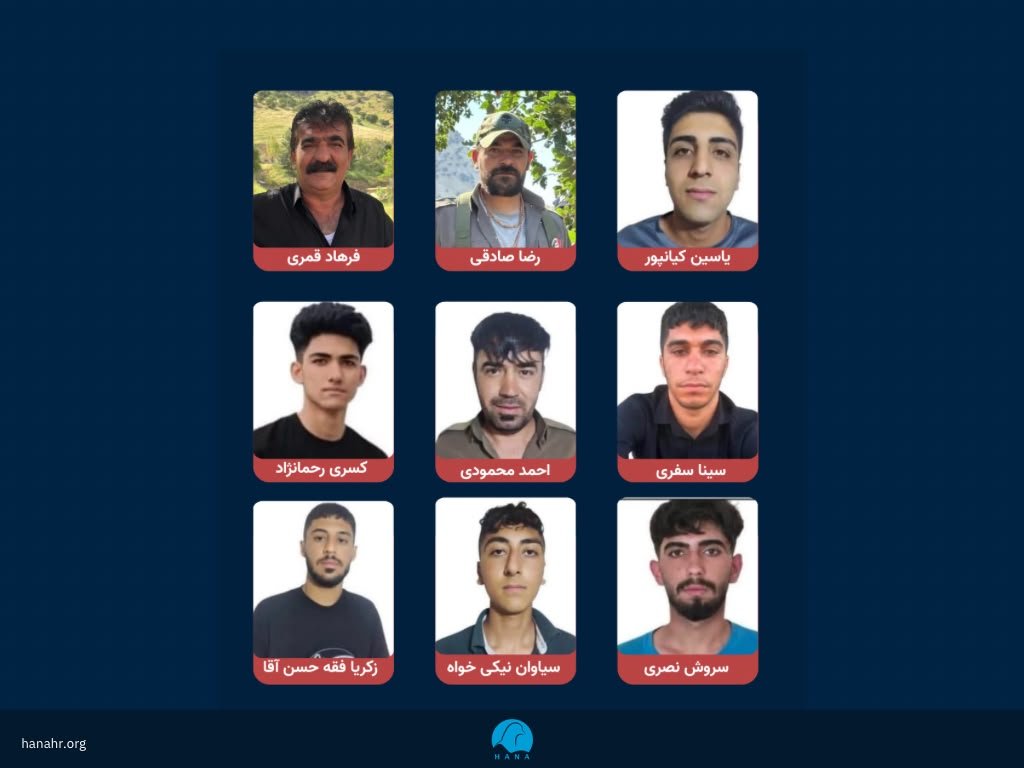
According to information documented by the HANA Human Rights Organization and an official statement issued by the Secretariat of the Central Committee of the Komala Party of Iranian Kurdistan, several camps and facilities affiliated with the party in the Zargwezle area, near Sulaymaniyah in the Kurdistan Region of Iraq, came under missile attack by Iran’s Islamic Revolutionary Guard Corps (IRGC) at approximately 6:00 a.m. on Friday, 17 July 2026.
Based on information verified by HANA to date, nine members of the Komala Party were killed and two others were injured in the strike. One of the injured is reported to be in critical condition.
In its official statement, Komala identified those killed as Peshmerga members but did not disclose the identities or conditions of the two injured individuals.
The deceased have been identified as:
- Farhad Qamari, from Divandareh
- Soroush Nasri, from Marivan
- Sina Safari, from Shahabad
- Yasin Kianpour, from Shazand
- Ahmad Mahmoudi, from Baneh
- Reza Sadeghi, from Bukan
- Kasra Rahmannejad, from Bukan
- Sivan Nikikha, from Bukan
- Zakaria Faqih Hassan Agha, from Bukan
According to HANA’s preliminary findings, several of those killed had only recently joined the Komala Party and there is, at present, no verified evidence indicating that they had assumed a continuous combat function or had directly participated in hostilities.
Under international humanitarian law (IHL), the legal status of an individual is not determined solely by labels such as “Peshmerga,” “party member,” or “volunteer.” Rather, the decisive factors are whether the individual belonged to an organized armed group with a continuous combat function and whether they were directly participating in hostilities at the time of the attack. Individuals who do not satisfy these criteria remain protected as civilians against direct attack.
The lawfulness of the strike must also be assessed in light of the nature of the target, its military use, and the concrete and direct military advantage anticipated from the attack. Even where a target constitutes a legitimate military objective, the attacking party remains bound by the core principles of distinction, proportionality, and precaution under international humanitarian law.
Given the proximity of the Zargwezle camps to civilian-populated areas, any credible investigation should examine, among other factors, the nature and explosive yield of the munitions used, the timing of the attack, whether less harmful means or methods were reasonably available, and the foreseeable risk of incidental civilian harm. HANA notes that the IRGC’s documented pattern of cross-border military operations over recent years raises serious concerns regarding its compliance with these fundamental obligations under international humanitarian law.
Komala further stated that, since the beginning of what it describes as the “39-Day War,” its camps and facilities have been targeted on nearly 40 occasions in missile and drone attacks involving hundreds of projectiles.
HANA’s Call
HANA calls for a prompt, independent, impartial, transparent, and effective investigation into this attack. Such an investigation should establish the circumstances of the strike, determine the legal status of the victims, assess the military nature of the targeted sites, examine the weapons employed, and evaluate whether the attacking party complied with its obligations under international humanitarian law, including the principles of distinction, proportionality, and precaution.
HANA further urges the International Committee of the Red Cross (ICRC), the United Nations, and other competent international mechanisms to closely monitor the incident and take all appropriate measures within their respective mandates to ensure accountability and compliance with international humanitarian law.
Should an independent investigation determine that persons entitled to civilian protection were intentionally targeted, or that the attack was carried out despite an anticipated level of incidental civilian harm that was excessive in relation to the concrete and direct military advantage expected, such conduct could constitute a serious violation of international humanitarian law and, depending on the applicable legal framework and the factual findings, may amount to a war crime.